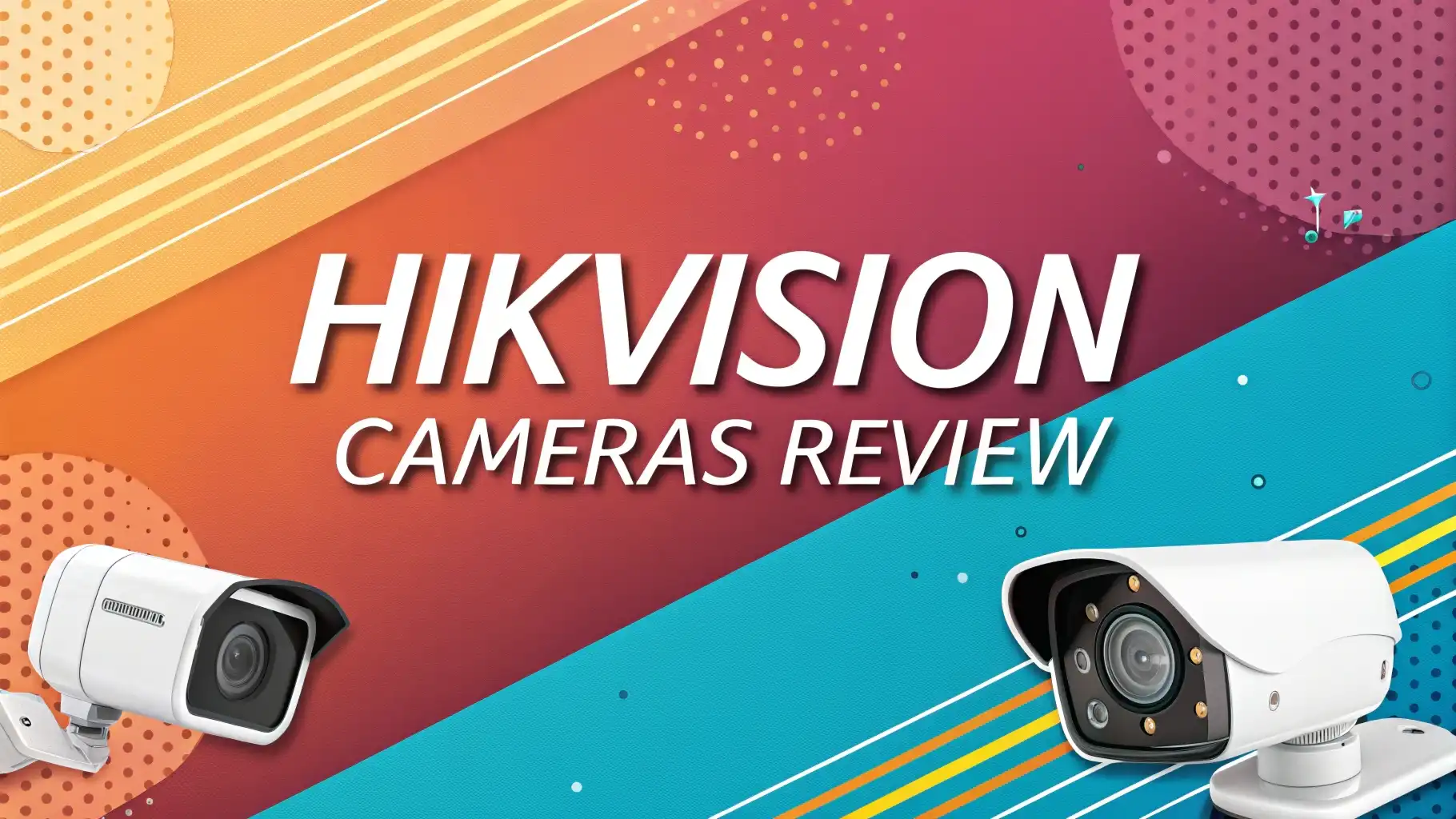
Hikvision Cameras Review 2026: The Honest Truth
If you have ever searched for a security camera, you have probably seen the name Hikvision pop up everywhere. And there is a very good reason for that.
Hikvision is the world’s largest manufacturer of video surveillance equipment, and in 2026, the brand continues to dominate shelves, installation trucks, and online carts worldwide.
Maybe you are a homeowner looking to protect your property. Maybe you run a small business and need reliable 24/7 coverage. Or maybe you just want to stop guessing and finally pick the right camera.
Key Takeaways
- Hikvision is the world’s number one CCTV camera brand, producing millions of units across dozens of product lines for homes, businesses, and large-scale industrial setups.
- ColorVu 3.0 technology delivers full-color video even in near-total darkness, down to 0.0005 lux, making it one of the most powerful low-light camera technologies available in 2026.
- AcuSense AI detection uses deep-learning algorithms to tell the difference between a human, a vehicle, and a random animal or tree branch, which cuts down false alarms significantly.
- Hikvision cameras are NOT NDAA compliant, which means they cannot be used by US federal government agencies or contractors. For private residential and commercial use, this restriction does not apply.
- Prices start around $45 and go up to several hundred dollars, depending on resolution, camera type, and smart features, making Hikvision accessible at almost every budget level.
- The Hik-Connect app works well for live viewing and alerts, though some users report occasional lag during cloud-based playback. Local network performance tends to be much smoother.

What Makes Hikvision Cameras Stand Out in 2026
Hikvision has been producing security cameras for over two decades, and the brand has not stood still. In 2026, the company continues to push forward with some genuinely impressive upgrades across its product range.
Hikvision cameras are known for three big things: image quality, smart detection, and affordability. Unlike many budget brands that force you to choose between performance and price, Hikvision manages to deliver both in the same package. You get a camera that captures sharp, detailed footage without breaking the bank.
The brand produces every type of security camera you can think of. Dome cameras, bullet cameras, PTZ (pan-tilt-zoom) cameras, turret cameras, doorbell cameras, and even thermal imaging cameras are all part of the Hikvision lineup. This means you can build an entire security ecosystem using one brand, one app, and one NVR system.
What really sets Hikvision apart in 2026 is its deep investment in AI-powered features. The latest generation of cameras includes smart motion detection that tells the difference between a person and a swaying tree branch. This kind of accuracy was previously only available on enterprise-grade systems costing tens of thousands of dollars. Hikvision brings it to a camera you can buy for under $100.
Best Hikvision Camera Models to Consider in 2026
Hikvision offers a huge lineup, and the number of models can feel overwhelming. Here is a breakdown of the models worth your attention in 2026.
The DS-2CD2143G2-I is one of the most popular choices for outdoor use. It is a 4MP AcuSense PoE IP dome camera with 120dB Wide Dynamic Range (WDR), H.265+ compression, and IP67 weatherproofing. It handles human and vehicle detection with impressive accuracy and connects easily to most Hikvision NVRs.
The DS-2CD2347G2-LSU/SL is the ColorVu version, built for areas where you need color footage at night. It adds a strobe light and audible warning feature, turning the camera into an active deterrent. This model is ideal for driveways, gates, and parking lots.
The DS-2CD2387G2-LU is the premium 8MP (4K) ColorVu model for buyers who want the highest possible resolution with full-color night vision. It is priced higher but delivers noticeably sharper detail, especially useful when you need to identify license plates or faces.
For PTZ coverage, the DS-2DE2A404IW-DE3 gives you 4MP resolution, 4x optical zoom, and 355-degree rotation. This is the go-to model when you need one camera to cover a wide area like a parking lot or warehouse floor.
Hikvision ColorVu Technology: Full-Color Night Vision Explained
Night vision is one of the most important features in any security camera. Traditional IR cameras produce grainy, black-and-white footage that can make it hard to identify colors, clothing, or license plates in the dark. Hikvision’s ColorVu technology changes that completely.
ColorVu uses a large F1.0 aperture lens combined with a high-sensitivity image sensor and a built-in supplemental warm light. Together, these elements let the camera capture vivid, full-color images even when ambient light drops to 0.0005 lux. That is essentially total darkness from a human perspective.
In real-world testing, ColorVu cameras produce footage that looks almost like daylight images, even at midnight. You can clearly see the color of a person’s jacket, the make of a car, or the expression on someone’s face. This is a massive advantage over standard IR night vision cameras.
The latest ColorVu 3.0 generation, introduced in 2025 and carrying into 2026, adds further improvements. ColorVu 3.0 boosts overall brightness, improves color accuracy, and integrates directly with AcuSense 3.0 AI detection. It also introduces Audio 2.0, which adds dual microphones for clearer sound capture in challenging conditions.
Top 3 Alternatives for Hikvision Cameras


AcuSense Technology: Smart Detection Done Right
One of the biggest frustrations with older security cameras is false alarms. Your phone lights up with a motion alert, and it turns out to be a cat walking across the yard or a plastic bag blowing in the wind. Over time, you start ignoring alerts altogether, which defeats the entire purpose of having a security system.
Hikvision’s AcuSense technology solves this problem directly. It uses deep-learning algorithms built into the camera’s processor to analyze motion in real time. The system classifies detected objects into three categories: humans, vehicles, and “other.” If a detection falls into the “other” category, the camera can be set to skip the alert entirely or send a lower-priority notification.
This cuts false alarms by up to 90%, according to Hikvision. For homeowners, this means you only get woken up at 3am if something actually worth waking up for has happened.
AcuSense 3.0, the latest generation, takes things even further. It improves detection accuracy, reduces the time it takes to identify a target, and works better in challenging lighting conditions. The technology also supports line-crossing detection and perimeter protection, where you define specific zones on the camera view. Any time a human or vehicle enters that zone, the camera triggers an alert immediately.
Image Quality and Video Resolution
Let us talk about picture quality because that is ultimately what a security camera is judged on. Hikvision cameras are available in resolutions ranging from 2MP all the way up to 32MP, covering every use case from basic home monitoring to high-security commercial installations.
For most home and small business users, a 4MP or 8MP camera hits the sweet spot between storage efficiency and image clarity. At 4MP, you get a resolution of 2560×1440 pixels, which is sharp enough to identify faces and read license plates at a reasonable distance. At 8MP (4K), the detail is even more impressive, with footage that holds up well even when digitally zoomed in.
H.265+ compression is a standard feature across most modern Hikvision models. This compression format reduces file sizes by up to 50% compared to H.264, without any loss in image quality. That matters a lot if you are recording 24/7 across multiple cameras, because storage costs add up quickly.
Hikvision cameras also feature Wide Dynamic Range (WDR) rated at 120dB to 130dB. WDR helps the camera handle scenes where one part of the frame is very bright (like sunlit windows) and another part is dark. Without WDR, you often get a blown-out image. With it, both areas of the frame remain clear and detailed.
Build Quality and Weatherproofing
A security camera is only useful if it keeps working when conditions get tough. Hikvision cameras are built to handle real-world environments. Most outdoor models carry an IP67 rating, which means they are fully dustproof and can withstand water immersion. Some models are rated IP68 for even deeper water resistance.
For areas where physical tampering is a concern, many Hikvision dome cameras carry an IK10 vandal-resistance rating. IK10 means the camera housing can absorb up to 20 joules of impact energy without breaking. That is roughly equivalent to a 5kg weight dropped from a height of 40cm, which covers most real-world impacts.
Hikvision cameras are designed to operate in temperatures ranging from -40°C to +60°C (-40°F to 140°F). This makes them suitable for use in extreme climates, whether you live somewhere freezing cold or intensely hot.
Installation and Setup Process
One common concern people have about Hikvision cameras is whether they are hard to set up. The honest answer is: it depends on the model and your technical comfort level.
IP cameras using PoE (Power over Ethernet) are the most popular type in the Hikvision lineup. They require a PoE switch or PoE NVR to power the camera through the same Ethernet cable that carries video data. This simplifies cabling significantly because you only need one cable per camera. If you are comfortable running Ethernet cable and connecting to a router or NVR, you can handle the installation yourself.
The initial configuration involves connecting the camera to your network, finding its IP address, and logging into the web interface to set a password and configure settings. Hikvision’s SADP (Smart Active Discovery Protocol) tool makes finding cameras on your network easy. The entire process for a single camera typically takes 15 to 30 minutes for a first-time user.
Hik-Connect App Experience
The Hik-Connect app is Hikvision’s mobile platform for remote camera access. It works on both iOS and Android and allows you to view live feeds, play back recorded footage, receive motion alerts, and manage your camera system from anywhere.
The app design is clean and fairly intuitive once you get past the initial setup. Adding cameras works through QR code scanning or manual entry of device serial numbers.
Live streaming performance on a local Wi-Fi network is smooth and responsive. On mobile data (4G or 5G), performance is generally good for single-camera viewing, though switching between multiple cameras can introduce brief loading delays.
Push notifications for AcuSense alerts are fast and reliable. When a person or vehicle is detected, the notification arrives on your phone within seconds, along with a snapshot of the detected event. This makes Hik-Connect genuinely useful as a day-to-day security monitoring tool.
Hikvision Cameras for Home vs Business Use
Hikvision serves both the residential and commercial markets, and the product range reflects this dual focus clearly.
For home use, the Value Series cameras and basic AcuSense models are the best starting point. A 4MP dome camera like the DS-2CD2143G2-I gives you solid image quality, smart detection, and weatherproofing at a very reasonable price. Paired with a 4-channel or 8-channel Value Series NVR, you can cover an entire home with professional-grade equipment for under $500.
For small to medium-sized businesses, the Pro Series with AcuSense offers more advanced analytics, better WDR performance, and integration with Hikvision’s access control and alarm systems. These cameras support more complex detection rules and can feed into larger multi-camera setups without performance issues.
For large commercial or industrial installations, Hikvision’s Ultra Series and DeepinMind NVRs take things to a completely different level. The DeepinMind platform uses machine learning to improve detection accuracy over time, supports facial recognition, and enables fast, targeted searches across hours of recorded footage.
Cybersecurity and NDAA Compliance: What You Should Know
This is the section many buyers overlook, and it is important. Hikvision is a Chinese state-owned company, and the US government has placed the brand on restricted lists due to national security concerns.
Under Section 889 of the National Defense Authorization Act (NDAA), Hikvision cameras cannot be used by US federal government agencies or organizations working under federal contracts. The FCC has also issued restrictions on Hikvision equipment. In 2025, Canada ordered Hikvision to cease operations in the country due to similar security concerns.
The concern centers around potential data vulnerabilities and backdoor access risks, though Hikvision has consistently denied these allegations. The company regularly releases firmware updates to address security vulnerabilities and encourages users to follow cybersecurity best practices.
For private homeowners and commercial businesses without government contracts, these restrictions do not apply. Millions of private users across the US and worldwide continue to use Hikvision cameras without any legal or security issues. However, if you work in a government-adjacent industry, you should verify your specific compliance requirements before purchasing.
Pricing and Value for Money
Hikvision cameras sit in a very competitive price range. Entry-level models start around $44 to $55, offering 4MP resolution with basic night vision and weatherproofing. Mid-range models with ColorVu or AcuSense technology typically fall between $79 and $135. Premium 4K ColorVu models with all smart features range from $150 to $200 per camera.
Compared to brands like Axis or Hanwha, Hikvision offers 50% to 70% lower pricing for equivalent feature sets. This makes it possible to cover a property with 8 to 10 cameras for the same budget that a premium brand might spend on 3 to 4 cameras.
When you add up the cost of cameras, a compatible NVR, hard drives, and cabling, a complete Hikvision system for a home or small business typically costs between $400 and $1,200, depending on the number of cameras and the level of features required. That is significantly less than comparable systems from Western brands.
The value proposition is strong. You are getting professional-grade image quality, AI-powered detection, durable weatherproof housing, and a feature-rich software ecosystem at a price that fits real-world budgets.
Final Verdict: Should You Buy Hikvision Cameras in 2026?
After going through everything, the answer is clear for most buyers. Yes, Hikvision cameras are worth buying in 2026, provided you are a private homeowner or commercial business user without government compliance restrictions.
The image quality is excellent across the range. The ColorVu 3.0 night vision is genuinely impressive and far ahead of standard IR cameras. AcuSense 3.0 detection reduces false alarms to a level that actually makes motion alerts useful. The build quality is durable and weather-resistant. And the pricing remains very competitive compared to Western alternatives.
The main concerns are the NDAA compliance issue for government-adjacent users and the occasional app performance limitations for cloud-based playback. Both are manageable with the right approach: verify compliance for your specific situation, and configure local network access for the best remote viewing experience.
If you want a security camera that delivers professional features at an accessible price, Hikvision remains one of the best choices available in 2026.
Frequently Asked Questions
Are Hikvision cameras good for home use?
Yes. Hikvision cameras work very well for home use. Models like the DS-2CD2143G2-I offer 4MP resolution, IP67 weatherproofing, and AcuSense smart detection at under $100. They connect easily to Hikvision NVRs and can be monitored remotely through the Hik-Connect app.
What is the difference between Hikvision ColorVu and AcuSense?
ColorVu is a low-light imaging technology that delivers full-color video in near-total darkness. AcuSense is an AI detection technology that identifies humans and vehicles to reduce false alarms. Many Hikvision cameras now combine both technologies in a single unit.
Can I use Hikvision cameras without an NVR?
Yes. Many Hikvision IP cameras support local microSD card recording and can be accessed directly through the Hik-Connect app without an NVR. However, for multi-camera setups with scheduled recording and smart search features, using an NVR is strongly recommended.
Are Hikvision cameras banned in the USA?
Hikvision cameras are banned for use by US federal government agencies under NDAA Section 889. They are not banned for private residential or commercial use. Millions of private users in the US continue to use Hikvision cameras legally.
How long do Hikvision cameras last?
Hikvision cameras are built for long-term use. Many professional installers report systems running reliably for 5 to 10 years with proper installation and regular firmware updates. The IP67 housing and metal construction contribute to their durability in outdoor environments.
Does Hikvision work with third-party NVRs?
Hikvision cameras use the ONVIF standard, which means they are technically compatible with many third-party NVRs. However, smart features like AcuSense detection and ColorVu notifications work best when paired with a genuine Hikvision NVR. Some features may not transfer to third-party systems.
What is the Hik-Connect app and is it free?
Hik-Connect is Hikvision’s free mobile app for iOS and Android. It lets you view live camera feeds, play back recorded footage, receive smart detection alerts, and manage your devices remotely. The app is free to download and use. Some cloud storage features may require a subscription, but local network access is completely free.