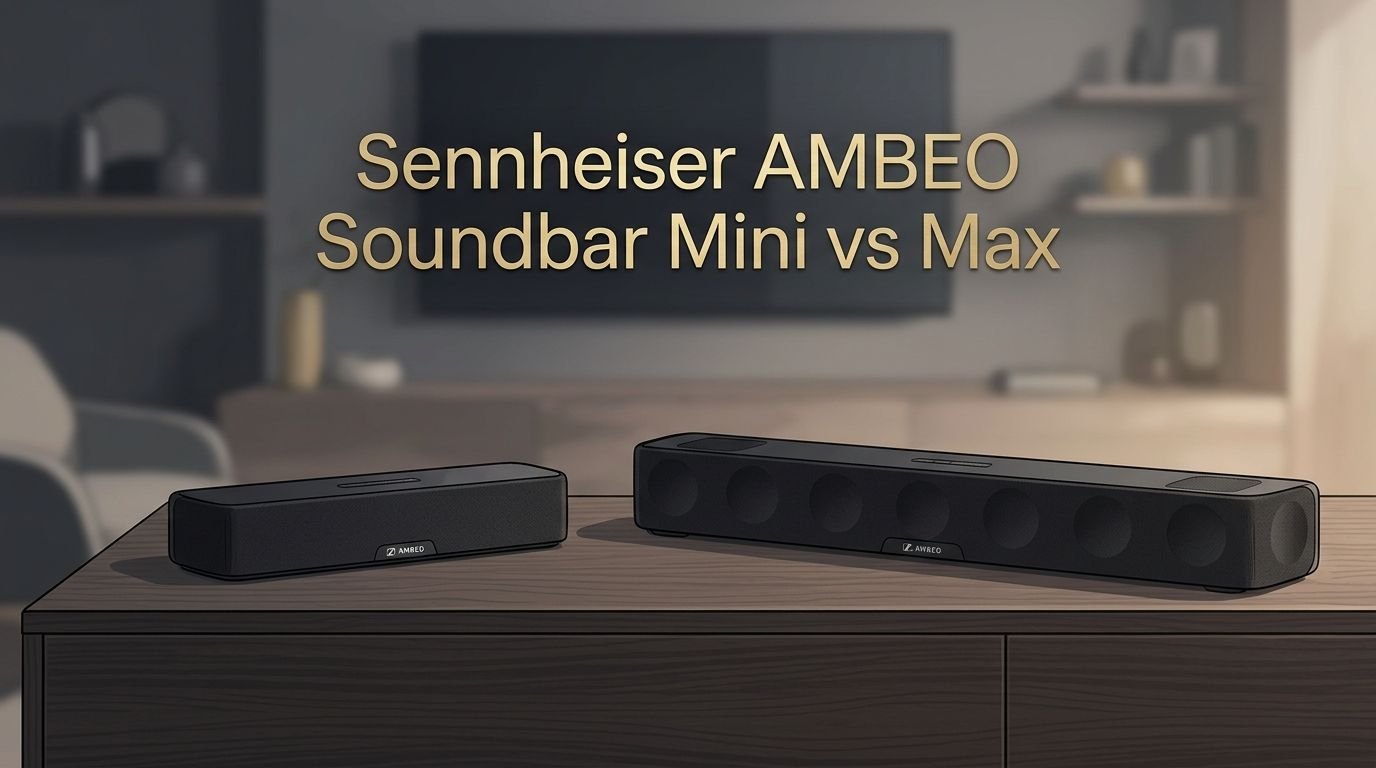
Sennheiser AMBEO Soundbar Mini vs Max in 2026?
Are you stuck choosing between the Sennheiser AMBEO Soundbar Mini and the AMBEO Soundbar Max? You are not alone. Both soundbars carry the famous Sennheiser name and promise immersive Dolby Atmos audio.
But they serve very different rooms, budgets, and listeners. One fits neatly under a bedroom TV. The other fills an entire living room with theater-grade bass. The price gap between them is over $1,000, so making the wrong pick can hurt your wallet.
This head-to-head comparison breaks down every detail you need. We cover sound quality, driver count, bass performance, design, connectivity, and value. By the end, you will know exactly which AMBEO soundbar matches your space and your expectations. Let us dive right in.
Key Takeaways
- The AMBEO Soundbar Max packs 13 drivers and 500W of peak power, making it the clear winner for large living rooms and home theater setups. It reaches a low frequency of 30 Hz and does not need an external subwoofer.
- The AMBEO Soundbar Mini uses 6 drivers with 250W RMS power and works best in bedrooms, offices, or apartments. It weighs just 3.3 kg compared to the Max at 18.5 kg.
- The Mini supports newer wireless standards including Bluetooth 5.2 and Wi-Fi 6. The Max uses Bluetooth 4.2 and Wi-Fi 5. The Mini also has Alexa voice control and four built-in microphones.
- Price difference is significant. The Mini retails around $800 while the Max costs about $2,500. Both models often go on sale, but the gap remains over $1,000.
- Both soundbars support Dolby Atmos and DTS:X, AirPlay, Chromecast, Spotify Connect, and the Sennheiser Smart Control app. They share the same AMBEO virtualization technology for 3D sound.
- Room size determines the best pick. The Mini suits rooms up to about 150 square feet with TVs 55 inches or smaller. The Max is built for open-plan living areas and TVs 65 inches and larger.
Sennheiser AMBEO Soundbar Mini Overview

The Sennheiser AMBEO Soundbar Mini launched in August 2023. It brought Sennheiser’s AMBEO 3D virtualization to a compact form factor for the first time. The bar measures roughly 700 mm wide, making it a good fit under TVs up to 55 inches.
Inside, you get six drivers: four 1.6-inch full-range cellulose cone speakers and two 4-inch woofers. Six dedicated Class D amplifiers push out 250 watts RMS. The bar virtualizes a 7.1.4 channel layout, so you hear height and surround effects from a single unit.
Setup is quick through the Sennheiser Smart Control app. The app runs automatic room calibration using the four built-in microphones. This adjusts the sound profile to match your specific room shape and furniture.
Pros:
- Very compact and lightweight at just 3.3 kg
- Bluetooth 5.2 and Wi-Fi 6 for fast, stable wireless streaming
- Built-in Alexa voice control with four microphones
- Automatic room calibration through the app
- Supports Dolby Atmos, DTS:X, and 360 Reality Audio
Cons:
- Bass drops off below 43 Hz without an external subwoofer
- Limited volume for larger rooms
- No dedicated height-firing drivers; relies on virtualization only
- No AUX input or Ethernet port
Sennheiser AMBEO Soundbar Max Overview

The AMBEO Soundbar Max is Sennheiser’s flagship soundbar. It originally launched in late 2019 and has received firmware updates that keep it competitive. This bar measures about 1,265 mm wide and weighs a substantial 18.5 kg.
It contains 13 high-end drivers: five dedicated tweeters, six long-throw woofers, and two upward-firing speakers for Dolby Atmos height effects. Thirteen independent Class D amplifiers deliver 500 watts of peak power. The bass reaches down to 30 Hz, which means you may not need a separate subwoofer at all.
The Max outputs a true 5.1.4 channel configuration. Physical upward-firing drivers bounce sound off your ceiling. This creates a more convincing overhead Atmos effect than virtualization alone.
Pros:
- 13 drivers with dedicated upward-firing speakers for real Atmos height
- Deep 30 Hz bass eliminates the need for a subwoofer in many setups
- 500W peak power fills large rooms with ease
- NFC Bluetooth pairing for quick connections
- Ethernet port for a stable wired network connection
Cons:
- Very heavy at 18.5 kg and over 1.2 meters wide
- Older Bluetooth 4.2 and Wi-Fi 5 standards
- No built-in microphones or voice assistant
- High price tag around $2,500
Sound Quality Comparison
Sound quality is where these two soundbars show their biggest differences. The AMBEO Max delivers richer, fuller audio thanks to its 13-driver array. The dedicated tweeters produce crisp high frequencies. The six woofers create bass you can feel in your chest.
The Mini still sounds impressive for its size. Reviewers praise its ability to punch above its weight class. It creates a wide soundstage and handles dialogue well. However, it cannot match the Max for sheer volume or bass depth.
The Max also wins on channel separation. Its physical upward-firing drivers create a more precise Atmos bubble. The Mini uses virtualization to simulate height channels, which works well but lacks the physical impact of real drivers aimed at your ceiling.
Bass Performance
Bass is a critical factor for movie lovers and music fans. The AMBEO Max reaches 30 Hz, which covers nearly the full range of human hearing. Explosions, rumbling thunder, and deep musical bass all sound full and powerful.
The Mini bottoms out at around 43 Hz. That is still respectable for a compact bar. Most dialogue and music stays above this range. But you will notice a lack of sub-bass during action movie scenes or bass-heavy tracks.
Sennheiser sells a separate AMBEO Sub that pairs with the Mini. This brings the low-end response close to the Max. But adding the sub raises the total cost to about $1,400, which narrows the value gap between the two models.
Design and Build Quality
Both soundbars feature Sennheiser’s signature premium build quality. The Max has a fabric-wrapped front with a metal grille. It looks commanding beneath a large TV. The angled design helps direct sound toward the listener.
The Mini shares a similar design language but in a much smaller package. Its angled top plate aids acoustic performance. The compact frame sits easily on a desk, shelf, or TV stand. It also wall-mounts with minimal effort.
Weight is a major difference. The Mini weighs 3.3 kg, so one person can set it up in minutes. The Max weighs 18.5 kg and may need two people for safe placement. The Max also needs a sturdy surface or a reinforced wall mount.
Connectivity and Wireless Features
The Mini wins this category. It supports Bluetooth 5.2 for stable, low-latency audio streaming. It also includes Wi-Fi 6, which provides faster data transfer and better range than Wi-Fi 5.
The Max uses Bluetooth 4.2 and Wi-Fi 5. These are older standards. They still work fine for streaming music and receiving updates. But you may notice slightly more latency or range limitations compared to the Mini.
Both soundbars include HDMI eARC, optical input, AirPlay, Chromecast built-in, and Spotify Connect. The Max adds an Ethernet (RJ-45) port and an AUX input. The Mini skips both of these physical connections but compensates with its stronger wireless specs.
Smart Features and Voice Control
The Mini has a clear advantage here. It includes four built-in microphones and native Amazon Alexa support. You can ask Alexa to play music, adjust volume, check the weather, or control smart home devices without touching a remote.
The Max does not have built-in microphones. It does not offer native voice assistant support. You can still control it through the Sennheiser Smart Control app or pair it with an external smart speaker, but the experience is less seamless.
Both models support Google Assistant compatibility through linked devices. Both also work with the Sennheiser Smart Control app for EQ adjustments, room calibration, and firmware updates.
Room Size and Placement
Room size should guide your decision more than any other factor. The Mini suits rooms up to roughly 150 square feet. Think bedrooms, home offices, dorm rooms, or small apartments. It pairs best with TVs 55 inches or smaller.
The Max fills rooms of 300 square feet or more with ease. It is built for open-plan living rooms, dedicated home theaters, and large entertainment spaces. It pairs best with TVs 65 inches or larger.
Placing the Max in a small room can actually overwhelm the space. The bass may become boomy and hard to control. Meanwhile, the Mini in a large room may sound thin and lack the power to fill every corner.
Dolby Atmos and Surround Sound
Both bars support Dolby Atmos and DTS:X. These formats place sounds in 3D space around you. However, the way each bar delivers Atmos differs significantly.
The Max has two physical upward-firing drivers. These bounce sound off the ceiling to create real overhead effects. This approach works best with flat ceilings between 7 and 9 feet high.
The Mini relies entirely on AMBEO virtualization for height effects. The four full-range drivers and digital processing simulate overhead and surround channels. The effect is convincing in a small room but less dramatic than the Max in a larger space.
Price and Value
The AMBEO Soundbar Mini retails at about $800. Sale prices often drop it closer to $700. For a compact Dolby Atmos bar with room calibration and Alexa, this represents solid value.
The AMBEO Soundbar Max carries a list price of roughly $2,500. Street prices often hover around $2,000. You get 13 drivers, true upward-firing Atmos, and bass that rivals a dedicated subwoofer setup.
The value calculation depends on your room. If you have a large space, the Max delivers performance that would cost more in a traditional speaker system. If your room is small, the Mini gives you 90% of the AMBEO magic at a fraction of the cost.
Who Should Buy the AMBEO Soundbar Mini?
The Mini is perfect for apartment dwellers, bedroom setups, and desk audio enthusiasts. If your TV is 55 inches or smaller and your room is modest in size, this bar delivers outstanding performance.
It also fits buyers who want modern wireless features. Bluetooth 5.2, Wi-Fi 6, and built-in Alexa make daily use convenient. You can stream music, control playback with your voice, and enjoy Dolby Atmos movies without wires everywhere.
Budget-conscious shoppers will appreciate the lower price. You still get Sennheiser’s respected audio engineering and the AMBEO virtualization engine that set this brand apart.
Who Should Buy the AMBEO Soundbar Max?
The Max belongs in large living rooms and dedicated home theaters. If you own a 65-inch or bigger TV and want one device to replace a full surround sound system, this is it.
Audiophiles and movie enthusiasts will love the deep 30 Hz bass and the physical upward-firing drivers. The Max creates a sound field that feels like real speakers are placed around the room. It handles everything from quiet dialogue to explosive action scenes with authority.
If you do not mind the size, weight, and price, the Max offers one of the best single-bar audio experiences available. It remains a top pick among premium soundbars even years after its original launch.
Quick Specs Comparison Table
| Feature | AMBEO Soundbar Mini | AMBEO Soundbar Max |
|---|---|---|
| Drivers | 6 | 13 |
| Power | 250W RMS | 500W Peak |
| Channel Config | Virtual 7.1.4 | 5.1.4 |
| Low Frequency | 43 Hz | 30 Hz |
| Bluetooth | 5.2 | 4.2 |
| Wi-Fi | Wi-Fi 6 | Wi-Fi 5 |
| Weight | 3.3 kg | 18.5 kg |
| Voice Assistant | Alexa built-in | None |
| Price (MSRP) | ~$800 | ~$2,500 |
| Best For | Small rooms, TVs ≤55″ | Large rooms, TVs ≥65″ |
Frequently Asked Questions
Can the AMBEO Soundbar Mini replace a full surround sound system?
The Mini can simulate a 7.1.4 channel layout through AMBEO virtualization. It works well in small rooms. However, it cannot match a physical multi-speaker surround setup for pinpoint accuracy and bass depth. For bedrooms and small spaces, it offers a very convincing alternative.
Does the AMBEO Soundbar Max need a subwoofer?
Most users find the Max does not need a subwoofer. Its six woofers reach 30 Hz, which covers the vast majority of movie and music content. If you want ground-shaking bass for action films, you can add the optional AMBEO Sub for extra low-end extension.
Can I use the AMBEO Soundbar Mini with a 65-inch TV?
Physically, yes. The Mini works with any TV that has HDMI eARC or optical output. However, the bar measures about 700 mm wide, so it may look undersized beneath a 65-inch screen. Its audio output also may not fill a large room paired with a big TV.
Do both soundbars support Apple AirPlay?
Yes. Both the AMBEO Soundbar Mini and AMBEO Soundbar Max support AirPlay for wireless streaming from iPhones, iPads, and Macs. They also both support Chromecast and Spotify Connect.
Which AMBEO soundbar has better connectivity?
The Mini has newer wireless standards with Bluetooth 5.2 and Wi-Fi 6. The Max offers a physical Ethernet port and AUX input that the Mini lacks. The best choice depends on whether you prefer cutting-edge wireless or reliable wired connections.
Is the AMBEO Soundbar Max worth the extra $1,700 over the Mini?
It depends on your room and priorities. If you have a large space, a big TV, and you demand deep bass with physical Atmos height effects, the Max justifies its price. For smaller rooms, the Mini delivers excellent sound at a much lower cost, making it the smarter buy for most people.