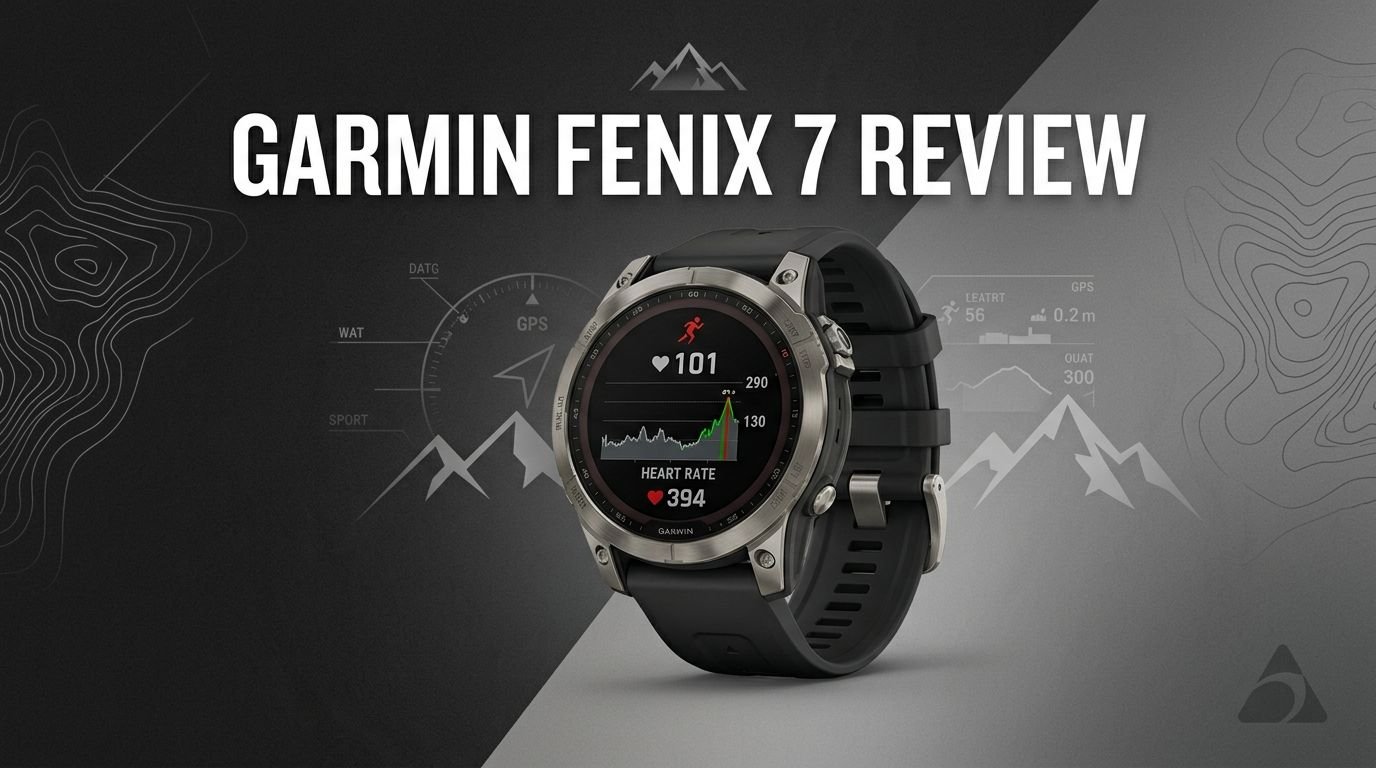
Garmin Fenix 7 Review 2026: Is This GPS Watch Worth It?
So you’re eyeing the Garmin Fenix 7 and wondering if it still holds up in 2026. You’re not alone. Even with the Fenix 8 now on the market, thousands of athletes and outdoor lovers are still picking up the Fenix 7. Why? Because it delivers serious performance at a much lower price than its successor.
This watch launched back in January 2022. It shook up the GPS watch world with its touchscreen addition, solar charging options, and an insane battery life that left competitors scrambling.
Fast forward to 2026, and it remains one of the most capable multisport watches you can strap on your wrist.
Key Takeaways
- The Garmin Fenix 7 still delivers outstanding GPS accuracy and battery life that can last up to 18 days in smartwatch mode and up to 57 hours in GPS mode. Solar models push these numbers even higher. Few watches in this price range match that kind of endurance.
- The touchscreen and button combo makes this watch easy to use. The Fenix 7 was the first in the Fenix line to add a touchscreen alongside the traditional five button layout. This gives you quick access to maps and menus without fumbling during workouts.
- Training and health metrics are deep and accurate. You get VO2 max estimates, Training Readiness, Training Status, Body Battery, sleep tracking, heart rate variability, and Pulse Ox. These features help serious athletes fine tune their performance.
- Build quality is premium and made for abuse. The standard model uses a fiber reinforced polymer case with a Corning Gorilla Glass DX lens. Sapphire Solar editions upgrade to a scratch resistant sapphire crystal. This watch handles rain, mud, rocks, and daily bumps without issues.
- The price has dropped significantly since launch. With the Fenix 8 available, retailers have cut Fenix 7 prices by $200 to $400. You can now get a Sapphire Solar model for what the standard edition used to cost. That makes it one of the best value premium GPS watches in 2026.
- It lacks the AMOLED display found on the Fenix 8. The Fenix 7 uses a transflective MIP display. It reads well in sunlight but looks dated next to the vibrant AMOLED screens on newer watches. If screen quality matters to you, keep this in mind.

Garmin Fenix 7 Design and Build Quality
The Garmin Fenix 7 looks and feels like a watch that means business. It comes in three sizes: 42mm (7S), 47mm (7), and 52mm (7X). The standard 47mm model weighs about 79 grams. That’s light enough for daily wear yet substantial enough to feel premium on the wrist.
Garmin used a fiber reinforced polymer case on the standard model. It handles drops, scrapes, and outdoor abuse well. The stainless steel bezel adds a layer of toughness and a clean visual accent. Sapphire Solar models swap in titanium bezels and sapphire crystal lenses for even more protection.
The five button layout sits on both sides of the case. These buttons respond with a satisfying click and work perfectly with wet or gloved hands. The 22mm quick release bands make swapping straps simple. You can go from a silicone sport band to a nylon strap in seconds.
Water resistance is rated at 10 ATM, which means this watch handles swimming, rain, and water sports without worry. The overall finish feels refined. Even after years of use, the Fenix 7 holds up well against scratches and daily wear.
Display Performance and Touchscreen Experience
The Fenix 7 features a 1.3 inch transflective MIP (Memory in Pixel) display on the 47mm model. The resolution sits at 260 x 260 pixels. This type of screen performs best outdoors where direct sunlight makes it even easier to read.
The touchscreen was a big deal for the Fenix line. Previous models relied only on buttons for navigation. The Fenix 7 added touch input for scrolling through widgets, zooming into maps, and selecting menu options. You can disable the touchscreen during activities if you prefer buttons only.
Indoor readability is decent but not stunning. The MIP technology does not produce the same vivid colors or contrast you see on AMOLED displays. Garmin did include a backlight for low light conditions, and it works well enough for nighttime checks.
For athletes who spend most of their time outdoors, the MIP display is actually an advantage. It consumes far less power than AMOLED screens. This is a key reason the Fenix 7 achieves its impressive battery life. The tradeoff between visual pop and battery endurance is one you should weigh based on your usage.
Battery Life That Goes the Distance
Battery life is where the Garmin Fenix 7 truly shines. The standard 47mm model delivers up to 18 days in smartwatch mode and up to 57 hours in GPS only mode. These numbers are based on typical usage with standard settings.
The Solar models push these figures even further. With enough sunlight, the Fenix 7 Solar can reach 22 days in smartwatch mode and 73 hours in GPS mode. The 7X Solar model goes beyond that with up to 37 days in smartwatch mode and 122 hours in GPS mode.
Battery saver mode extends the life even more. You can squeeze up to 57 days from the standard 47mm model in this mode. For multi day hikes or ultramarathon events, this kind of stamina is hard to beat.
Real world usage usually falls slightly below Garmin’s official numbers. Heavy use of GPS, notifications, music, and sensors will drain the battery faster. But even with all features active, most users report 10 to 14 days of daily use before needing a charge. That crushes most smartwatches on the market.
Top 3 Alternatives for Garmin Fenix 7
1. Garmin Fenix 8 AMOLED 47mm

2. COROS VERTIX 2

3. Apple Watch Ultra 2
![Apple Watch Ultra 2 [GPS + Cellular 49mm] Smartwatch with Rugged Titanium Case & Green/Gray Trail Loop M/L. Fitness Tracker, Precision GPS, Action Button, Extra-Long Battery Life](https://lijaai.blog/wp-content/plugins/aawp/public/image.php?url=YUhSMGNITTZMeTl0TG0xbFpHbGhMV0Z0WVhwdmJpNWpiMjB2YVcxaFoyVnpMMGt2TkRGTVJVVXlRMVkyY2t3dWFuQm58MTc3NjQyNjc5Mw=)
GPS Accuracy and Multi Band Satellite Support
The Garmin Fenix 7 supports multi band GPS on its Sapphire Solar models. This means the watch connects to multiple satellite systems at the same time. It pulls signals from GPS, GLONASS, and Galileo to deliver more precise location tracking.
Standard models use single band GPS, which is still very good for most activities. You get reliable tracking for running, cycling, and hiking. The difference shows up in dense forests, deep canyons, and urban environments with tall buildings. Multi band users report fewer GPS drift issues in these settings.
Garmin’s SatIQ technology helps manage satellite connections. It automatically switches between multi band and standard GPS based on your environment. This preserves battery life without sacrificing accuracy. It’s a smart feature that works quietly in the background.
For trail runners and hikers, the GPS performance on the Fenix 7 remains among the best in the market. Route recording is clean with minimal wandering. The watch also supports breadcrumb navigation, so you can retrace your steps if you get lost on an unfamiliar trail.
Training and Performance Metrics
The Fenix 7 packs a deep set of training tools. VO2 max estimation gives you a snapshot of your cardiorespiratory fitness. The watch calculates this during running and cycling activities. It adjusts for heat and altitude so the number stays relevant across conditions.
Training Status shows whether you’re productive, peaking, recovering, or overreaching. It combines your workout history with your current fitness level to provide this insight. Training Load tracks your exercise volume over the past seven days and compares it to your baseline.
Real Time Stamina is a standout feature. It displays your remaining energy during an activity. This helps you pace yourself during races and long efforts. You can see both a short term and overall stamina reading on your wrist.
PacePro provides grade adjusted pace guidance for running. It accounts for elevation changes along your route and adjusts target paces accordingly. This is especially useful for trail running and hilly road races. The ClimbPro feature breaks down upcoming climbs during hikes and runs, showing distance, gradient, and elevation gain for each ascent.
Health Monitoring and Daily Tracking
The Garmin Fenix 7 tracks your health around the clock. Wrist based heart rate monitoring uses Garmin’s Elevate sensor. It records your heart rate 24/7 and logs resting heart rate trends over time.
Heart Rate Variability (HRV) tracking measures the variation between heartbeats during sleep. Garmin uses this data to calculate your HRV Status, which reflects your overall stress and recovery balance. A consistent HRV reading suggests your body handles training loads well.
Body Battery is one of Garmin’s most popular features. It assigns a score from 0 to 100 that represents your energy level throughout the day. It combines heart rate, HRV, stress, and sleep data to produce this number. A high Body Battery in the morning suggests you’re ready for a hard workout. A low score means rest might serve you better.
Sleep tracking breaks your night into light, deep, and REM stages. It also gives you a sleep score that summarizes sleep quality. Pulse Ox measures blood oxygen saturation levels during sleep. Respiration rate tracking runs continuously day and night. Stress tracking uses HRV data to show your stress levels throughout the day with a score from 0 to 100.
Navigation and Mapping Features
Navigation is a strong suit for the Fenix 7. Sapphire Solar models come preloaded with TopoActive maps. These full color topographic maps cover trails, terrain contours, and points of interest. Standard models support breadcrumb navigation and downloadable courses but do not include preloaded maps.
You can plan routes on Garmin Connect or Garmin Explore and sync them to the watch. The Fenix 7 displays turn by turn directions on the screen. It alerts you with a vibration and a visual cue at each turn. This works well for unfamiliar trail networks and cycling routes.
Round trip routing suggests routes based on a set distance and direction. It’s useful for runners who want variety in their daily routes without planning ahead. The watch also supports waypoint navigation and coordinate entry for backcountry exploration.
The ABC sensors (altimeter, barometer, compass) provide real time elevation data, weather trend info, and directional guidance. The altimeter uses both GPS and barometric data for accurate elevation readings. Storm alerts notify you when barometric pressure drops quickly, giving you a heads up about approaching bad weather.
Multisport Mode and Activity Profiles
The Garmin Fenix 7 supports dozens of built in activity profiles. Running, cycling, swimming, hiking, skiing, golf, and strength training are just a few. Each profile has customizable data screens so you see the metrics that matter most to you.
Multisport mode lets you chain activities together. Triathletes love this feature. You can set up a swim bike run sequence and transition between segments with a single button press. The watch logs each segment separately and provides a combined summary at the end.
Surf, mountain bike, and indoor climbing profiles add specific metrics for each sport. The surf profile tracks wave count, distance surfed, and speed on each wave. The mountain bike profile includes grit and flow scores that rate trail difficulty and riding smoothness.
Strength training mode counts reps and identifies exercises. It works reasonably well for common movements like squats, presses, and curls. You can also create structured workouts in Garmin Connect and push them to the watch. Yoga, Pilates, breathwork, and HIIT profiles round out the fitness options. The Fenix 7 covers almost every activity you can think of.
Smart Features and Connectivity
The Fenix 7 handles smart notifications from your phone. Texts, calls, emails, and app alerts appear on your wrist with a vibration. You can read full messages but cannot reply from the watch on most phone setups.
Garmin Pay lets you make contactless payments from your wrist. It supports many major banks and credit cards. Music storage is available on select models and holds up to 2,000 songs. You can connect Bluetooth headphones and listen to Spotify, Amazon Music, or Deezer playlists offline.
Garmin Connect IQ is the watch’s app store. It offers watch faces, widgets, data fields, and apps created by third party developers. You can customize your watch extensively through this platform. Popular additions include weather widgets, advanced training apps, and custom watch faces.
The watch connects via Bluetooth, ANT+, and Wi Fi. Bluetooth handles phone pairing and sensor connections. ANT+ supports heart rate straps, power meters, and cycling sensors. Wi Fi enables automatic activity uploads and software updates when you’re near a saved network. LiveTrack lets others follow your activities in real time through a shared link.
Garmin Fenix 7 vs Garmin Fenix 8
This comparison comes up often in 2026. The Fenix 8 launched with an AMOLED display option, which produces sharper and more colorful visuals than the Fenix 7’s MIP screen. The Fenix 8 also has a larger display in its 47mm model at 1.4 inches versus 1.3 inches on the Fenix 7.
The Fenix 8 added a built in speaker and microphone for voice commands and phone calls. It also introduced dive features rated to 40 meters and an upgraded LED flashlight. These are features the Fenix 7 does not offer.
However, the Fenix 7’s MIP display gives it a significant battery advantage. The Fenix 8 AMOLED model lasts about 29 days in smartwatch mode compared to the Fenix 7’s 18 days with its standard display. But the AMOLED screen drains faster during GPS activities. The Fenix 7 still holds its own in endurance.
Price is the biggest factor. The Fenix 8 starts around $999, while the Fenix 7 can now be found for $400 to $550 depending on the model. If you don’t need the AMOLED display, dive features, or speaker, the Fenix 7 delivers about 90% of the experience for roughly half the cost. For budget conscious buyers, the Fenix 7 is a smarter pick.
Software Updates and Long Term Support
Garmin has a strong track record of supporting its watches with software updates. The Fenix 7 has received multiple major firmware updates since its 2022 launch. These updates added new features like Morning Report, HRV Status, and improved Training Readiness metrics.
Garmin typically supports its premium watches for three to four years after launch. The Fenix 7 continues to receive bug fixes and feature improvements through Garmin Connect. This means your watch gets better over time without any extra cost.
The Connect IQ platform also keeps the watch fresh. New watch faces, widgets, and data fields appear regularly from independent developers. This extends the watch’s usefulness well beyond its stock software.
Users who purchased the Fenix 7 at launch have seen their watch gain dozens of new features through updates alone. That’s a significant advantage over competitors who offer limited post purchase software support. Garmin’s ecosystem adds lasting value to the Fenix 7 investment.
Who Should Buy the Garmin Fenix 7 in 2026?
The Fenix 7 fits a specific audience. Trail runners, hikers, and multisport athletes will find the most value here. The deep training metrics, GPS accuracy, and rugged build match the demands of serious outdoor activity.
Budget conscious fitness enthusiasts should pay attention. The current street price puts the Fenix 7 in a sweet spot between midrange and flagship watches. You get premium features without the premium price tag that comes with the Fenix 8.
Ultramarathon runners benefit from the exceptional battery life. Few watches last as long as the Fenix 7 during extended GPS activities. Multi day events and long hikes become stress free when your watch can keep up.
If you want a vibrant AMOLED screen, phone call support from your wrist, or dive capabilities, the Fenix 7 is not for you. Those features require the Fenix 8 or alternatives. But if your priorities are battery life, GPS performance, training data, and durability, the Fenix 7 remains an excellent choice in 2026.
Pros and Cons of the Garmin Fenix 7
Pros:
The battery life is outstanding and beats most competitors. GPS accuracy with multi band support is highly reliable. The training and health metrics are deep and useful for serious athletes. Build quality is exceptional with materials that handle outdoor abuse. The price has dropped to offer great value. Garmin’s software updates keep the watch current.
Cons:
The MIP display looks plain compared to newer AMOLED watches. The standard model lacks preloaded maps. Music storage is limited to specific editions. There is no built in speaker or microphone. The watch is bulky for people with smaller wrists, especially the 7X model. Garmin Connect app can feel overwhelming for new users with its many menus and options.
Final Verdict on the Garmin Fenix 7
The Garmin Fenix 7 is a proven performer that still earns its place on wrists in 2026. It does not have the flashiest screen or the newest hardware. But it delivers where it counts: battery life, GPS accuracy, training tools, and durability.
The discounted prices make it even more attractive. You can now own a Sapphire Solar model for less than $600 at many retailers. That puts premium GPS watch features within reach for a wider audience.
If you value substance over flash, the Fenix 7 remains a top tier choice. It tracks your runs, guides your hikes, monitors your health, and lasts for days on a single charge. For the price, very few watches in 2026 offer this combination of features and reliability.
The Garmin Fenix 7 is not the newest. But it might still be the smartest buy.
Frequently Asked Questions
Is the Garmin Fenix 7 still worth buying in 2026?
Yes. The Garmin Fenix 7 still delivers excellent GPS performance, deep training metrics, and outstanding battery life. The price has dropped significantly since the Fenix 8 launched. Many users on forums report that it provides everything they need at roughly half the cost of the newer model. It remains a strong buy for runners, hikers, and multisport athletes.
How long does the Garmin Fenix 7 battery last?
The standard 47mm model lasts up to 18 days in smartwatch mode and up to 57 hours in GPS only mode. Solar models extend these numbers further. Real world usage with notifications, sensors, and GPS active typically gives you 10 to 14 days between charges. The 7X model offers even longer battery life due to its larger battery.
Does the Garmin Fenix 7 have an AMOLED display?
No. The Garmin Fenix 7 uses a transflective MIP display. This screen type excels in outdoor sunlight but does not produce the vibrant colors of an AMOLED panel. The Fenix 8 offers an AMOLED option if screen quality is a priority for you.
Can the Garmin Fenix 7 track swimming?
Yes. The Fenix 7 has a 10 ATM water resistance rating and supports pool swimming and open water swimming profiles. It tracks laps, distance, stroke type, stroke count, and pace. It works well for swim training and casual pool sessions.
Does the Garmin Fenix 7 have maps?
The standard Fenix 7 supports breadcrumb navigation and downloadable courses but does not include preloaded maps. Sapphire Solar models come with preloaded TopoActive maps that show topographic details, trails, and terrain features. You can also download additional maps through Garmin Connect.
What is the difference between the Garmin Fenix 7 and Fenix 7 Pro?
The Fenix 7 Pro added an LED flashlight, a new heart rate sensor, and an upgraded solar panel. It also included preloaded maps on all models rather than just the Sapphire editions. The Pro version launched in mid 2023 as a refresh of the original Fenix 7 line with these targeted improvements.