Sonos vs Denon Smart Speakers 2026: Which One Is Best?
Are you stuck choosing between Sonos and Denon smart speakers in 2026? You are not alone. Both brands have released impressive new products this year.
Sonos launched the Sonos Play and Era 100 SL. Denon fired back with the Home 200, Home 400, and Home 600. Each brand offers a unique ecosystem, sound signature, and feature set.
This comparison breaks down every key difference between the two brands. You will learn about sound quality, app experience, multi-room support, pricing, and much more. Whether you want a single speaker for your bedroom or a full multi-room audio setup, this guide will help you make a smart buying decision. Read on to find the perfect smart speaker for your home.
Key Takeaways
- Sonos uses the Sonos app for multi-room control. Denon uses the HEOS app. Both systems support grouping speakers across rooms. Sonos has a more polished app experience overall, but HEOS works across Denon and Marantz products for wider hardware support.
- Denon’s 2026 speakers support native Dolby Atmos Music playback with physical up-firing drivers in the Home 200, 400, and 600. Sonos offers Dolby Atmos through the Era 300. Both brands deliver immersive audio, but Denon now matches Sonos in this area at every price tier.
- Sonos speakers tend to cost less at the premium level. The Sonos Era 300 sells for $449, while the comparable Denon Home 400 costs $599. Budget-conscious buyers will find better value in the Sonos lineup for similar features.
- Denon supports high-resolution audio natively at 24-bit/192kHz. Sonos accepts hi-res input but downscales during playback. Listeners who stream from Tidal or play FLAC files will prefer Denon for audio fidelity.
- Both brands support AirPlay 2, Bluetooth, and Wi-Fi streaming. Denon adds a 3.5mm aux jack on several models. Sonos uses USB-C adapters for wired connections. Denon offers more physical connectivity options out of the box.
- Sonos integrates directly as an Alexa speaker. Denon supports full Siri integration through AirPlay 2 in addition to Alexa. Apple users may find Denon’s Siri support a useful advantage.
Sonos Era 100: Best Compact Sonos Speaker


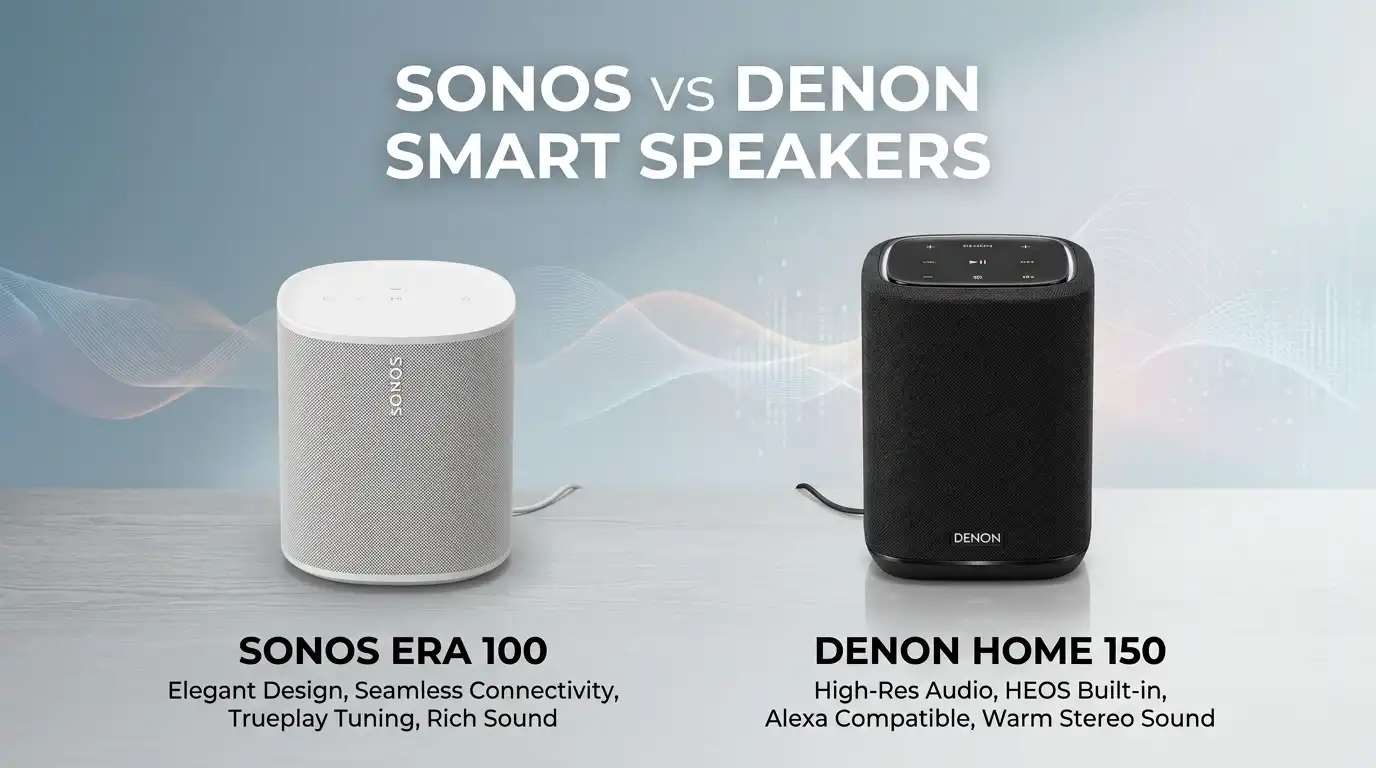
The Sonos Era 100 remains one of the best compact smart speakers you can buy in 2026. It costs $219 and delivers rich stereo sound from a small form factor. Two angled tweeters and a midwoofer produce a wide soundstage that fills small to medium rooms with ease.
This speaker supports Wi-Fi, Bluetooth, AirPlay 2, and Alexa voice control. You can pair two Era 100 units for stereo playback. You can also use them as rear surrounds with a Sonos soundbar. The Sonos app handles setup in just a few minutes.
Trueplay tuning on iOS adjusts the sound based on your room’s shape. This feature improves bass response and clarity. The Era 100 is a strong pick for bedrooms, kitchens, and home offices.
Pros:
- Excellent stereo sound from a compact speaker
- Easy setup through the Sonos app
- Works as a surround speaker with Sonos soundbars
- Trueplay room tuning on iOS
- Alexa voice assistant built in
Cons:
- No Dolby Atmos support
- USB-C adapter needed for line-in connections
- Trueplay only works on iOS devices
- No 3.5mm aux input
Sonos Era 300: Premium Spatial Audio Speaker

The Sonos Era 300 is the flagship smart speaker from Sonos. It costs $449 and supports Dolby Atmos through physical up-firing drivers. The speaker has four tweeters and two woofers arranged in a unique shape that sends sound in multiple directions.
This speaker creates an immersive three-dimensional soundstage. Music, podcasts, and Atmos content sound wide and detailed. You can pair two Era 300 units as rear surround speakers with a Sonos Arc for a full home theater experience.
The Era 300 supports AirPlay 2, Bluetooth, Wi-Fi, and Alexa. The sound signature is slightly bass-forward and bright. Most listeners find it immediately engaging and fun to hear.
Pros:
- Dolby Atmos with physical up-firing drivers
- Expansive and immersive spatial audio
- Works as home theater surround speakers
- Strong bass and lively sound signature
- Trueplay room calibration support
Cons:
- Priced at $449 which is a premium investment
- USB-C adapter required for aux input
- Large and unusual shape may not fit every shelf
- No native hi-res audio playback above 24/48
Denon Home 200: Affordable Dolby Atmos Entry Point

The Denon Home 200 launched in March 2026 at $399. It is the entry-level speaker in Denon’s new lineup. This speaker delivers stereo sound and Dolby Atmos Music from a single unit. It has three 0.98-inch tweeters and a 4-inch woofer inside a compact body.
The Home 200 runs on the HEOS platform for multi-room control. It supports Wi-Fi 6, Bluetooth, AirPlay 2, USB-C, and a 3.5mm aux jack. You can stream from Spotify, Apple Music, Tidal, Amazon Music, and more. HEOS allows you to group up to 64 speakers throughout your home.
The speaker comes in stone and charcoal finishes. Denon designed it to blend into home decor with a warm, modern aesthetic. Sound quality is detailed and balanced with a neutral tuning profile.
Pros:
- Dolby Atmos Music support at $399
- Built-in 3.5mm aux jack and USB-C input
- HEOS multi-room with up to 64 devices
- Wi-Fi 6 for stable streaming
- Full Siri integration through AirPlay 2
Cons:
- HEOS app is less refined than the Sonos app
- No built-in Alexa on this model
- Newer product with fewer user reviews available
- Single speaker may lack bass depth of larger models
Denon Home 400: Mid-Range Powerhouse

The Denon Home 400 is the mid-tier speaker in the 2026 lineup at $599. It uses a six-driver array that includes two 0.75-inch tweeters, two 5.5-inch woofers, and two one-inch up-firing drivers. This setup delivers full stereo sound with true Dolby Atmos height channels.
Sound quality on the Home 400 is impressive. Reviews praise its instrument separation, rich bass, and clear vocals. The tuning is more neutral than the Sonos Era 300. Audiophile listeners will appreciate the balanced and accurate presentation.
The Home 400 supports 24-bit/192kHz high-resolution audio natively. It handles FLAC files through USB without downscaling. Physical connectivity includes USB-C and a 3.5mm aux input for turntables or other devices.
Pros:
- Six-driver array with dedicated up-firing speakers
- Native 24-bit/192kHz hi-res audio support
- Neutral and balanced sound profile
- USB-C and 3.5mm aux for wired connections
- HEOS multi-room and AirPlay 2 support
Cons:
- Costs $599 which is $150 more than the Sonos Era 300
- HEOS app needs improvement compared to Sonos
- Large footprint requires more shelf space
- Limited color options with stone and charcoal only
Denon Home 600: Flagship Sound Quality

The Denon Home 600 sits at the top of the lineup at $799. It has a custom eight-driver array with dual 6.5-inch woofers, two tweeters, two mid-range drivers, and two upward-pointing speakers. Each driver has its own dedicated amplifier for precise control.
This speaker fills large rooms with detailed, powerful audio. The dual woofers push deep bass that you can feel. The up-firing drivers add a vertical dimension for Dolby Atmos content. The Home 600 competes with speakers costing much more.
Build quality is excellent. The speaker comes in stone and charcoal finishes with a premium feel. It supports all the same HEOS, AirPlay 2, Wi-Fi 6, Bluetooth, USB-C, and aux connections as the smaller models.
Pros:
- Eight-driver array with individual amplifiers
- Deep and powerful bass from dual 6.5-inch woofers
- Full Dolby Atmos with up-firing drivers
- Premium build quality and design
- Complete connectivity options including aux and USB-C
Cons:
- Priced at $799 which is a significant investment
- Large and heavy speaker design
- No direct Sonos equivalent at this size and price
- Overkill for small rooms
Sound Quality Comparison
Sonos speakers lean toward a bass-forward and bright sound profile. The Era 300 pushes low-end frequencies and pulls back slightly on the mids. This creates a fun, engaging listening experience that most casual listeners enjoy right away.
Denon speakers aim for a more neutral and balanced sound. The Home 400 and Home 600 offer smoother highs and stronger low-mids. Audiophiles and music enthusiasts will appreciate the accurate reproduction of instruments and vocals.
Both brands deliver excellent sound for wireless smart speakers. The difference is subtle but noticeable during side-by-side listening. Sonos sounds more exciting out of the box. Denon sounds more refined and flat. Your preference depends on whether you want energy or accuracy from your speaker.
Multi-Room Ecosystem: Sonos App vs HEOS
The Sonos app is one of the most mature multi-room platforms available. It supports speaker grouping, volume control, and music streaming from dozens of services. Setup takes minutes. The interface is clean and easy to use. Sonos speakers only work within the Sonos ecosystem.
The HEOS app from Denon supports up to 64 devices in a single home. It works across Denon speakers, Denon receivers, and Marantz products. This gives you more flexibility if you already own Denon or Marantz home theater equipment. HEOS also supports Dolby Atmos Music streaming directly.
The Sonos app has a slight edge in polish and reliability. HEOS offers broader hardware compatibility. If you own a Denon AV receiver, HEOS lets your speakers and receiver work together seamlessly. Sonos cannot match that level of integration with third-party gear.
Connectivity and Physical Inputs
Denon wins on physical connectivity. The Home 200, 400, and 600 all include a 3.5mm aux jack and USB-C input. You can connect a turntable, CD player, or external audio device directly. No adapters are needed.
Sonos relies on USB-C for wired connections. You need a separate adapter for line-in or Ethernet. The Sonos Era 100 and Era 300 do not have a 3.5mm jack. This adds cost and inconvenience if you use physical audio sources.
Both brands support Wi-Fi, Bluetooth, and AirPlay 2 for wireless streaming. Denon’s 2026 models upgraded to Wi-Fi 6 for faster and more stable connections. Sonos still uses Wi-Fi 5 on most models. For pure wireless use, both perform well. For wired connections, Denon has a clear advantage.
Voice Assistant Support
Sonos Era 100 and Era 300 work with Amazon Alexa as a built-in voice assistant. You can ask Alexa to play music, control smart home devices, set timers, and more. Sonos previously supported Google Assistant but dropped it.
Denon Home speakers support Siri through AirPlay 2 natively. You can use Siri voice commands to control playback on your Denon speaker from your iPhone or HomePod. The older Denon Home 150 also has built-in Alexa.
Apple users who rely on Siri will prefer Denon’s approach. It lets you use your Denon speaker as a proper Siri endpoint. Sonos does not support Siri voice commands on the speaker itself. This is a meaningful difference for households deep in the Apple ecosystem.
Pricing Breakdown: Which Brand Offers Better Value?
Sonos offers strong value at every price point. The Era 100 SL starts at just $189. The standard Era 100 costs $219. The Era 300 costs $449. These prices are competitive for the features and sound quality you receive.
Denon’s 2026 lineup starts higher. The Home 200 costs $399. The Home 400 costs $599. The Home 600 costs $799. You pay more for native hi-res audio, Dolby Atmos at every tier, and better physical connectivity.
For most buyers, Sonos offers better value per dollar. The Era 300 delivers Dolby Atmos at $150 less than the Denon Home 400. Budget shoppers should look at the Sonos Era 100 SL for an affordable entry into multi-room audio. Denon justifies its higher prices with audiophile-grade features.
Sonos Move 2 and Roam 2: Portable Options

Sonos also leads in portable smart speakers. The Sonos Move 2 costs $499 and delivers room-filling sound with a rechargeable battery. It has automatic Trueplay tuning, Bluetooth, Wi-Fi, and up to 24 hours of battery life.

The Sonos Roam 2 costs $179 and fits in your hand. It is waterproof, lightweight, and sounds great outdoors. Denon does not currently offer any portable speakers in its Home lineup. If you want a speaker for travel or outdoor use, Sonos is your only choice between these two brands.
Move 2 Pros:
- 24-hour battery life
- Automatic Trueplay tuning
- Premium portable sound quality
Move 2 Cons:
- Expensive at $499
- Heavy compared to other portable speakers
Roam 2 Pros:
- Compact and waterproof design
- Affordable at $179
- Great for outdoor use
Roam 2 Cons:
- Limited bass due to small size
- Shorter battery life than Move 2
Denon Home 150: Budget-Friendly Starter Speaker

The Denon Home 150 is the most affordable Denon smart speaker at $249. It has a compact design with a single full-range driver configuration. This speaker supports HEOS, Wi-Fi, Bluetooth, AirPlay 2, and built-in Alexa.
Sound quality is solid for its size. The Home 150 works best in small rooms like bedrooms and kitchens. You can pair two for stereo playback. It also connects to Denon receivers and soundbars through HEOS for a complete audio system.
The Home 150 does not support Dolby Atmos. It lacks the up-firing drivers found in the newer 2026 models. For Atmos support at an affordable price, you need the Home 200 at $399.
Pros:
- Affordable at $249
- Built-in Alexa voice assistant
- Compact design fits anywhere
- HEOS multi-room support
Cons:
- No Dolby Atmos support
- Limited bass response from small driver
- Older design compared to 2026 models
- Sounds best only in small rooms
Which Brand Should You Choose in 2026?
Choose Sonos if you want a polished app experience, affordable pricing, and portable speaker options. Sonos is perfect for casual listeners who value simplicity and ease of use. The Sonos Era 300 gives you Dolby Atmos at a lower price than Denon’s comparable model.
Choose Denon if you want native hi-res audio, better physical connectivity, and integration with Denon or Marantz receivers. Denon is ideal for audiophiles and home theater enthusiasts who already own Denon equipment. The new 2026 lineup brings Dolby Atmos to every price tier.
Both brands make excellent smart speakers. Your decision depends on your priorities. Budget and simplicity point to Sonos. Audio fidelity and connectivity point to Denon. Either way, you will enjoy great sound in your home.
FAQs
Is Sonos better than Denon for multi-room audio?
Sonos has a more refined and user-friendly multi-room app. The Sonos app groups speakers quickly and runs reliably. HEOS from Denon supports more device types including AV receivers and amplifiers. Sonos is better for simple setups. Denon is better if you own Denon or Marantz home theater gear.
Does Denon Home 400 sound better than Sonos Era 300?
Both speakers sound excellent. The Denon Home 400 has a more neutral and balanced tuning. The Sonos Era 300 has a bass-forward and bright sound signature. Audiophiles may prefer the Denon. Casual listeners often enjoy the Sonos more. The Home 400 costs $150 more than the Era 300.
Can I use Siri with Sonos speakers?
Sonos supports AirPlay 2 for streaming from Apple devices. However, you cannot use Siri voice commands directly on a Sonos speaker. Denon Home speakers support Siri natively through AirPlay 2 and can act as Siri endpoints for voice control.
Do Denon and Sonos speakers support Spotify Connect?
Yes. Both Sonos and Denon smart speakers support Spotify Connect. You can stream directly from the Spotify app to either brand. Both also support Apple Music, Amazon Music, Tidal, and many other music services.
Are Denon Home speakers portable?
No. Denon Home speakers require a power connection. They do not have built-in batteries. Sonos offers portable options with the Move 2 and Roam 2. If you need a portable smart speaker, Sonos is the better choice between these two brands.
Which brand has better build quality?
Both brands use high-quality materials. Denon speakers are often praised for slightly better build quality and a premium feel. Sonos speakers have a clean, modern design that blends well with most interiors. Both brands offer durable products that last for years.