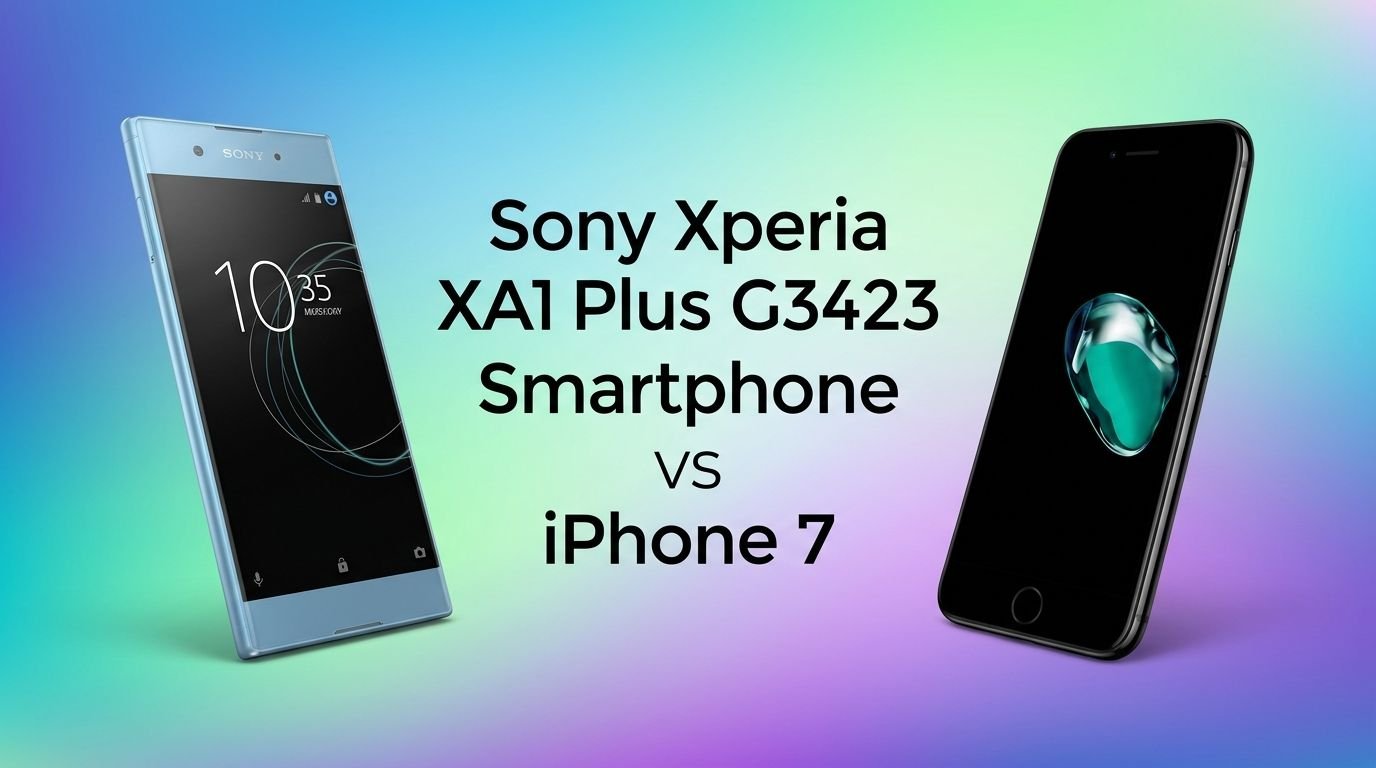
Sony Xperia XA1 Plus G3423 32GB Smartphone vs iPhone 7
Choosing between the Sony Xperia XA1 Plus G3423 and the Apple iPhone 7 can feel like a real head-scratcher. Both phones launched around the same era and target budget-conscious buyers today. They each bring unique strengths to the table.
The Sony Xperia XA1 Plus offers a large display, solid camera specs, and expandable storage. The iPhone 7 counters with Apple’s polished ecosystem, fast performance, and lasting software support. So which one actually gives you more bang for your buck?
In this detailed comparison, we break down every major feature side by side. We look at design, display, camera quality, battery life, performance, and much more. By the end, you will have a clear picture of which smartphone fits your daily needs best.
Key Takeaways:
- Display Size Matters: The Sony Xperia XA1 Plus features a 5.5-inch Full HD display, which is significantly larger than the iPhone 7’s 4.7-inch Retina HD screen. If you enjoy watching videos or browsing on a bigger screen, the Sony has a clear advantage here.
- Camera Comparison: The Xperia XA1 Plus packs a 23MP rear camera with Sony’s own Exmor RS sensor. The iPhone 7 has a 12MP rear camera but benefits from Apple’s excellent image processing software. Both deliver solid photos, but they approach photography differently.
- Storage Flexibility: The Sony phone supports microSD card expansion up to 256GB on top of its 32GB internal storage. The iPhone 7 has no expandable storage option. You get what you buy, whether that is 32GB, 128GB, or 256GB.
- Performance and Software: The iPhone 7 runs on Apple’s A10 Fusion chip, which still handles everyday tasks smoothly. The Xperia XA1 Plus uses a MediaTek Helio P20 processor with 3GB or 4GB of RAM. Apple’s chip generally delivers snappier real-world performance.
- Battery Life: The Xperia XA1 Plus houses a large 3,430mAh battery that comfortably lasts a full day. The iPhone 7 has a smaller 1,960mAh battery but benefits from iOS power optimization.
- Price Point Today: Both phones are available at steep discounts from their original launch prices. They represent excellent value in the used and refurbished smartphone market right now.
Sony Xperia XA1 Plus G3423 32GB: Overview and First Impressions

The Sony Xperia XA1 Plus G3423 launched in late 2017 as a mid-range Android smartphone. It runs Android 7.0 Nougat out of the box with Sony’s custom skin layered on top. The phone features a clean, rectangular design that Sony fans will instantly recognize.
It uses a MediaTek Helio P20 octa-core processor paired with 3GB or 4GB of RAM depending on the region. The 32GB internal storage gives you decent space for apps and media files. You can expand this further with a microSD card.
The phone supports 4G LTE connectivity, Bluetooth 4.2, Wi-Fi, GPS, and NFC. It also includes a fingerprint scanner mounted on the side for quick and secure unlocking. The overall build quality feels solid in the hand.
Pros:
- Large 5.5-inch Full HD display for comfortable media consumption
- 23MP rear camera with Sony Exmor RS sensor
- Expandable storage via microSD card slot up to 256GB
- 3,430mAh battery provides excellent all-day battery life
- Side-mounted fingerprint scanner for quick access
- Dedicated camera shutter button
Cons:
- Android software updates stopped after Android 8.0 Oreo
- MediaTek processor is less powerful than flagship chips
- No water or dust resistance rating
- Bezels above and below the screen are quite thick
- Limited availability of accessories compared to mainstream phones
Apple iPhone 7 32GB: Overview and First Impressions

The Apple iPhone 7 debuted in September 2016 and became one of Apple’s best-selling models. It introduced water resistance (IP67) to the iPhone lineup for the first time. Apple also removed the headphone jack with this model, a move that sparked major debate.
The phone runs on Apple’s A10 Fusion chip, which was a powerhouse at launch. It still handles daily tasks like browsing, social media, and video streaming without major lag. The 32GB base storage model is the most common version available today.
Apple’s iOS ecosystem provides seamless integration with other Apple devices like iPads, Macs, and Apple Watch. The iPhone 7 received software updates for many years, with support extending through iOS 15. This long software support cycle is a significant advantage.
Pros:
- A10 Fusion chip delivers smooth and responsive performance
- IP67 water and dust resistance rating
- Excellent build quality with aluminum unibody design
- Long software support history up through iOS 15
- Strong resale value compared to most Android phones
- Wide availability of cases and accessories
Cons:
- Small 4.7-inch display feels cramped by modern standards
- No headphone jack requires dongles or wireless earbuds
- No expandable storage option at all
- 1,960mAh battery is relatively small
- 32GB base storage fills up quickly with photos and apps
- Older single-lens 12MP camera system
Design and Build Quality Comparison
The Sony Xperia XA1 Plus follows Sony’s signature rectangular design language. It has a polycarbonate back panel with a metal frame. The phone measures 155 x 75 x 8.7mm and weighs about 190 grams. It feels solid but slightly bulky due to the larger screen.
The iPhone 7 features Apple’s iconic aluminum unibody construction. It measures 138.3 x 67.1 x 7.1mm and weighs just 138 grams. The phone feels premium in the hand with its smooth, rounded edges. Apple offered it in several colors including Jet Black, Black, Silver, Gold, and Rose Gold.
The iPhone 7 wins on build quality with its seamless aluminum body and IP67 rating. The Sony feels sturdy but lacks water resistance. If you care about a compact, pocket-friendly design, the iPhone 7 is the better pick. If you prefer a bigger phone, the Sony’s larger body is actually a plus.
Display Quality: 5.5 Inches vs 4.7 Inches
The Xperia XA1 Plus uses a 5.5-inch IPS LCD display with a resolution of 1920 x 1080 pixels (Full HD). This gives you a pixel density of about 401 PPI. Colors look vivid, and text appears sharp on screen. The larger panel makes video watching and gaming more enjoyable.
The iPhone 7 has a 4.7-inch IPS LCD Retina HD display with a resolution of 1334 x 750 pixels. Its pixel density sits at around 326 PPI. Apple’s display calibration produces accurate colors and good brightness levels. However, the lower resolution is noticeable when compared side by side with the Sony.
The Sony Xperia XA1 Plus takes the display crown here. It offers a bigger screen with higher resolution and greater pixel density. The iPhone 7’s display is still good, but it feels small and dated by today’s standards.
Camera Performance: 23MP vs 12MP
No products found.
The Sony Xperia XA1 Plus boasts a 23MP rear camera with an f/2.0 aperture and Sony’s Exmor RS sensor. It captures sharp, detailed photos in good lighting conditions. The front camera is an 8MP shooter suitable for selfies and video calls. Sony also included a dedicated physical camera button on the side of the phone.
The iPhone 7 has a 12MP rear camera with an f/1.8 aperture and optical image stabilization (OIS). Apple’s image processing software produces natural-looking photos with excellent dynamic range. The 7MP front camera supports Portrait mode through software and records 1080p video.
In well-lit conditions, the Sony captures more detail thanks to its higher megapixel count. In low-light situations, the iPhone 7 performs better because of its wider aperture and OIS. Apple’s image processing also tends to produce more consistent results across different lighting scenarios.
Battery Life and Charging
The Xperia XA1 Plus packs a 3,430mAh battery. This is a generous capacity for a phone of this era. Most users report getting a full day of moderate to heavy use on a single charge. The phone supports MediaTek Pump Express fast charging to reduce downtime.
The iPhone 7 has a much smaller 1,960mAh battery. Apple relies on iOS optimization to squeeze out acceptable battery life from this small cell. Most users get around 10 to 12 hours of mixed use before needing to plug in. The iPhone 7 does not support fast charging natively.
The Sony wins the battery comparison convincingly. Its larger battery simply lasts longer throughout the day. If battery life is a priority for you, the Xperia XA1 Plus is the stronger choice. The iPhone 7 may require a midday top-up for heavy users.
Performance and Processing Power
The Sony Xperia XA1 Plus runs on a MediaTek Helio P20 octa-core processor clocked at 2.3GHz. It pairs this with 3GB or 4GB of RAM. The chip handles everyday tasks like messaging, social media, and web browsing without issues. However, it can struggle with demanding games and heavy multitasking.
The iPhone 7 uses Apple’s A10 Fusion quad-core chip with 2GB of RAM. Despite the lower RAM count, iOS manages memory efficiently. The A10 Fusion chip delivers faster real-world performance than the Helio P20 in most tasks. App loading times and system animations feel smoother on the iPhone.
Apple’s A10 Fusion chip outperforms the MediaTek Helio P20 in both single-core and multi-core benchmarks. The iPhone 7 feels snappier in daily use. The Sony handles basics well, but power users will notice the difference.
Software and Operating System
The Xperia XA1 Plus shipped with Android 7.0 Nougat and received an update to Android 8.0 Oreo. Sony stopped providing major OS updates after that. You still get access to the Google Play Store with millions of apps. Android offers greater customization and flexibility in how you set up your phone.
The iPhone 7 launched with iOS 10 and received updates all the way to iOS 15. That means Apple supported this phone with major software updates for about five years. Even though it no longer receives the latest iOS versions, it still gets occasional security patches. The App Store also provides a massive library of optimized apps.
The iPhone 7 wins on software support by a wide margin. Longer update support means better security and access to newer app features. The Sony’s Android flexibility is nice, but the outdated software is a concern for security-conscious users.
Storage Options and Expandability
The Sony Xperia XA1 Plus comes with 32GB of internal storage. It supports microSD card expansion up to 256GB. This means you can store thousands of photos, videos, and music files without worrying about space. Adding a microSD card is cheap and easy.
The iPhone 7 was available in 32GB, 128GB, and 256GB configurations. It has no microSD card slot. You must choose your storage tier at the time of purchase. If you buy the 32GB model, you cannot add more storage later.
The Sony offers better storage flexibility thanks to its expandable memory option. The 32GB iPhone 7 can feel cramped quickly, especially if you take lots of photos or download many apps. Budget buyers who pick up the base 32GB iPhone should plan to use iCloud storage.
Audio and Multimedia Features
The Xperia XA1 Plus retains the 3.5mm headphone jack. This lets you use any standard wired headphones without an adapter. Sony also included support for Hi-Res Audio, which is a nice bonus for music lovers. The single bottom-firing speaker delivers average sound quality.
The iPhone 7 removed the headphone jack entirely. Apple included a Lightning-to-3.5mm adapter in the box at launch. The phone features stereo speakers for the first time in an iPhone, producing louder and richer sound than the Sony’s single speaker. It also works seamlessly with AirPods and other Bluetooth accessories.
For wired headphone users, the Sony is the obvious choice. For speaker quality, the iPhone 7’s stereo setup sounds better. Your preference here depends on whether you have already moved to wireless audio or still rely on wired headphones.
Connectivity and Extra Features
Both phones support 4G LTE, Wi-Fi, Bluetooth, GPS, and NFC. The Sony uses Bluetooth 4.2 while the iPhone 7 also supports Bluetooth 4.2. Both phones include NFC for contactless payments. Apple Pay works on the iPhone 7, and the Sony supports Google Pay.
The Xperia XA1 Plus offers a dedicated dual SIM option in some variants. This is useful for travelers or people who use separate work and personal numbers. The iPhone 7 supports only a single nano-SIM card.
The Sony also includes a side-mounted fingerprint sensor and a dedicated camera shutter button. The iPhone 7 has the Touch ID fingerprint sensor built into the home button. Both methods work quickly and reliably. The iPhone 7 adds Taptic Engine haptic feedback, which provides satisfying tactile responses.
Which Phone Should You Buy in 2026?
Both the Sony Xperia XA1 Plus and the iPhone 7 are aging devices in 2026. However, they still serve specific use cases well. The right choice depends on your priorities.
Choose the Sony Xperia XA1 Plus if you want a bigger screen, expandable storage, a headphone jack, longer battery life, and a high-megapixel camera. It suits users who prefer Android’s flexibility and do not mind older software.
Choose the iPhone 7 if you value smooth performance, long software support history, water resistance, a premium build, and seamless Apple ecosystem integration. It suits users already invested in Apple products.
For most buyers today, the iPhone 7 offers a more polished overall experience. But the Sony Xperia XA1 Plus provides better value in hardware features per dollar spent.
Frequently Asked Questions
Is the Sony Xperia XA1 Plus still worth buying in 2026?
The Sony Xperia XA1 Plus can still work as a basic smartphone for calls, messaging, and light browsing. However, its software is outdated, and many newer apps may not run properly. It works best as a secondary or backup phone.
Does the iPhone 7 still receive software updates?
The iPhone 7 last received a major update with iOS 15. Apple may still push occasional security patches, but the phone no longer gets new iOS versions. It remains functional for most everyday apps.
Which phone has a better camera for everyday photos?
The iPhone 7 generally produces more consistent and natural-looking photos thanks to Apple’s image processing. The Sony captures more detail in bright light with its 23MP sensor. For casual photography, the iPhone 7 is the safer bet.
Can I use a memory card with the iPhone 7?
No. The iPhone 7 does not support microSD cards or any form of expandable storage. You must rely on the internal storage you purchased or use cloud storage services like iCloud.
Which phone has better battery life?
The Sony Xperia XA1 Plus has significantly better battery life thanks to its larger 3,430mAh battery. The iPhone 7’s 1,960mAh battery requires more frequent charging, especially under heavy use.
Is the iPhone 7 waterproof?
The iPhone 7 has an IP67 rating, which means it can survive submersion in up to 1 meter of water for 30 minutes. It is water-resistant but not fully waterproof. The Sony Xperia XA1 Plus has no official water resistance rating.