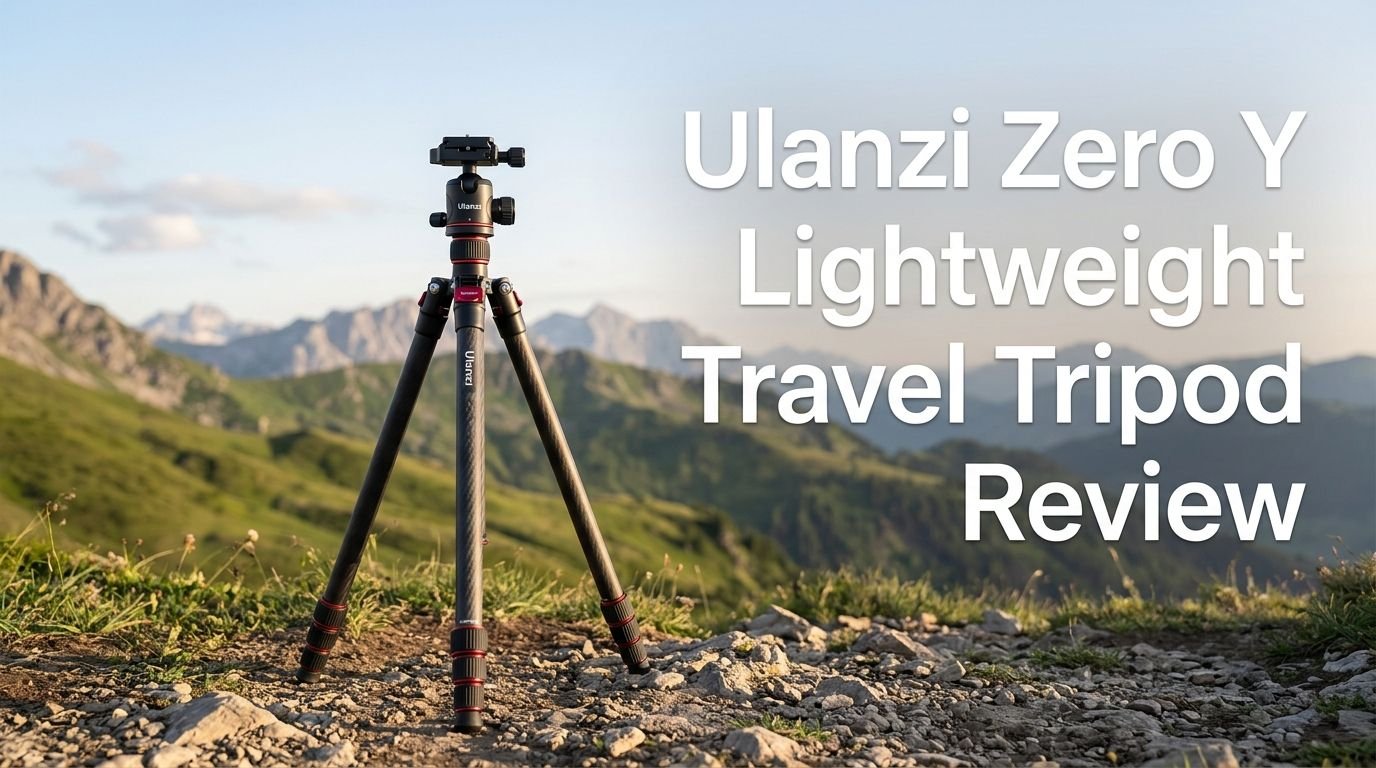
Ulanzi Zero Y Lightweight Travel Tripod Review 2026: Worth It?
Are you tired of carrying heavy, bulky tripods on your travel adventures? The Ulanzi Zero Y Lightweight Travel Tripod promises to solve that problem. It weighs just 1.1 kg and folds down to a mere 42 cm. That makes it smaller than most water bottles.
This carbon fiber tripod has been a favorite among travel photographers and content creators since its launch. It stands tall at 157 cm with the center column extended. It costs a fraction of what premium brands charge. But does it actually perform well in real conditions?
In this review, we break down every feature, every strength, and every weakness of the Ulanzi Zero Y. We tested it across different terrains and shooting scenarios.
Key Takeaways:
- The Ulanzi Zero Y weighs only 1.1 kg (2.4 lbs), making it one of the lightest full-size carbon fiber travel tripods available. You can toss it in a backpack and barely notice the extra weight during long hikes or city walks.
- It folds down to just 42.3 cm (16.65 inches), which is compact enough to fit inside most carry-on luggage and camera backpacks. The five-section leg design keeps the folded length impressively short.
- The maximum height reaches 157 cm (61.7 inches) with the center column extended. This allows most photographers to shoot at or near eye level without crouching. Without the center column, it still reaches a solid 133 cm.
- The Arca-Swiss compatible ball head offers smooth 360-degree panning. It handles lightweight mirrorless camera setups with ease. However, the ball head may struggle under heavier loads, so keep your gear under 3 kg for best results.
- Carbon fiber legs and aluminum alloy joints deliver a strong build at a budget-friendly price. You get premium materials at roughly one-third the cost of the Peak Design Carbon Fiber Travel Tripod.
- Included accessories add real value to the package. The tripod comes with a storage bag, shoulder strap, three metal spike feet, and a hidden hex wrench inside the center column.

Ulanzi Zero Y Lightweight Travel Tripod: Overview and First Impressions
The Ulanzi Zero Y is a collaboration between Ulanzi and COMAN, two brands headquartered in Guangdong, China. Ulanzi was founded in 2015 and has quickly built a reputation for affordable, high-quality camera accessories. This tripod is their flagship travel model.
Out of the box, the tripod feels premium. The carbon fiber legs display a clean weave pattern. The machining on the aluminum joints is precise. Everything clicks and locks with satisfying firmness.
The package includes the tripod, a padded storage bag, a shoulder strap, three stainless steel spike feet, and an instruction guide. The storage bag deserves special mention. It uses a deep-zippered design that makes it easy to slide the tripod in and out.
The overall build quality punches well above its price point. Photographers moving up from basic aluminum tripods will immediately notice the difference in both weight and rigidity. The carbon fiber dampens vibrations better than aluminum, and the entire unit feels well-assembled.
Build Quality and Materials
The Ulanzi Zero Y uses 10-layer carbon fiber for its leg tubes. This material choice keeps weight low while offering excellent stiffness. The metal components, including the leg joints, center column housing, and ball head, use aluminum alloy.
Each leg section connects through flip-lock levers. These locks snap open and closed quickly. They provide faster setup compared to twist-lock designs. However, flip locks can wear over time, and some users report slight loosening after extended use.
The rubberized feet on each leg provide solid grip on hard surfaces. They unscrew easily. You can replace them with the included stainless steel spike feet for soft terrain like sand, dirt, or grass. This two-foot system adds genuine field versatility.
The overall finish is smooth and clean. There are no rough edges or loose parts. The tripod feels like it belongs in a higher price bracket. For a product under $200, the material quality and assembly precision stand out as major strengths.
Design and Portability
Portability is the core selling point of the Ulanzi Zero Y. At 1.1 kg, it is lighter than a typical DSLR camera body. The folded length of 42.3 cm means it slides easily into a backpack side pocket or inside a carry-on suitcase.
The five-section leg design is responsible for this compact size. Each leg collapses into itself, reducing the overall footprint dramatically. The reverse-folding leg mechanism wraps the legs around the center column and ball head.
Carrying the tripod is effortless. The included shoulder strap attaches to the storage bag. You can sling it across your body for hands-free transport. The slim profile means it does not catch on branches during trail hikes or bump into fellow passengers on trains.
The tripod’s diameter when folded is similar to a 500 ml water bottle. This makes it one of the most packable full-height travel tripods on the market. If saving space and weight is your top priority, the Zero Y delivers on that promise without major trade-offs.
Top 3 Alternatives for Ulanzi Zero Y Lightweight Travel Tripod

1. Peak Design Travel Tripod Carbon Fiber

2. SIRUI Compact Traveler 5C Carbon Fiber Tripod

3. SmallRig AP-100 FreeRover Carbon Fiber Tripod
Leg Performance and Stability
The Ulanzi Zero Y features five-section carbon fiber legs with three adjustable angle positions: 20, 55, and 75 degrees. The 20-degree setting works for standard shooting. The 55-degree setting lowers the camera for tabletop-level shots. The 75-degree setting brings the tripod close to the ground for macro photography or creative low-angle compositions.
The flip-lock levers on each section operate smoothly. You can deploy all five sections on all three legs in under 15 seconds with practice. This speed is a genuine advantage in fast-changing shooting conditions.
However, the five-section design has a downside. The thinnest leg segment measures just 12 mm in diameter. At full extension, this creates some flex. Wind or accidental bumps can introduce slight vibrations at maximum height. The tripod performs best when you avoid fully extending the thinnest bottom section.
Stability on flat, hard surfaces is excellent. On uneven ground, the three-angle leg system helps. You can set each leg to a different angle for leveling on rocks, slopes, or stairs. The spike feet improve grip significantly on soft terrain. For lightweight mirrorless cameras under 1.5 kg, the Zero Y feels solid and dependable.
Ball Head Performance
The integrated ball head on the Ulanzi Zero Y uses a lever-lock system instead of a traditional screw knob. Lifting the lever about 5 cm loosens the ball. Pushing it back down locks the position. This design allows for quick adjustments between shots.
The head offers 360-degree panning with engraved degree markings. This feature is especially useful for panoramic photography. You can rotate the head smoothly and track your position using the scale. The panning motion feels fluid and consistent.
Two notches on the ball head allow quick switching between landscape and portrait orientations. This saves time compared to heads that require full loosening for orientation changes. The detent positions feel solid and hold the camera securely.
The ball head handles lightweight setups well. A mirrorless camera body with a standard zoom lens works perfectly. However, heavier gear causes the ball head to sag or slip. Users with cameras and lenses totaling over 2.5 to 3 kg may find the head frustrating. Frequent lever readjustments become necessary under load. This is the head’s biggest limitation.
Center Column and Height Range
The Ulanzi Zero Y reaches a maximum height of 133 cm without the center column extended. Raising the center column adds an extra 24 cm, bringing the total to approximately 157 cm. This height allows most adults to shoot comfortably at eye level.
The center column operates with a simple lever-lock mechanism. You release the lever, slide the column up or down, and lock it in place. The adjustment is quick and intuitive. A minimum height of roughly 15 cm is possible with the legs fully splayed.
One standout feature is the removable and invertible center column. You can flip it upside down to mount the camera beneath the tripod for extreme low-angle and macro shots. The column also splits into two sections for even lower positioning.
A hidden hex wrench lives inside the center column. This 3 mm wrench works on the camera mounting screw and the leg tightening screws. It is a clever design touch that saves you from carrying extra tools. A hook at the bottom of the column lets you hang a bag or weight for added stability in windy conditions.
The column itself is thin, though. At full extension, it introduces some wobble with heavier setups. Use it only when you truly need the extra height.
Arca-Swiss Compatibility and Quick Release Plate
The Ulanzi Zero Y comes with an Arca-Swiss compatible quick release plate. This is the most widely used plate standard in photography. It works with most third-party Arca-Swiss clamps and L-brackets.
The included plate is small but functional. It attaches to your camera using a 1/4-inch screw with a finger-tightening knob. No tools are needed for mounting. The plate has a small rubber pad to prevent scratching your camera’s base.
One drawback is the lack of a true quick-release mechanism. Unlike the Ulanzi F38 model, which uses a Falcam quick-release system, the Zero Y requires about four turns of the clamp knob to secure or release the plate. This takes a few extra seconds each time you mount or dismount the camera.
The plate’s rear screw protrudes slightly to prevent accidental sliding. While this improves security, it makes sliding the plate into the clamp less smooth. You may need to lift the plate slightly and drop it into position rather than glide it in from the side.
If you already own Arca-Swiss compatible plates from other brands, they will work fine on this tripod. The clamp width accommodates standard-size plates without issue. For photographers who need faster plate changes, the Ulanzi F38 variant might be a better fit.
Who Should Buy the Ulanzi Zero Y?
The Ulanzi Zero Y fits a specific type of photographer and creator. Travel photographers will love its featherlight weight and compact folded size. It slides into a daypack and barely adds to your load during long days of exploration.
Hiking and outdoor photographers benefit from the carbon fiber construction and included spike feet. The tripod handles trail conditions well. It provides enough height for landscape shots without the bulk of a studio tripod.
Solo content creators and vloggers will appreciate the 360-degree panning and smooth ball head. The tripod works well for self-timer shots, time-lapse videos, and stationary video recording. The lever-lock ball head speeds up framing adjustments.
Budget-conscious photographers get a carbon fiber tripod at a price that undercuts major competitors by a wide margin. You save hundreds of dollars compared to the Peak Design Carbon Fiber Travel Tripod.
This tripod is not ideal for heavy camera setups. If you shoot with a full-frame DSLR, large telephoto lenses, or heavy video rigs, the ball head and thin leg sections may not provide enough support. Studio and professional event photographers should look at sturdier options.
Ulanzi Zero Y vs Peak Design Travel Tripod
The Peak Design Travel Tripod is the most common comparison point for the Ulanzi Zero Y. Both share a similar philosophy: compact, lightweight, travel-first design. But they differ significantly in price and execution.
The Peak Design Carbon Fiber model weighs 1.27 kg compared to the Zero Y’s 1.1 kg. The Peak Design folds to 39.4 cm, which is slightly shorter than the Zero Y’s 42.3 cm. In terms of pure compactness, Peak Design wins by a small margin.
Build quality on the Peak Design is outstanding. The machining, the materials, and the overall fit and finish are noticeably more refined. The ball head is ergonomic and holds heavier loads more reliably. It also includes a built-in phone mount and tool-free adjustments.
However, the price difference is massive. The Peak Design Carbon Fiber model costs roughly three times as much as the Ulanzi Zero Y. For many photographers, the Zero Y delivers 80% of the performance at 30% of the cost.
The Zero Y reaches a greater maximum height (157 cm vs 152 cm), which benefits taller photographers. The Peak Design’s ball head handles heavier cameras better. If your budget allows, the Peak Design is the premium choice. If you want excellent value, the Zero Y offers hard-to-beat performance per dollar.
Durability and Long-Term Use
Long-term durability is a genuine concern with budget tripods. The Ulanzi Zero Y handles daily use well for the first several months. The carbon fiber legs resist scratches and dents. The aluminum alloy joints maintain their integrity.
However, some users report flip-lock loosening after 12 to 18 months of regular use. The locks still function but require occasional tightening. The included hex wrench addresses this issue. A few turns on the lock screws restore the original tension.
The ball head shows wear over time with heavier camera setups. The lever mechanism can lose some of its holding power. This is more noticeable with cameras and lenses above 2 kg. Users who pair the tripod with lightweight mirrorless bodies report fewer issues.
The rubberized feet hold up well. The spike feet show minimal corrosion even after exposure to damp environments. The storage bag maintains its shape and padding after extensive use.
Ulanzi offers a warranty that typically covers manufacturing defects. In the EU, the standard warranty period is two years. Their customer support team is reported to be responsive and helpful. The ball head cannot be removed from the stock center column, but Ulanzi sells a replacement center column with a thread adapter for users who want to mount a third-party head.
Accessories and What’s in the Box
The Ulanzi Zero Y package includes several useful accessories beyond the tripod itself. You get a padded storage bag with a deep zipper and a detachable shoulder strap. The bag fabric feels premium and protects the tripod during transport.
Three stainless steel spike feet come included. They screw directly onto the leg bottoms after removing the rubber feet. These spikes provide excellent grip on soil, sand, and grass. They are a must-have for outdoor photographers.
A 3 mm hex wrench hides inside the center column. It works on the camera plate screw and the leg lock adjustment screws. This hidden tool eliminates the need to carry a separate toolkit for field maintenance.
The Arca-Swiss quick release plate comes pre-installed on the ball head clamp. A spare plate would have been a nice bonus, but only one is included. The plate works with standard Arca-Swiss accessories from other brands.
You also get an instruction guide with setup diagrams. The guide covers leg deployment, ball head operation, center column inversion, and spike foot installation. Everything you need to start shooting is inside the box.
Pricing and Value for Money
The Ulanzi Zero Y typically retails for around $170 to $190 USD on Amazon and the official Ulanzi store. Prices vary by region and availability. Occasional sales and coupons can drop the price below $150.
At this price point, you get a carbon fiber travel tripod that competes with products costing two to three times more. The Peak Design Carbon Fiber Travel Tripod sells for approximately $600. The SIRUI Traveler 5C sits around $200 to $250. The SmallRig AP-100 FreeRover costs roughly $250.
The Ulanzi Zero Y delivers exceptional value per dollar. You get carbon fiber legs, an Arca-Swiss ball head, a padded case, spike feet, and a hidden tool. Few tripods at this price offer the same combination of lightweight design, maximum height, and build quality.
The main trade-off for the lower price is the ball head performance under load and the long-term durability of the flip locks. These are real limitations. But for photographers who use lightweight to mid-weight mirrorless camera systems, these trade-offs rarely cause problems.
If you are a travel photographer on a budget, the Zero Y offers one of the best price-to-performance ratios in the carbon fiber travel tripod market.
Potential Drawbacks You Should Know
No product is perfect. The Ulanzi Zero Y has a few notable weak spots. The ball head sags under heavy loads. Cameras and lenses above 2.5 to 3 kg push the lever-lock system beyond its comfortable range. You will need to readjust the lever frequently.
The thinnest leg section is only 12 mm wide. At full extension, this creates visible flex. Strong winds or heavy camera setups amplify this issue. Avoid extending the bottom leg section unless absolutely necessary.
The center column is thin and introduces wobble at full extension. Use it sparingly and add weight to the hook for stability. For critical sharpness, keep the center column retracted.
The ball head is not removable from the stock center column. If the included head does not meet your needs, you must purchase a separate Ulanzi center column with a thread adapter. This adds cost and inconvenience.
The quick release plate clamp lacks a fast-release mechanism. Mounting and removing the plate requires multiple turns. This slows down camera transitions compared to the Ulanzi F38 or Peak Design systems.
Some flip locks loosen over time with heavy use. Regular maintenance with the included hex wrench keeps them functional. But this is an extra step that higher-end tripods rarely require.
Final Verdict: Should You Buy the Ulanzi Zero Y in 2026?
The Ulanzi Zero Y Lightweight Travel Tripod earns a strong recommendation for travel photographers, hikers, and content creators who prioritize portability and value. At just 1.1 kg with a 42.3 cm folded length, it is one of the most packable full-size carbon fiber tripods available.
The build quality, material choices, and included accessories punch above its price class. The Arca-Swiss compatibility ensures it works with existing gear ecosystems. The three-position leg angles and invertible center column add genuine versatility.
The ball head and thin leg sections limit the tripod’s ability to handle heavy camera setups. This is not the right tripod for large telephoto lenses or studio-grade configurations. But for mirrorless camera bodies with standard zoom or prime lenses, the Zero Y performs admirably.
At roughly $170 to $190, it offers a fraction of the cost of the Peak Design Carbon Fiber Travel Tripod while delivering surprisingly close real-world performance. If you need a reliable, lightweight, and affordable travel tripod in 2026, the Ulanzi Zero Y remains one of the best choices in its class.
Frequently Asked Questions
Is the Ulanzi Zero Y tripod good for heavy DSLR cameras?
The Ulanzi Zero Y works best with lightweight mirrorless cameras and standard lenses. The ball head has a stated load capacity, but practical performance drops with setups above 2.5 to 3 kg. Heavy DSLRs paired with large lenses may cause the ball head to sag. For heavy setups, consider a sturdier tripod with a larger ball head.
Can I replace the ball head on the Ulanzi Zero Y?
The ball head is not removable from the stock center column. However, Ulanzi sells a separate center column with a 3/8-inch thread adapter. This allows you to mount third-party ball heads. Many users recommend the INNOREL N36 as a compatible upgrade that improves stability with heavier gear.
How does the Ulanzi Zero Y compare to the Ulanzi F38?
Both tripods share a similar body design and carbon fiber construction. The main difference is the quick release system. The Zero Y uses an Arca-Swiss clamp, while the F38 uses a Falcam quick-release plate. The F38 allows faster camera mounting and removal. Choose the F38 if speed matters, and the Zero Y if you prefer Arca-Swiss compatibility.
Is the Ulanzi Zero Y stable enough for long exposure photography?
The Ulanzi Zero Y can handle long exposures with lightweight cameras on calm days. For best results, avoid extending the center column and the thinnest leg section. Hang a weight from the center column hook for added stability. In windy conditions, the thin legs may introduce some vibration that affects sharpness at very slow shutter speeds.
What is the warranty on the Ulanzi Zero Y tripod?
Ulanzi offers a standard manufacturer warranty that covers defects in materials and workmanship. In the EU, this is typically a two-year warranty. In other regions, check with your retailer for specific terms. Ulanzi’s customer support team is generally responsive and helpful with warranty claims and replacement parts.
Does the Ulanzi Zero Y fit inside a carry-on bag for flights?
Yes. The Ulanzi Zero Y folds to 42.3 cm (16.65 inches), which fits comfortably inside most standard carry-on suitcases and camera backpacks. Its slim profile also allows it to fit in backpack side pockets. It meets the size requirements of virtually all major airlines for carry-on luggage.