
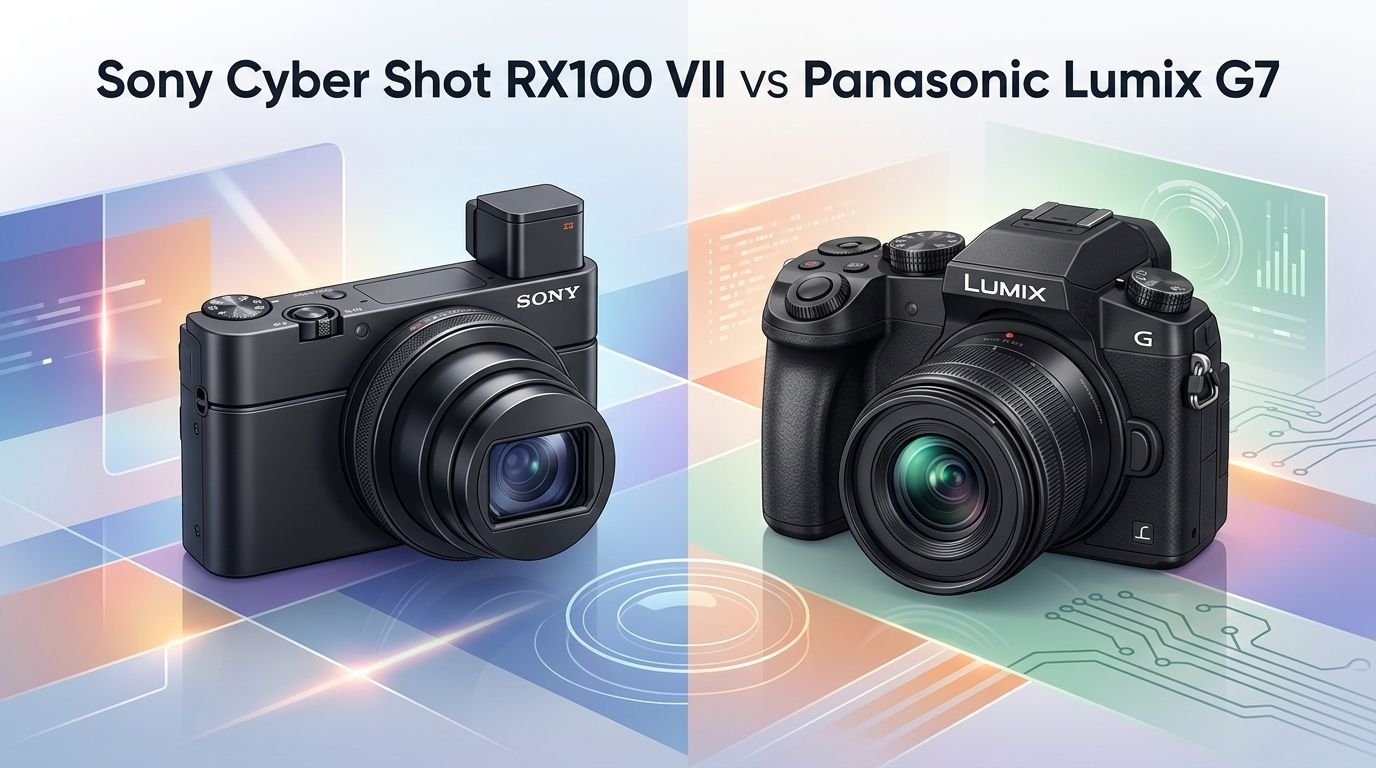
Sony Cyber Shot RX100 VII vs Panasonic Lumix G7
Choosing between a premium pocket compact and a budget mirrorless camera is not easy. The Sony Cyber Shot RX100 VII packs flagship autofocus into a body that fits your jacket pocket. The Panasonic Lumix G7 gives you interchangeable lenses and 4K video at a fraction of the price.
Both cameras attract very different buyers. One favors portability above all else. The other rewards photographers who want room to grow with new lenses and accessories.
This detailed comparison breaks down every important difference between these two popular cameras. You will learn about image quality, video performance, autofocus speed, build quality, and real world usability.
Key Takeaways
- The Sony RX100 VII uses a 1 inch stacked CMOS sensor with 20.1 megapixels. It delivers excellent image quality from an incredibly small body that weighs just 302 grams.
- The Panasonic Lumix G7 features a Micro Four Thirds 16 megapixel sensor with interchangeable lens support. This gives you far more creative flexibility over time.
- Autofocus goes to Sony hands down. The RX100 VII has 357 phase detection AF points and real time eye tracking. The Lumix G7 has 49 AF points with contrast detection.
- Both cameras record 4K video, but the RX100 VII shoots 4K with no crop from its full sensor area. The Lumix G7 shoots 4K at up to 30fps and offers a unique 4K Photo mode for grabbing 8MP stills from video.
- Price is the biggest dividing factor. The RX100 VII costs significantly more than the Lumix G7 with its kit lens. Budget conscious buyers will find the G7 hard to beat.
- Portability favors the Sony. It slips into a pants pocket. The Lumix G7 is small for a mirrorless camera but still requires a bag or strap.
Sony Cyber Shot RX100 VII Overview

The Sony Cyber Shot RX100 VII launched in 2019 as the seventh generation of Sony’s popular RX100 line. It carries a 20.1 megapixel 1 inch stacked CMOS sensor paired with a BIONZ X image processor. The lens is a ZEISS Vario Sonnar T* with a 24 to 200mm equivalent zoom range and an aperture of f/2.8 to f/4.5.
This camera borrowed autofocus technology straight from Sony’s flagship Alpha a9. It has 357 phase detection AF points covering 68% of the frame. Real time tracking and real time Eye AF for both humans and animals make it one of the most capable compact cameras ever built.
The RX100 VII shoots bursts at 20 frames per second with no viewfinder blackout. A single shot burst mode fires 7 frames at an astonishing 90 fps. These numbers are rare even in cameras that cost two or three times as much.
Video shooters get 4K UHD recording at 30fps with no sensor crop. Slow motion is available at 1080p 120fps. A 3.5mm microphone input was added for the first time in the RX100 series. The camera also records 4K HDR video in HLG format.
The body measures just 101.6 x 58.1 x 42.8mm. It weighs only 302 grams with the battery. A pop up OLED electronic viewfinder and a 180 degree tilting touchscreen LCD round out the package.
Pros:
- Extremely compact and lightweight body
- Class leading 357 point phase detection autofocus
- 24 to 200mm zoom range in a pocket size camera
- 20fps burst shooting with real time tracking
- 4K video with no crop and microphone input
- Pop up electronic viewfinder
Cons:
- Premium price point compared to many alternatives
- 1 inch sensor limits low light performance vs larger sensors
- Battery life is modest at around 260 shots per charge
- No weather sealing
- Fixed lens with no option to swap glass
Panasonic Lumix G7 Overview

The Panasonic Lumix G7 arrived in 2015 as a mid range mirrorless camera. It uses a 16 megapixel Live MOS Micro Four Thirds sensor with a Venus Engine 9 image processor. The kit lens is the Lumix G Vario 14 to 42mm f/3.5 to 5.6 II, which covers a 28 to 84mm equivalent focal range.
The G7 brought 4K video recording to an affordable price bracket. It records UHD 4K at 24 or 30fps with a bitrate of 100Mbps. Full HD recording goes up to 60fps for smooth slow motion clips.
Panasonic’s 4K Photo mode is a standout feature. It lets you pull 8 megapixel still images from 4K video footage at 30 frames per second. This is very useful for capturing fast action moments you might otherwise miss.
The autofocus system uses 49 contrast detection AF points with Panasonic’s DFD (Depth from Defocus) technology. It works well in good light but can struggle with fast moving subjects compared to phase detection systems.
Build quality is solid for the price. The body has a comfortable DSLR style grip. A 2.36 million dot OLED electronic viewfinder sits on top. The rear screen is a 3 inch free angle touchscreen with 1.04 million dots that flips out and rotates.
The G7 weighs 410 grams with the battery and kit lens. It supports the full range of Micro Four Thirds lenses from Panasonic, Olympus, and third party manufacturers.
Pros:
- Very affordable price point
- Interchangeable lens system with dozens of options
- 4K video at 100Mbps bitrate
- Unique 4K Photo mode for action shots
- Comfortable DSLR style grip
- Fully articulating touchscreen display
Cons:
- 16 megapixel resolution is lower than many competitors
- Contrast detection AF can be slow in 4K video
- No in body image stabilization
- Micro Four Thirds sensor is smaller than APS C alternatives
- Plastic body construction
- No headphone jack for audio monitoring
Sensor and Image Quality Comparison
The sensor is the heart of any camera. The Sony RX100 VII uses a 1 inch (13.2 x 8.8mm) stacked CMOS sensor with 20.1 effective megapixels. The Panasonic Lumix G7 uses a Micro Four Thirds (17.3 x 13mm) Live MOS sensor with 16 megapixels.
The Lumix G7 has the physically larger sensor. A Micro Four Thirds sensor is about 1.6 times larger in area than a 1 inch sensor. This gives the G7 a slight advantage in dynamic range and low light noise at base ISO.
However, the RX100 VII uses a stacked CMOS design with a built in DRAM chip. This allows much faster data readout. It reduces rolling shutter effects and enables the extreme burst speeds that define this camera.
In good light, both cameras produce sharp and detailed images. The RX100 VII resolves more fine detail thanks to its higher pixel count. The G7 produces pleasant colors with Panasonic’s characteristic warm tone.
At higher ISO values, the G7 holds a slight edge because of its larger sensor. But the difference is not dramatic. Both cameras produce usable images up to about ISO 3200 before noise becomes visible.
Raw shooters will find more editing flexibility with the G7’s files. The larger sensor captures more light data per pixel. The RX100 VII’s raw files are still very capable but show noise a bit sooner during heavy shadow recovery.
Autofocus Performance
Autofocus is where these two cameras diverge dramatically. The Sony RX100 VII has a hybrid autofocus system with 357 phase detection points and 425 contrast detection points. The Panasonic Lumix G7 relies on 49 contrast detection AF points with DFD technology.
The RX100 VII locks focus in just 0.02 seconds according to Sony. It tracks moving subjects with impressive accuracy using real time tracking powered by AI based object recognition. Real time Eye AF works for humans and animals and activates with a half press of the shutter.
The Lumix G7’s DFD system calculates focus by comparing two slightly defocused images. It works well for still subjects and slow moving scenes. Portrait photographers will find it adequate. But it lags behind the Sony for sports, wildlife, and fast action.
In video mode, the gap widens even further. The RX100 VII maintains smooth and confident autofocus throughout 4K recording. The G7’s contrast detection AF can hunt and pulse during 4K video. It performs better in 1080p 60fps mode.
If you shoot moving subjects regularly, the RX100 VII is the clear winner. If you mostly shoot landscapes, street photography, or controlled portrait sessions, the G7’s autofocus will serve you well.
Video Recording Capabilities
Both cameras record 4K video, but the details matter. The Sony RX100 VII records 4K UHD at 30fps using the full width of its sensor with no crop. It also offers 1080p at 120fps for slow motion. A microphone input supports external audio recording.
The Panasonic Lumix G7 records 4K UHD at 24 or 30fps at 100Mbps. Full HD recording tops out at 60fps. There is no microphone input on the camera body. The G7 also lacks a headphone jack for monitoring audio levels.
The RX100 VII supports 4K HDR recording in HLG format. This produces video with a wider dynamic range that looks great on compatible displays. The G7 does not offer HDR video modes.
Panasonic’s 4K Photo mode on the G7 is still a unique advantage. You can shoot 4K video and extract 8MP stills at 30fps. This is a powerful tool for capturing split second moments like a bird taking flight or a child’s expression.
The RX100 VII has Active SteadyShot stabilization for video. This electronic stabilization smooths out handheld footage significantly. The G7 relies entirely on optical stabilization in the lens. With the kit lens, stabilization is decent but not outstanding.
For serious video work with external microphones and smooth stabilized footage, the RX100 VII has a clear edge. For budget filmmakers who want 4K at a low price, the G7 remains a fantastic value.
Lens Options and Flexibility
This is the biggest structural difference between these two cameras. The Sony RX100 VII has a fixed ZEISS 24 to 200mm f/2.8 to 4.5 zoom lens. You cannot remove or replace it. What you get out of the box is what you use forever.
The Panasonic Lumix G7 uses the Micro Four Thirds lens mount. This gives you access to hundreds of lenses from Panasonic, Olympus (OM System), Sigma, Tamron, and others. You can buy fast primes, wide angle zooms, telephoto lenses, and macro lenses.
The RX100 VII’s built in lens is impressive for its size. A 24 to 200mm equivalent range covers everything from wide landscapes to distant wildlife. The ZEISS optics produce sharp images across the zoom range. But you cannot add a faster aperture prime for shallow depth of field.
The G7’s kit lens covers 28 to 84mm equivalent. This is a useful everyday range but lacks the telephoto reach of the Sony. Adding a 45 to 200mm lens gives you similar reach. A fast prime like the Panasonic 25mm f/1.7 opens up beautiful background blur.
Over time, the Lumix G7 becomes a more versatile system. You invest in lenses that grow with your skills. The RX100 VII is a complete all in one solution that never changes. Your choice depends on whether you prefer simplicity or expandability.
Build Quality and Design
The Sony RX100 VII has an all metal body with a sleek, minimal design. It looks and feels premium. The camera is incredibly small at just 101.6 x 58.1 x 42.8mm. It slides into a jacket pocket or a small pouch with ease.
The Panasonic Lumix G7 has a polycarbonate (plastic) body with a DSLR inspired shape. A prominent grip makes it comfortable to hold for long periods. The body measures 124.9 x 86.2 x 77.4mm with the kit lens attached.
Neither camera has weather sealing. You should be careful with both in rain or dusty environments. The Sony’s metal construction feels more resistant to minor bumps. The G7’s plastic body is lighter but less rigid.
The G7’s larger grip is a real comfort advantage. Holding the tiny RX100 VII for extended shooting sessions can cause hand fatigue. Many RX100 VII owners buy an aftermarket grip accessory to improve ergonomics.
Both cameras have electronic viewfinders. The RX100 VII’s EVF pops up from the body and retracts flush when not in use. The G7’s EVF is always visible in a traditional hump on top. Both viewfinders have 2.36 million dot resolution and provide a clear, bright image.
Portability and Travel Friendliness
Portability is the Sony RX100 VII’s strongest selling point. At just 302 grams with the battery, it is one of the lightest cameras with a 1 inch sensor. The entire camera fits in a pants pocket. Travelers love it because it replaces a heavy DSLR kit.
The Panasonic Lumix G7 weighs 410 grams with the battery and memory card (body only). Add the kit lens and you reach roughly 500 grams total. It requires a camera bag or neck strap. It will not fit in any pocket.
For hikers, backpackers, and casual travelers, the RX100 VII is a dream companion. You always have it with you because it takes up almost no space. The best camera is the one you actually carry.
The G7 is still relatively compact for a mirrorless camera. It is smaller and lighter than most DSLRs. But carrying extra lenses adds weight and bulk. A two lens setup easily exceeds a kilogram.
If travel photography is your primary goal and you value light packing, the RX100 VII wins this category decisively. If you plan to set up for dedicated shoots and don’t mind a camera bag, the G7 offers more creative tools.
Battery Life and Storage
Battery life differs between these two cameras. The Sony RX100 VII uses the NP BX1 battery and is rated for approximately 260 shots per charge (CIPA standard). This is modest. Heavy shooters will want a spare battery.
The Panasonic Lumix G7 uses the DMW BLC12 battery and is rated for around 350 shots per charge. This is notably better than the Sony. The larger body accommodates a bigger battery.
Both cameras use SD memory cards. The RX100 VII also supports Memory Stick Duo media. The G7 has a single SD card slot that supports UHS I speeds.
The RX100 VII supports USB charging. You can top up the battery using a power bank during travel. This partially offsets the shorter battery life. The G7 does not support USB charging, so you need the dedicated charger.
For all day shooting, carry at least one spare battery for the RX100 VII. The G7’s longer battery life gives you more confidence for extended sessions. Both cameras perform well with modern high capacity SD cards for 4K recording.
Display and Viewfinder Comparison
Both cameras offer electronic viewfinders and rear LCD screens. The details of each display affect the shooting experience.
The Sony RX100 VII has a 3 inch TFT touchscreen LCD with 921,600 dots. It tilts up 180 degrees for selfies and vlogging. It tilts down about 90 degrees for overhead shots. The touch functionality works for focus point selection and menu scrolling.
The Panasonic Lumix G7 has a 3 inch free angle touchscreen with 1,040,000 dots. It flips out to the side and rotates 180 degrees. This gives you far more flexibility for creative angles. You can shoot from waist level, above your head, or face the screen forward for vlogging.
The G7’s articulating screen is more versatile than the Sony’s tilting design. The Sony’s screen cannot face forward while mounted on a tripod because the hotshoe blocks it. The G7’s side hinge avoids this issue entirely.
Both electronic viewfinders share the same 2.36 million dot OLED resolution. They provide bright, clear images that make manual focus comfortable. The RX100 VII’s pop up EVF is clever but adds an extra step to your workflow. The G7’s fixed EVF is always ready.
Connectivity and Sharing Features
Sharing photos from your camera matters in today’s connected world. Both cameras offer Wi Fi connectivity for transferring images to your smartphone.
The Sony RX100 VII adds Bluetooth alongside Wi Fi. Bluetooth maintains a low power connection to your phone at all times. This makes initial pairing faster and enables remote control through the Sony Imaging Edge app.
The Panasonic Lumix G7 uses Wi Fi only without Bluetooth. It connects through the Panasonic Image App. The app allows remote shooting, image transfer, and basic editing on your phone.
The RX100 VII also supports NFC for one touch pairing with compatible Android devices. This speeds up the connection process for quick sharing.
Both cameras output video through Micro HDMI. This lets you connect to external monitors or capture devices. The RX100 VII supports clean HDMI output for live streaming and external recording.
For social media creators and travel photographers who share frequently, the RX100 VII’s Bluetooth and NFC make the workflow smoother. The G7’s Wi Fi works fine but requires a few more taps to get connected each time.
Price and Value for Money
Price is a critical factor in this comparison. The Sony RX100 VII sells for a premium. It sits in the high end compact camera category. You get a complete, pocketable system with advanced autofocus and video features.
The Panasonic Lumix G7 with its kit lens costs a fraction of the Sony’s price. It is one of the best value 4K cameras available. Budget filmmakers and photography students have praised it for years.
The G7 offers more camera for less money in terms of raw specifications. You get a larger sensor, interchangeable lenses, a fully articulating screen, and 4K video. Future lens purchases add cost, but you choose when and what to buy.
The RX100 VII justifies its price through extreme portability, class leading autofocus, and all in one convenience. You pay for the engineering required to fit so much technology into such a small body.
If your budget is tight, the Lumix G7 is the smarter choice. It delivers excellent quality and flexibility at a low entry price. If you value compactness and speed above all else and have the budget, the RX100 VII is worth the investment.
Who Should Buy the Sony RX100 VII?
The Sony RX100 VII is ideal for travelers, street photographers, and vloggers who need a compact camera with professional features. Parents who want to capture fast moving kids will love the 20fps burst mode and Eye AF.
Wildlife enthusiasts benefit from the 200mm telephoto reach in a pocket camera. Concert and event photographers can bring it into venues where large cameras are prohibited.
If you already own a full frame or APS C system, the RX100 VII serves as an excellent everyday carry companion. It fills the gap on days when you leave the big kit at home. It is also a great choice for anyone who wants one camera that does everything without the complexity of swapping lenses.
Who Should Buy the Panasonic Lumix G7?
The Panasonic Lumix G7 is perfect for beginners, students, and budget filmmakers. It teaches you the fundamentals of photography with manual controls, interchangeable lenses, and a traditional camera layout.
YouTube creators on a budget will appreciate 4K video at this price point. The G7 produces clean, detailed footage that looks great on screen. Pair it with a fast prime lens and you get a cinematic look that punches above its weight.
Hobbyist photographers who enjoy experimenting with different lenses will find the Micro Four Thirds system rewarding. You can build a versatile kit over time without spending a fortune. The G7 is a camera you grow with rather than grow out of quickly.
Frequently Asked Questions
Is the Sony RX100 VII better than the Panasonic Lumix G7 for video?
The Sony RX100 VII offers several video advantages. It records 4K with no crop, supports 1080p at 120fps, has a microphone input, and provides active stabilization. The Lumix G7 shoots great 4K at 100Mbps but lacks a mic input and has weaker autofocus in video mode. For most video creators, the RX100 VII delivers a better overall package.
Can the Panasonic Lumix G7 produce professional quality photos?
Yes. The Lumix G7’s 16 megapixel Micro Four Thirds sensor produces sharp, detailed images. Paired with quality lenses like the Panasonic 25mm f/1.7 or Olympus 45mm f/1.8, it delivers results that satisfy professional standards for web, print, and client work.
Which camera is better for beginners?
The Panasonic Lumix G7 is the better beginner camera. It costs less, offers interchangeable lenses for learning, has a comfortable grip, and provides a traditional camera layout with a mode dial and manual controls. It is a great platform for learning photography and videography fundamentals.
Does the Sony RX100 VII have a viewfinder?
Yes. The Sony RX100 VII has a pop up OLED electronic viewfinder with 2.36 million dots. You press a switch to raise it from the camera body. It retracts flush for a sleek profile. The viewfinder is bright and sharp enough for comfortable framing and manual focus.
How long do the batteries last on each camera?
The Sony RX100 VII lasts about 260 shots on a single charge. The Panasonic Lumix G7 lasts about 350 shots. The Sony supports USB charging, which helps extend shooting time with a power bank. The G7 requires its dedicated charger.
Can I use the Panasonic Lumix G7 for live streaming?
The Lumix G7 has a Micro HDMI output for connecting to a capture card. This makes it usable as a webcam or streaming camera with additional hardware. The Sony RX100 VII also supports clean HDMI output for the same purpose.