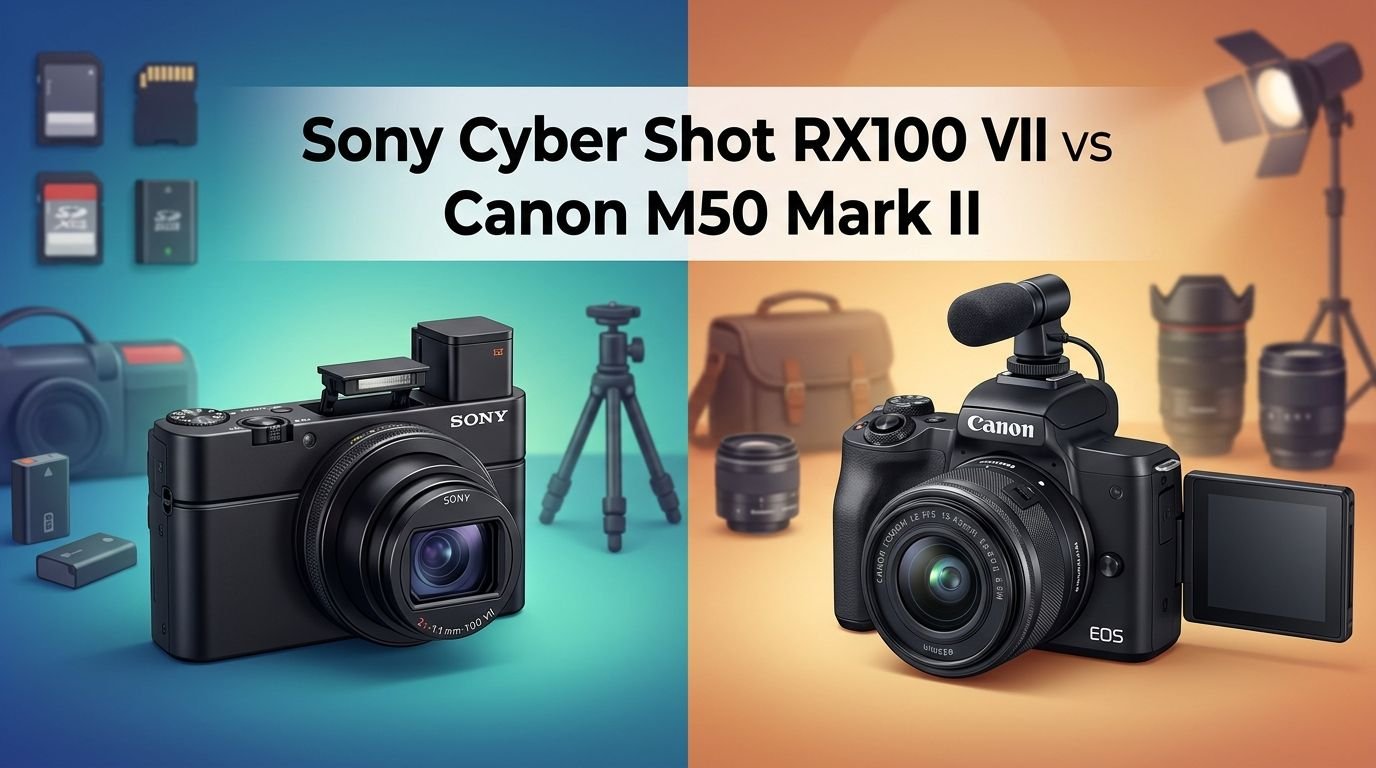
Sony Cyber Shot RX100 VII vs Canon M50 Mark II
Choosing between a premium compact camera and a mirrorless interchangeable lens camera is not easy.
The Sony Cyber Shot RX100 VII and the Canon M50 Mark II sit at similar price points but serve very different types of photographers. One fits in your pocket. The other gives you room to grow with different lenses.
Both cameras deliver solid image quality, 4K video recording, and fast autofocus systems. But the differences between a 1 inch sensor compact and an APS-C mirrorless body are significant. Your decision will depend on what you shoot, how you shoot, and where you plan to take your camera.
Key Takeaways
- The Sony RX100 VII uses a 1 inch stacked CMOS sensor with 20.1 megapixels. The Canon M50 Mark II features a larger APS-C CMOS sensor with 24.1 megapixels. The bigger sensor on the Canon captures more light and produces better image quality in low light conditions.
- The RX100 VII is a true pocket camera. It weighs just 302 grams and measures 101.6 x 58.1 x 42.8 mm. The Canon M50 Mark II weighs 387 grams (body only) and requires a separate lens. Portability goes to the Sony without question.
- Autofocus speed favors the Sony. The RX100 VII offers 357 phase detection AF points and acquires focus in just 0.02 seconds. The Canon M50 Mark II uses Dual Pixel CMOS AF with 143 AF zones, which is fast but not quite as advanced.
- The Canon M50 Mark II accepts interchangeable EF-M lenses. This gives you creative freedom to use wide angle, telephoto, and prime lenses. The Sony has a fixed 24 to 200mm zoom lens built in, which is versatile but not expandable.
- Both cameras record 4K video, but with trade-offs. The Canon M50 Mark II crops heavily in 4K mode and lacks Dual Pixel AF at that resolution. The Sony RX100 VII records 4K with full autofocus support and less cropping.
- The Canon M50 Mark II costs less and delivers excellent value for beginners. The Sony RX100 VII commands a premium price for its advanced technology packed into a compact body.
Sony Cyber Shot RX100 VII Overview

The Sony Cyber Shot RX100 VII launched in 2019 as the seventh generation of Sony’s beloved RX100 line. It packs the technology of Sony’s flagship Alpha A9 into a camera body that fits in your jacket pocket. The camera uses a 20.1 megapixel 1 inch stacked CMOS sensor paired with the BIONZ X image processor.
Sony gave this camera a 24 to 200mm equivalent Zeiss Vario Sonnar T zoom lens* with an aperture range of f/2.8 to f/4.5. This focal range covers everything from wide landscapes to tight telephoto shots. The built in OLED electronic viewfinder pops up from the body for bright daylight shooting.
The RX100 VII captures 20 frames per second with continuous autofocus and zero viewfinder blackout. It also features a unique single burst shooting mode that fires 90 frames per second for seven frames. This makes it surprisingly capable for sports and action photography.
Pros:
- Ultra compact and pocketable design
- 24 to 200mm zoom range covers most situations
- 20 fps continuous shooting with AF tracking
- 4K video with full phase detection autofocus
- Built in pop up electronic viewfinder
- Real time eye AF for people and animals
Cons:
- Small 1 inch sensor limits low light performance
- Premium price tag for a compact camera
- Short battery life at roughly 260 shots per charge
- No external microphone jack on base model
- Small grip makes handling difficult during long shoots
Canon M50 Mark II Overview

The Canon EOS M50 Mark II arrived in late 2020 as an update to the popular original M50. Canon positioned it as an entry level mirrorless camera for content creators, vloggers, and beginner photographers. It uses a 24.1 megapixel APS-C CMOS sensor with the DIGIC 8 image processor.
The camera comes with the EF-M 15 to 45mm f/3.5 to 6.3 IS STM kit lens. It supports Canon’s full range of EF-M mount lenses. You can also use EF and EF-S lenses with an adapter. The vari-angle touchscreen flips forward for selfies and vlogging.
Canon added improved Dual Pixel CMOS AF with eye detection AF to this model. The M50 Mark II also gained better vertical video support and live streaming features over the original M50. It shoots up to 10 frames per second in burst mode with servo AF.
Pros:
- Larger APS-C sensor delivers better image quality and dynamic range
- Interchangeable lens system offers creative flexibility
- Vari-angle touchscreen is perfect for vlogging
- Strong Dual Pixel CMOS AF with eye detection
- Built in microphone input for external audio
- Affordable price point for a mirrorless camera
Cons:
- Heavy 4K crop reduces field of view significantly
- No Dual Pixel AF available in 4K video mode
- EF-M lens system has a limited future (Canon shifted to RF mount)
- No in body image stabilization
- Limited burst shooting speed compared to Sony
- Electronic viewfinder resolution is just 2.36 million dots
Sensor Size and Image Quality
The Canon M50 Mark II has a clear advantage in sensor size. Its APS-C sensor measures 22.3 x 14.9 mm. The Sony RX100 VII uses a 1 inch sensor that measures 13.2 x 8.8 mm. A larger sensor captures more light per pixel and produces images with better dynamic range, less noise, and smoother bokeh.
In practical terms, the Canon produces cleaner images at ISO 1600 and above. The Sony starts showing noticeable noise around ISO 800 to 1600 depending on the scene. For daylight photography, both cameras deliver sharp and colorful results.
The Canon’s 24.1 megapixel resolution also edges out the Sony’s 20.1 megapixels. This gives you slightly more room to crop images in post production. Color science differs between the two brands. Canon produces warmer, more pleasing skin tones out of the camera. Sony leans toward a neutral and slightly cooler color profile.
Both cameras shoot in RAW format, which gives you full control during editing. The Canon’s RAW files contain more data thanks to the larger sensor. If image quality is your top priority, the Canon M50 Mark II wins this category.
Autofocus Performance
The Sony RX100 VII dominates in autofocus performance. It uses 357 focal plane phase detection AF points along with 425 contrast detection points. The combined system covers approximately 68% of the image frame. Focus acquisition takes just 0.02 seconds, making it one of the fastest compact cameras ever made.
Sony’s Real Time Tracking AF locks onto subjects and follows them across the frame. Real Time Eye AF works for both humans and animals. This technology comes directly from Sony’s professional Alpha cameras.
The Canon M50 Mark II uses Dual Pixel CMOS AF with 143 AF zones covering approximately 88% of the frame horizontally and 100% vertically. It performs well in most situations and includes eye detection AF for still photos and 1080p video.
However, the Canon loses Dual Pixel AF in 4K video mode. It falls back to slower contrast detection AF, which hunts for focus more often. The Sony maintains full phase detection AF in all video modes.
For action photography, sports, wildlife, and fast moving subjects, the Sony RX100 VII is the better choice. The Canon handles portraits, street photography, and casual shooting just fine.
Video Recording Capabilities
Both cameras record 4K video at 24 and 25 frames per second. The Sony RX100 VII records 4K with full pixel readout and minimal rolling shutter. It supports S-Log2 and S-Log3 picture profiles for color grading. You also get high frame rate 1080p recording at up to 120 fps for slow motion footage.
The Canon M50 Mark II records 4K but applies a significant 1.6x crop on top of the existing 1.6x APS-C crop factor. This results in a very narrow field of view. The camera also drops Dual Pixel CMOS AF in 4K mode and switches to contrast detection only.
In 1080p mode at 60 fps, the Canon performs much better. Dual Pixel AF works fully, and the image quality is solid. Many Canon M50 Mark II users stick with 1080p for this reason.
The Sony RX100 VII offers a better overall video experience. It maintains autofocus in all video modes, handles 4K with less crop, and provides professional color profiles. For YouTube, vlogging, and content creation, the Sony produces more consistent results in 4K.
The Canon fights back with its vari-angle screen and external microphone input. The base model RX100 VII lacks a mic input, though the shooting grip kit version adds one. The vari-angle screen on the Canon is far more useful for solo content creators who film themselves.
Lens Options and Flexibility
This is where the two cameras differ the most. The Canon M50 Mark II is an interchangeable lens camera. You can swap lenses based on your needs. Canon’s EF-M lens lineup includes wide angle, standard zoom, telephoto, and macro options. You can also adapt Canon’s extensive EF and EF-S lens library with the EF-EOS M adapter.
The Sony RX100 VII has a fixed 24 to 200mm equivalent lens. You cannot change it. This Zeiss branded zoom covers a wide range from landscapes to distant subjects. The lens is optically excellent for its size, with sharp results across the zoom range.
The fixed lens approach has benefits. The camera stays compact and sealed. You never worry about dust on the sensor or carrying extra glass. The 24 to 200mm range handles travel, street, portrait, and wildlife photography in a single unit.
The Canon offers more creative control. A fast prime lens like the EF-M 22mm f/2 creates beautiful background blur that the Sony cannot match. A long telephoto like the EF-M 55 to 200mm extends your reach. However, lenses add weight, bulk, and cost.
If you value portability and simplicity, the Sony’s fixed lens is a strength. If you want creative freedom and growth potential, the Canon’s interchangeable system is the better choice.
Portability and Build Quality
The Sony RX100 VII is one of the smallest and lightest cameras with a 1 inch sensor. It measures 101.6 x 58.1 x 42.8 mm and weighs 302 grams with the battery and memory card. You can slide it into a pants pocket or a small bag. The body is made from a combination of magnesium alloy and high quality plastic.
The Canon M50 Mark II measures 116.3 x 88.1 x 58.7 mm and weighs 387 grams body only. Add the 15 to 45mm kit lens and the total weight goes above 500 grams. It does not fit in a pocket. You will need a camera bag or neck strap.
The Canon has a comfortable grip that makes it easier to hold for long periods. The Sony’s flat body can feel slippery without an aftermarket grip. Sony sells a shooting grip accessory to help with handling.
Neither camera offers weather sealing. Both cameras feel well built for their respective categories. The Canon has a more traditional camera feel with dedicated dials and buttons. The Sony relies more on menus and multi-function controls due to its compact size.
For travel, hiking, and everyday carry, the Sony RX100 VII wins on portability. For extended shooting sessions and comfortable handling, the Canon M50 Mark II is the better pick.
Electronic Viewfinder Comparison
Both cameras include a built in electronic viewfinder (EVF). The Sony RX100 VII features a 2.36 million dot OLED Tru-Finder that pops up from the camera body. It provides a clear and bright image for composing shots in bright sunlight. The pop up design keeps the camera profile slim.
The Canon M50 Mark II also has a 2.36 million dot OLED EVF built into the camera body. It sits in a traditional position above the LCD screen. The Canon’s viewfinder is always accessible and does not require a physical pop up mechanism.
Both viewfinders share the same resolution, so sharpness is similar. The Sony’s OLED panel produces slightly better contrast and more vivid colors. The Canon’s viewfinder has a slightly larger 0.39 inch panel compared to the Sony’s smaller size.
In practical use, both EVFs do their job well. The Sony’s pop up mechanism adds a small delay before shooting. The Canon’s fixed viewfinder is ready at all times. For photographers who use the viewfinder frequently, the Canon’s setup is more convenient.
Display and Touchscreen
The Canon M50 Mark II features a 3 inch vari-angle touchscreen with 1.04 million dots. The vari-angle design lets you flip the screen to the front for vlogging and selfies. You can also tilt it to any angle for low or high shooting positions. The touchscreen supports tap to focus, touch shutter, and menu control.
The Sony RX100 VII has a 3 inch tilting touchscreen with 921,600 dots. It tilts up 180 degrees for selfies and down 90 degrees. However, the tilting mechanism is less flexible than a full vari-angle design. The touchscreen only works for touch focus, not for menu or settings control.
Canon wins this category clearly. The vari-angle screen offers more positioning options. The full touchscreen functionality makes the Canon easier and faster to operate. Content creators and vloggers will appreciate the Canon’s screen much more.
The Sony’s tilting screen works for basic selfie framing but blocks the hot shoe in the fully tilted position. For vlogging, selfie shooting, and flexible composition, the Canon M50 Mark II has the superior display.
Battery Life and Storage
The Sony RX100 VII uses the NP-BX1 battery and delivers approximately 260 shots per charge using the LCD screen. This is below average for most cameras. The small body limits battery size. You will likely need a spare battery for a full day of shooting.
The Canon M50 Mark II uses the LP-E12 battery and lasts for approximately 250 shots per charge with the LCD screen. This is also modest. The Canon does slightly better in live view and video recording time thanks to its more efficient processor.
Both cameras accept SD memory cards (UHS-I compatible). The Sony supports the faster UHS-I standard for reliable 4K recording. The Canon also uses a single SD card slot with UHS-I support.
USB charging is available on both cameras. The Sony charges through its Micro USB port. The Canon uses a Micro USB connection as well. You can top up the batteries using a portable power bank during travel, which helps offset the short battery life on both models.
For extended shooting, carry at least one or two spare batteries for either camera.
Connectivity and Wireless Features
Both cameras offer Wi-Fi and Bluetooth connectivity. The Sony RX100 VII connects to the Sony Imaging Edge Mobile app for remote control, image transfer, and GPS tagging through your phone. Bluetooth maintains a low power connection for quick transfers.
The Canon M50 Mark II connects to the Canon Camera Connect app. It also offers Bluetooth for easy pairing and Wi-Fi for fast image and video transfer. Canon added live streaming support to the M50 Mark II. You can stream directly to YouTube and Facebook through the camera using Wi-Fi.
The Canon’s live streaming feature is a significant bonus for content creators. The Sony does not support built in live streaming. Both cameras offer clean HDMI output for external recording and streaming through a capture card.
Canon also includes image.canon, a cloud based service for automatic backup. The Sony app works reliably but offers fewer features. For social media sharing and content creation, Canon provides a more complete wireless experience.
Who Should Buy the Sony RX100 VII?
The Sony RX100 VII is perfect for photographers who want maximum performance in the smallest body. Travelers will love its pocket size and 24 to 200mm zoom range. Street photographers can shoot discreetly without drawing attention.
This camera also suits sports and action enthusiasts who need fast autofocus and 20 fps burst shooting. Wildlife photographers who want a light backup camera will find the 200mm reach useful. The 4K video quality with full AF support makes it a strong option for videographers who prioritize portability.
The Sony RX100 VII works best as a secondary camera or a high performance everyday carry. Its price is high for a compact, but the technology inside justifies the cost for the right user.
Who Should Buy the Canon M50 Mark II?
The Canon M50 Mark II is ideal for beginners, vloggers, and content creators on a budget. Its APS-C sensor produces excellent image quality. The interchangeable lens system lets you expand your kit over time.
New photographers will appreciate Canon’s intuitive menu system and easy to learn controls. The vari-angle touchscreen makes vlogging simple. The external microphone input improves audio quality for video. Live streaming support adds extra value for creators who broadcast online.
The Canon M50 Mark II serves as a great first serious camera. It teaches you the fundamentals of photography and videography while delivering results that look professional. The lower price makes it accessible to a wider audience.
Final Verdict: Sony RX100 VII vs Canon M50 Mark II
These two cameras serve different purposes. The Sony RX100 VII wins on portability, autofocus speed, 4K video quality, and zoom range. The Canon M50 Mark II wins on image quality, lens flexibility, display usability, price, and beginner friendliness.
Choose the Sony if you want a high performance pocket camera for travel and everyday shooting. Choose the Canon if you want an affordable mirrorless camera with room to grow and excellent vlogging features.
Both cameras remain strong choices in their respective categories. Your final pick depends on whether you value size or versatility more.
Frequently Asked Questions
Is the Sony RX100 VII better than the Canon M50 Mark II for photography?
The Canon M50 Mark II produces better overall image quality because of its larger APS-C sensor. It captures more detail, handles noise better at high ISO values, and creates smoother background blur with the right lenses. The Sony RX100 VII offers faster autofocus and a more versatile built in zoom lens. For pure image quality, the Canon wins. For speed and convenience, the Sony has the edge.
Which camera is better for YouTube and vlogging?
The Canon M50 Mark II is the better vlogging camera overall. It features a fully articulating vari-angle screen, an external microphone input, and live streaming support. The Sony RX100 VII records better 4K video with full autofocus, but its tilting screen and lack of a mic input (on the base model) limit its vlogging appeal.
Can the Sony RX100 VII replace a mirrorless camera?
The Sony RX100 VII can serve as a capable primary camera for casual and travel photography. Its 24 to 200mm zoom range covers most shooting situations. However, its 1 inch sensor cannot match the low light performance and depth of field control of an APS-C or full frame mirrorless camera. It works best as a high quality compact or a backup camera.
Is the Canon M50 Mark II still worth buying?
Yes. The Canon M50 Mark II remains a strong option for beginners and content creators. Its image quality, autofocus system, and ease of use are still competitive. The main concern is that Canon has shifted focus to the RF mount system, so the EF-M lens lineup may not see new additions. Existing EF-M lenses still work great, and you can adapt EF lenses for more options.
Which camera has better battery life?
Both cameras have similar battery life. The Sony RX100 VII lasts about 260 shots per charge. The Canon M50 Mark II lasts about 250 shots. Neither camera excels in this area. Carrying a spare battery is a smart idea for both models during longer shooting sessions.
Can I use Canon EF lenses on the M50 Mark II?
Yes. Canon offers the EF-EOS M adapter that lets you mount full size EF and EF-S lenses on the M50 Mark II. Autofocus performance remains strong with most modern Canon lenses. The adapter adds some size and weight, but it greatly expands your lens options.