Potensic ATOM SE GPS Drone Review 2026: Is It Still Worth It?
Are you looking for a lightweight, pocket-friendly drone that shoots stunning 4K video without breaking the bank? The Potensic ATOM SE GPS Drone has been a fan favorite among budget drone pilots since its launch.
It weighs under 249 grams, packs a 4K EIS camera, flies for up to 31 minutes, and offers GPS auto return. But with new competitors entering the market in 2026, does the ATOM SE still hold its own?
In this full review, we break down everything you need to know. We cover the camera quality, flight performance, build, app experience, and real-world results.
Key Takeaways:
- Under 249 grams takeoff weight means you do not need to register with the FAA in the United States or equivalent agencies in most countries. This saves time, money, and paperwork, and lets you fly in more places with fewer restrictions.
- 4K video at 30fps with ShakeVanish EIS delivers smooth, vibration-free footage. The Sony 12MP CMOS sensor captures sharp photos in both JPG and RAW (DNG) formats. You get impressive image quality for a drone at this price point.
- Up to 31 minutes of flight time on a single 2,500 mAh battery gives you plenty of air time. The Fly More Combo bundles two or three batteries, pushing total flight time to 62 or 93 minutes.
- 4 km FPV transmission range through the Pixsync 2.0 system provides stable 720p live video feed on your phone. The signal stays strong and clear in most open-area conditions.
- GPS, GLONASS, and BeiDou satellite support ensures quick, accurate positioning. Auto Return to Home activates on low battery, signal loss, or with a single button press for worry-free flying.
- Three flight modes (Video, Normal, Sport) let you adjust speed and responsiveness. Sport mode hits a top speed of 16 m/s, while Video mode prioritizes cinematic smoothness. This drone suits casual flyers and creative content creators alike.

Potensic ATOM SE GPS Drone: Design and Build Quality
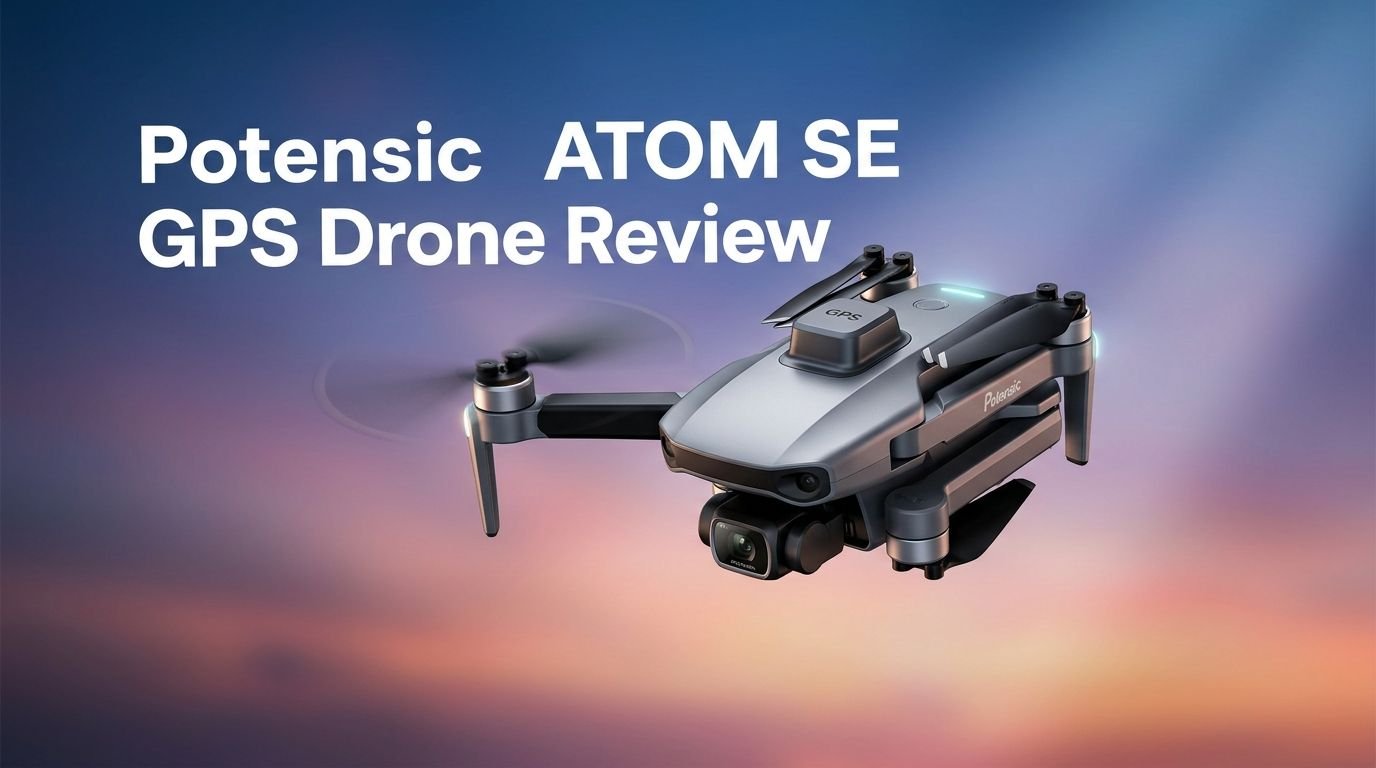
The Potensic ATOM SE uses a foldable design that shrinks down to just 3.46 x 5.63 x 2.28 inches. It fits inside a jacket pocket or a small carrying case. The drone unfolds to 11.8 x 9.45 x 2.28 inches, which gives the propellers enough span for stable hovering.
The body is made from durable plastic. It feels solid in the hand without adding unnecessary weight. At just 244 to 245 grams with battery, it stays comfortably under the 249-gram threshold. This weight classification matters a lot. It means fewer regulations, no registration requirement in many regions, and more freedom to fly.
The arms fold inward with a firm click. They do not feel loose or flimsy. Each arm has a brushless motor that runs quieter and lasts longer than brushed alternatives. The propellers attach easily and spin up fast.
On the bottom, you will find a downward vision sensor and a Time-of-Flight (ToF) sensor. These help the drone hold its position indoors or in GPS-denied areas. The overall build inspires confidence for a drone at this price range.
4K Camera Performance and Image Quality
The ATOM SE carries a Sony 12MP CMOS sensor with a 118-degree field of view. It records 4K video at 30 frames per second. Still photos come out at 12 megapixels in JPG or RAW DNG format.
RAW shooting is a standout feature at this price. It gives you much more flexibility in post-processing. You can adjust white balance, shadows, and highlights without destroying image data. Most budget drones only offer compressed JPG files.
The ShakeVanish Electronic Image Stabilization (EIS) does a solid job of smoothing out vibrations and jitter. It is not a mechanical gimbal, so you will not get the same butter-smooth results as a DJI Mini 3. But for a sub-$300 drone, the footage looks remarkably clean and stable.
The camera angle adjusts from +20 to -90 degrees, letting you tilt upward slightly or point straight down. This range covers most common aerial photography angles. Colors appear natural, and detail holds up well in good lighting. Low-light performance is average, as expected at this price tier.
Flight Performance and Stability
The Potensic ATOM SE flies with confidence. The SurgeFly Flight Control System keeps the drone responsive and predictable. Three flight modes let you match the drone’s behavior to your skill level and creative goals.
Video mode slows everything down. The drone moves gently, and turns are smooth. This mode is ideal for cinematic shots where steady motion matters most. Normal mode offers a balanced experience. Sport mode unlocks the full speed of 16 m/s (about 36 mph), and the drone accelerates from zero to top speed in just 2.8 seconds.
Wind resistance is decent for a sub-250g drone. It handles light to moderate breezes without drifting off course. In stronger winds, you will notice the drone working harder to hold position. This is normal for any ultralight aircraft.
The brushless motors provide smooth, responsive thrust. Hovering is steady thanks to the GPS lock and downward sensors. The drone holds altitude and position well, even at higher altitudes where wind picks up.
Top 3 Alternatives for Potensic ATOM SE GPS Drone
If you want to compare the ATOM SE against other popular options, here are three strong alternatives worth considering.
1. DJI Mini 2 SE

2. Holy Stone HS720G

3. Ruko F11GIM2

GPS and Satellite Navigation System
The Potensic ATOM SE uses a triple-satellite system: GPS, GLONASS, and BeiDou. This means the drone can lock onto more satellites at once, regardless of your location on the globe. The result is faster satellite acquisition and more accurate positioning.
In open areas, the drone typically locks onto 10 or more satellites within a minute of powering on. This fast lock-on reduces wait time before takeoff. Once airborne, the drone maintains a precise hover with minimal drift.
The satellite system also powers the Auto Return to Home feature. If the drone loses connection with the controller or the battery drops to a critical level, it flies back to the recorded takeoff point automatically. You can also trigger this manually with a dedicated button on the remote controller.
Waypoint mode lets you plot a flight path on the app. The drone follows the route on its own while you focus on camera work. Orbit mode circles a point of interest. These GPS-based intelligent flight modes add creative value without needing advanced piloting skills.
Battery Life and Charging
Each ATOM SE battery holds 2,500 mAh at 7.2V (18 Wh). Potensic rates the maximum flight time at 31 minutes per charge. Real-world results typically land between 25 and 28 minutes, depending on wind conditions and flight mode.
The battery weighs 103 grams and slides into the rear of the drone. It charges via a USB-C cable. A full charge takes roughly 60 to 90 minutes. The Fly More Combo (ASIN: B0CBLQDJ98) includes extra batteries and a fast parallel charging hub. This combo pushes total flight time to 62 or 93 minutes, depending on the package you choose.

The parallel charging hub is a smart addition. It charges multiple batteries at the same time, so you spend less time waiting between sessions. Battery indicators on the controller and in the app keep you informed of remaining power at all times.
Remote Controller and Range
The ATOM SE remote controller has a clean, ergonomic layout. It holds your smartphone in a top-mounted clamp. Physical joysticks give you precise control over flight direction, altitude, and camera tilt.
Dedicated buttons include one-key takeoff, one-key landing, Return to Home, and a speed switch. The learning curve is gentle. Most beginners feel comfortable within their first flight session.
The controller connects to the drone through Pixsync 2.0 transmission. The maximum control range reaches 4 km (about 2.5 miles) in open, interference-free conditions. The live FPV video feed streams at 720p resolution to your phone screen. Signal strength remains strong within 1 to 2 km for most users.
The controller runs on its own internal battery and lasts several flight sessions on a single charge. It feels lightweight but solid. The joysticks are removable for easier storage and transport.
Potensic Fly App Experience
The Potensic Fly app is available for both iOS and Android devices. It serves as your live camera feed, flight control dashboard, and editing suite all in one. The interface is clean and easy to understand.
You can access all intelligent flight modes through the app. These include Waypoint, Orbit, and Follow Me. Waypoint lets you tap points on a map, and the drone flies the route. Orbit circles a selected point. Follow Me keeps the drone trained on your phone’s GPS signal as you move.
Camera settings live in the app as well. You can switch between photo and video modes, adjust resolution, toggle EIS on or off, and choose between JPG and RAW formats. A histogram display helps you judge exposure in real time.
The app also stores a flight log. You can review past flights, check distances, and monitor battery consumption trends. Firmware updates push through the app, keeping your drone current with the latest features and fixes.
Intelligent Flight Modes
The ATOM SE offers several smart flight modes that make capturing creative footage easier. You do not need expert piloting skills to use them.
Waypoint Mode lets you draw a path on the map inside the app. The drone follows the exact route at a set altitude and speed. This is perfect for repeatable shots over landscapes, buildings, or events.
Orbit Mode selects a center point and circles around it at a fixed distance and altitude. You get smooth, cinematic rotation shots without touching the joysticks. It works well for showcasing architecture, landmarks, or vehicles.
Follow Me Mode uses GPS to track your phone’s location. The drone follows you as you walk, run, bike, or drive. The tracking is GPS-based rather than vision-based, so it works best in open areas without obstacles.
One-Key Takeoff and Landing simplify the start and end of every flight. Headless Mode removes orientation confusion for beginners. The drone moves relative to the controller’s position rather than its own front-facing direction.
Who Should Buy the Potensic ATOM SE?
This drone fits a specific audience very well. Beginners benefit from the simple setup, auto return, and forgiving flight characteristics. If you have never flown a drone before, the ATOM SE will not overwhelm you.
Travel content creators will appreciate the tiny footprint and sub-249g weight. You can toss it in a daypack and forget about it until you find an incredible view. The 4K camera delivers footage that looks great on social media platforms like YouTube, Instagram, and TikTok.
Budget-conscious hobbyists get a lot of value here. GPS positioning, 4K EIS video, RAW photo support, and 31-minute flight time are features that cost twice as much in other brands. The ATOM SE punches above its weight class in terms of features per dollar.
However, this drone may not satisfy advanced pilots who want obstacle avoidance sensors, a mechanical gimbal, or 4K60 video. It also lacks ActiveTrack-style visual subject tracking. If you need those features, you should look at the DJI Mini 3 or higher-end models.
Potensic ATOM SE vs DJI Mini 2 SE
This is the comparison most shoppers want to see. Both drones weigh under 249 grams. Both record video and both offer GPS features. But the differences matter.
The DJI Mini 2 SE uses a 3-axis mechanical gimbal. This delivers smoother, more professional footage than the ATOM SE’s electronic stabilization. DJI also offers a more polished app experience with OcuSync 2.0 transmission reaching up to 10 km.
The Potensic ATOM SE fights back on price. It costs significantly less than the DJI Mini 2 SE while still offering 4K video (the Mini 2 SE caps at 2.7K). The ATOM SE also shoots RAW photos, which the Mini 2 SE does not.
If budget is your top priority and you want 4K resolution, the ATOM SE wins. If you value stabilization quality, app polish, and brand reliability, the DJI Mini 2 SE is hard to beat. Both drones are excellent choices for casual pilots and hobbyists.
Pros and Cons of the Potensic ATOM SE
Pros:
The drone weighs under 249 grams, so registration is not required in most countries. The 4K EIS camera with RAW support delivers strong image quality at this price. Flight time of 31 minutes per battery is generous. The triple-satellite GPS system locks on fast and holds position accurately. The foldable design fits in a pocket or small bag. The Fly More Combo offers great value with extra batteries and a charging hub.
Cons:
Electronic image stabilization is not as smooth as a mechanical gimbal. Low-light video shows visible noise and grain. There are no obstacle avoidance sensors, so you must pilot carefully near trees and buildings. Follow Me mode tracks GPS only, not visual subjects. The app can feel sluggish on older smartphones. The controller lacks a built-in screen, so you depend on your phone.
Final Verdict: Is the Potensic ATOM SE Worth Buying in 2026?
The Potensic ATOM SE GPS Drone remains a strong contender in the budget drone market in 2026. It delivers an impressive set of features for its price. The 4K camera with EIS captures clean, usable footage. The GPS system works reliably. Battery life is solid. The compact, foldable design makes it one of the most portable drones available.
It does not replace higher-end models from DJI or Autel. You will notice the difference in stabilization, obstacle avoidance, and app quality. But for the money, the ATOM SE offers outstanding value. It is a perfect first drone, a reliable travel companion, and a capable tool for social media content.
If you want 4K aerial footage without spending $400 or more, the Potensic ATOM SE earns a strong recommendation. Pair it with the Fly More Combo for the best experience and the longest flight sessions.
Frequently Asked Questions
Does the Potensic ATOM SE require FAA registration?
No. The Potensic ATOM SE weighs under 249 grams. In the United States, drones under 250 grams flown recreationally do not require FAA registration. Rules may vary in other countries, so check your local regulations before flying.
How far can the Potensic ATOM SE fly?
The maximum control range is 4 km (approximately 2.5 miles) in open, interference-free conditions. The FPV video transmission also covers this range at 720p resolution. Real-world range may vary based on obstacles and signal interference.
Can the Potensic ATOM SE shoot RAW photos?
Yes. The camera supports RAW (DNG) format alongside standard JPG. RAW files give you greater flexibility in photo editing software like Lightroom or Photoshop. This feature is rare in drones at this price point.
Does the Potensic ATOM SE have obstacle avoidance?
No. The ATOM SE does not include obstacle avoidance sensors. It has downward vision and ToF sensors for position holding, but it cannot detect or avoid objects in front, behind, or to the sides. Always fly with a clear line of sight.
How long does the battery take to charge?
A single 2,500 mAh battery charges fully in approximately 60 to 90 minutes via USB-C. The Fly More Combo includes a parallel charging hub that charges multiple batteries at the same time, reducing total wait time between flying sessions.
Is the Potensic ATOM SE good for beginners?
Yes. The ATOM SE is one of the best beginner drones available. GPS hover hold, Auto Return to Home, one-key takeoff and landing, and a simple remote controller make it easy to learn. The Potensic Fly app walks you through calibration and setup in minutes.