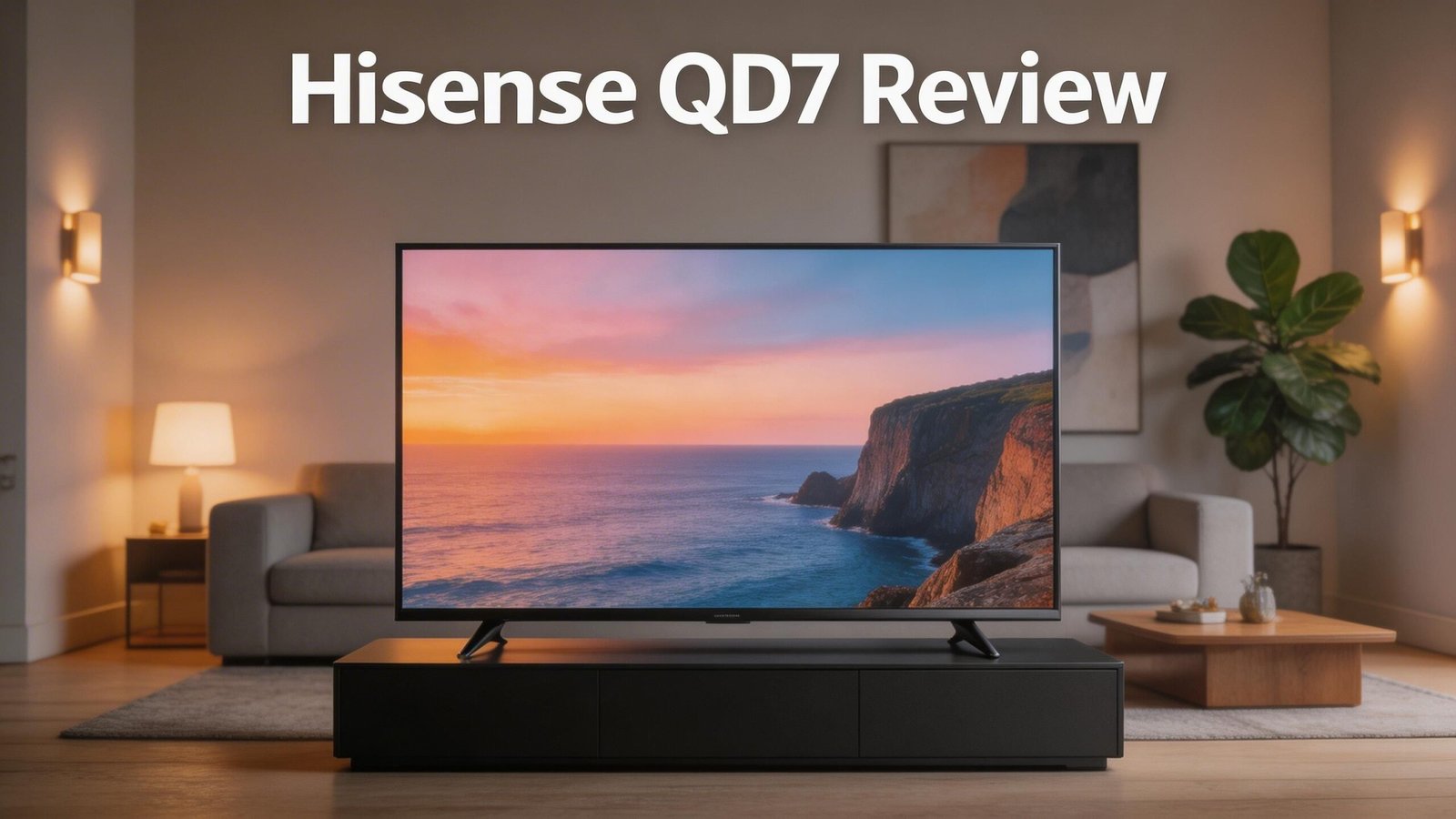
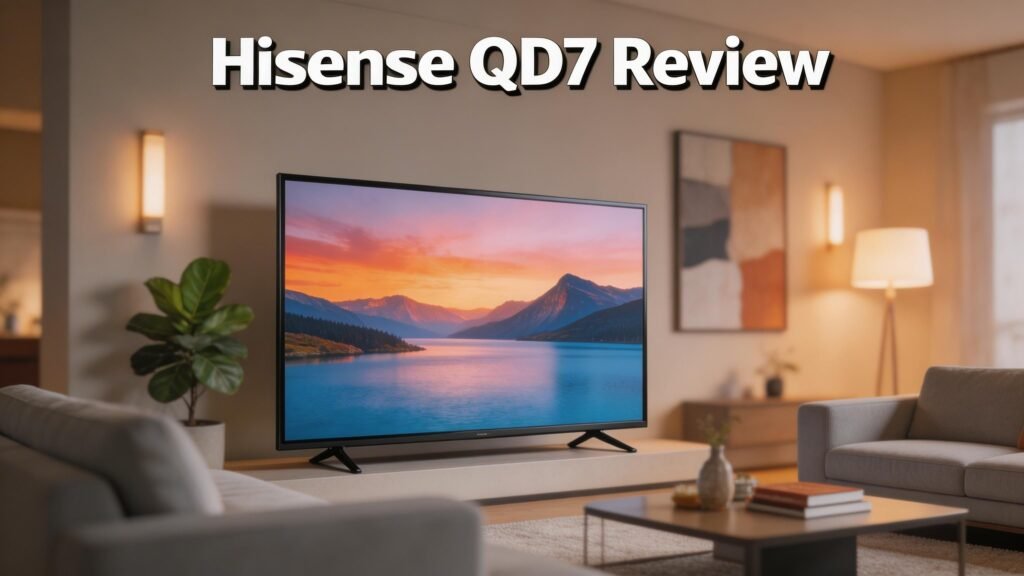
Hisense QD7 Review 2026: Is This the Best Mini LED TV?
Are you looking for a 4K TV that delivers stunning picture quality without emptying your wallet? The Hisense QD7 has taken the budget TV market by storm.
It packs Mini LED backlighting, QLED Quantum Dot color, and a native 144Hz refresh rate into a surprisingly affordable package. CNET even named it the best budget TV in late 2025, replacing the Samsung DU7200.
But does it really live up to the hype? In this detailed Hisense QD7 review for 2026, we break down everything you need to know.
Key Takeaways:
- The Hisense QD7 uses Mini LED backlighting with QLED Quantum Dot technology. This combination produces bright highlights, deep blacks, and over one billion color shades. It delivers picture quality that punches well above its price class.
- A native 144Hz refresh rate supports smooth motion for sports and gaming. The TV also includes HDMI 2.1 bandwidth, Variable Refresh Rate (VRR), and Auto Low Latency Mode (ALLM). These features make it a solid choice for PS5 and Xbox Series X owners.
- It comes in six size options: 50″, 55″, 65″, 75″, 85″, and 100″. This wide range means you can find a model that fits any room. Prices start at around $260 for the 50″ model and scale up from there.
- Dolby Vision HDR and Dolby Atmos audio are both supported. You get premium format support that many competitors skip at this price point. HDR content looks vibrant and punchy.
- Peak brightness reaches around 600 nits. This is solid for a budget TV and helps combat glare in moderately lit rooms. It also enhances HDR highlight detail.
- Smart TV features run on Fire TV (QD7QF) or Google TV (QD7N) depending on the model. Both platforms offer access to all major streaming apps and voice assistant support through Alexa or Google Assistant.

Hisense QD7 Overview and First Impressions
The Hisense QD7 is a budget friendly 4K Mini LED TV that launched in 2025 and continues to be a top seller in 2026. It sits below the Hisense U7 series in the company’s lineup. Yet it borrows several premium features from higher end models.
The TV feels solid and well built despite its low price. The bezels are thin, and the overall design looks clean and modern. You would not guess this is a budget model just by looking at it.
Setup is quick and straightforward. The stand assembly takes about ten minutes. The included remote is compact and easy to use. It features dedicated buttons for popular streaming services.
First impressions of the picture quality are genuinely impressive. Colors pop immediately out of the box. The Mini LED backlight creates noticeable contrast improvements over standard LED TVs. Dark scenes look deeper, and bright areas carry real punch.
This TV ships in two variants. The QD7N runs Google TV, while the QD7QF runs Amazon Fire TV. Both platforms work well, though the interface and app selection differ slightly. Choose the one that matches your existing ecosystem.
Picture Quality and HDR Performance
The Hisense QD7 delivers surprisingly good picture quality for its price. The QLED Quantum Dot layer produces vivid and accurate colors. Reds, greens, and blues appear rich without looking oversaturated in most viewing modes.
Mini LED backlighting is the real star here. It uses hundreds of local dimming zones to control brightness across different parts of the screen. The 50″ and 55″ models get around 128 to 160 zones. Larger models get even more. This results in better contrast than standard LED TVs at similar prices.
HDR performance is a highlight. The TV supports Dolby Vision, HDR10, HDR10+, and HLG formats. Peak brightness reaches approximately 600 nits. This is enough to make HDR highlights look bright and detailed. Sunsets glow, explosions sparkle, and specular highlights feel realistic.
SDR content also looks good. The TV handles upscaling well, making 1080p and 720p sources look crisp on the 4K panel. Standard definition content benefits from the processing too, though it cannot perform miracles with very low quality sources.
One area to watch is blooming around bright objects on dark backgrounds. This is common with all local dimming TVs. The QD7 handles it reasonably well, but sensitive viewers may notice halos during certain scenes.
Top 3 Alternatives for Hisense QD7


Gaming Features and Console Compatibility
The Hisense QD7 packs serious gaming features for a budget TV. It includes two HDMI 2.1 ports that support 4K resolution at up to 144Hz. This makes it compatible with the PS5, Xbox Series X, and modern gaming PCs.
Variable Refresh Rate (VRR) is supported. This helps reduce screen tearing during gameplay. Auto Low Latency Mode (ALLM) automatically switches to game mode when you turn on a compatible console. You do not need to change settings manually.
Input lag is impressively low in Game Mode. Gaming feels responsive, and button presses translate to on screen action quickly. This matters for competitive titles like first person shooters and fighting games.
The one drawback is pixel response time. RTINGS noted that the QD7 has slower response times compared to pricier options. Fast moving objects can show some motion blur. This is most noticeable in very fast paced games.
Display Technology: Mini LED and QLED Explained
The Hisense QD7 combines two key display technologies that work together to improve picture quality. Understanding them helps you appreciate what this TV offers.
Mini LED refers to the backlight system. Traditional LED TVs use a smaller number of large LEDs behind the screen. Mini LED TVs use hundreds or even thousands of tiny LEDs. These smaller LEDs allow for more precise control over brightness in different parts of the image. Bright areas stay bright while dark areas stay dark. The result is better contrast and fewer blooming artifacts.
QLED stands for Quantum Dot LED. This technology uses a layer of microscopic particles called quantum dots. These particles convert the backlight into purer and more saturated colors. The QD7 can produce over one billion color shades thanks to this quantum dot layer. Colors appear more lifelike and vibrant compared to standard LED TVs.
Sound Quality and Audio Features
The Hisense QD7 comes with a built in 20W 2.0 channel speaker system on most models. The 100″ QD7N model upgrades to a 2.1 channel setup with a dedicated subwoofer. Audio quality is decent for everyday TV watching.
Dolby Atmos support is included. This creates a virtual surround sound effect that adds depth and dimension to audio. You can hear rain falling overhead and footsteps moving around you during supported content. It is a nice addition at this price.
Dialog clarity is a strength. Voices come through clearly during movies and TV shows. You should not need to crank up the volume to understand what characters are saying.
However, bass output is limited. The small built in speakers struggle with deep low end. Explosions, rumbling engines, and dramatic music scores lack the impact you would get from a soundbar or home theater system.
Smart TV Platform and Streaming Apps
The Hisense QD7 is available with two smart TV platforms. The QD7N models use Google TV. The QD7QF models use Amazon Fire TV. Both platforms are mature, well supported, and offer access to thousands of apps.
Google TV provides a clean, content first interface. It surfaces recommendations from your streaming services on the home screen. It supports Google Assistant for voice control. You can search for shows, control smart home devices, and get answers to questions using just your voice.
Amazon Fire TV integrates deeply with the Alexa ecosystem. If you already own Echo devices or use Amazon Prime Video frequently, this platform feels familiar. Alexa voice control works through the remote and can also manage smart home devices.
Both platforms support all major streaming apps. Netflix, Disney+, Hulu, HBO Max, Apple TV+, YouTube, and Peacock are all available. App loading times are snappy, and the interface runs smoothly without noticeable lag.
Available Sizes and Pricing
The Hisense QD7 comes in six screen sizes to fit different rooms and budgets. This is one of the widest size ranges you will find in a single budget TV series.
The 50″ model (50QD7QF) starts at around $260 to $290. This is an excellent option for bedrooms, offices, or smaller living spaces. It offers the same core technology as larger models.
The 55″ model (55QD7QF) typically sells for around $300 to $350. It adds a bit more screen area without a huge price increase. This is a popular choice for apartments and mid sized rooms.
The 65″ model (65QD7QF) hits the sweet spot for many buyers at approximately $400 to $500. This is the most commonly purchased size and offers a great balance of screen area and price.
Moving up, the 75″ model (75QD7QF) costs roughly $550 to $700. The 85″ model (85QD7QF) typically runs between $800 and $1,000. These larger sizes deliver an immersive viewing experience for bigger living rooms.
The 100″ model (100QD7QF) brings a truly cinematic experience. Pricing varies but it remains remarkably affordable for a 100 inch TV. It provides a massive screen that rivals short throw projectors.
Prices fluctuate throughout the year. Amazon, Best Buy, Costco, and Walmart all carry the QD7 series. Watch for sales during Prime Day, Black Friday, and holiday events for the best deals.
Build Quality and Design
The Hisense QD7 has a sleek and modern design that looks good in any room. The bezels around the screen are thin. This gives the TV a premium appearance that exceeds expectations for a budget model.
The back panel is made from textured plastic. It feels sturdy and well assembled. Cable management is straightforward, with inputs neatly arranged along the side and bottom of the panel.
The included stand is a simple pedestal style base. It holds the TV securely and does not require a very wide surface. This is helpful if your TV stand or entertainment center has limited width.
VESA mount compatibility is standard across all sizes. You can easily wall mount the QD7 using a compatible bracket. The TV is relatively lightweight for its size, which makes wall mounting easier.
Hisense QD7 vs Hisense U7: Which Should You Choose?
This is one of the most common questions budget TV buyers ask. The Hisense U7 series sits one tier above the QD7 in the Hisense lineup. It costs more, but it delivers better performance in several areas.
The U7 is brighter. It achieves higher peak brightness in both SDR and HDR content. This makes it a better choice for rooms with lots of natural light or direct sunlight. The QD7’s 600 nit peak brightness is good, but the U7 surpasses it noticeably.
Reflection handling is better on the U7. It has improved anti glare processing that reduces the impact of ambient light on the screen. If your TV faces a window, the U7 will perform better during daytime viewing.
Both TVs share similar gaming features. They include HDMI 2.1, 4K at 144Hz, VRR, and ALLM. Gaming performance is comparable, though the U7 may have slightly better response times.
The key question is value. According to comparison reviews, the QD7 delivers about 90% of the U7’s performance at roughly 73% of the cost. For most viewers, those savings make the QD7 the smarter purchase. The differences are real but subtle in everyday use.
Viewing Angles and Room Placement Tips
The Hisense QD7 uses a VA type panel. This means it delivers excellent contrast and deep blacks when viewed from directly in front. However, picture quality degrades as you move to the sides.
Colors start to shift and contrast drops when you view the screen at an angle greater than about 25 to 30 degrees from center. This is typical for VA panels and is not unique to the QD7.
For the best experience, position the TV so that primary seating faces the screen directly. If you have a wide seating arrangement, consider angling the TV or using a swivel mount. This helps keep the viewing angle within the optimal range for all viewers.
The TV performs well in moderately lit rooms. Its 600 nit brightness handles ambient light reasonably well. Very bright rooms with direct sunlight on the screen may cause some visibility issues during daytime viewing.
Room size matters too. The 65″ model works well in rooms where the viewing distance is about 7 to 9 feet. The 75″ model is ideal for distances of 8 to 10 feet. Going larger? The 85″ and 100″ models shine in open living spaces with viewing distances of 10 feet or more.
Connectivity and Input Options
The Hisense QD7 offers a well rounded set of connections for a budget TV. You get multiple HDMI ports, USB inputs, and both wired and wireless connectivity options.
Two of the HDMI ports support HDMI 2.1 bandwidth. These handle 4K signals at up to 144Hz with VRR. This is important for next gen gaming consoles and high performance PCs. The remaining HDMI ports are HDMI 2.0, which support 4K at 60Hz.
A USB port lets you connect external storage devices. You can play media files directly from a USB drive, including photos, videos, and music.
Wi Fi connectivity supports dual band (2.4GHz and 5GHz) networks. The 5GHz band provides faster and more stable streaming performance. An Ethernet port is also available for wired connections. Wired connections offer the most reliable streaming experience with no buffering.
Bluetooth support is included. You can connect wireless headphones, soundbars, and other Bluetooth audio devices. This is great for late night viewing without disturbing others.
An optical audio output is available for connecting to older soundbars or AV receivers. A standard 3.5mm headphone jack is also present on most models.
Pros and Cons of the Hisense QD7
Every TV has strengths and weaknesses. Here is a clear look at what the Hisense QD7 does well and where it falls short.
On the positive side, the picture quality is outstanding for the price. Mini LED and QLED technology deliver deep contrast and vibrant colors that rival TVs costing twice as much. The 144Hz native refresh rate and HDMI 2.1 support make it a capable gaming TV. Six size options from 50″ to 100″ give buyers incredible flexibility. Dolby Vision and Dolby Atmos support add premium format compatibility.
The smart TV platforms are mature and reliable. Whether you prefer Google TV or Fire TV, both offer smooth performance and access to all major streaming apps.
On the negative side, the pixel response time is slow. Fast motion can look blurry, which affects both sports and gaming. Viewing angles are limited due to the VA panel. Sitting off center causes noticeable color and contrast shifts. Built in speakers lack bass, and most users will benefit from adding a soundbar.
Brightness is good but not great. At around 600 nits peak, the QD7 handles moderately lit rooms well. Very bright environments may challenge the screen’s visibility. The U7 series handles bright rooms better.
Some blooming is visible around bright objects on dark backgrounds. This is a trade off of local dimming technology at this price point.
Despite these drawbacks, the QD7 offers exceptional overall value. Its strengths far outweigh its weaknesses for the asking price.
Final Verdict: Should You Buy the Hisense QD7 in 2026?
The Hisense QD7 is one of the best budget TV options available in 2026. It delivers Mini LED picture quality, a 144Hz refresh rate, and premium HDR format support at a price that undercuts most competitors.
If you need a TV for mixed use including streaming, casual gaming, and sports, the QD7 is hard to beat. It performs well across all of these use cases. The wide range of sizes means you can find a perfect fit regardless of your room size or budget.
Competitive gamers and brightness sensitive buyers should consider stepping up to the Hisense U7 or TCL QM6K. These TVs offer faster response times and higher brightness. But for the majority of buyers, the QD7 provides more than enough performance.
Frequently Asked Questions
Is the Hisense QD7 a good TV for gaming?
Yes, the Hisense QD7 is a solid gaming TV for most players. It supports 4K at up to 144Hz through its HDMI 2.1 ports. VRR and ALLM are both included. Input lag is low in Game Mode, so gameplay feels responsive. The main weakness is slower pixel response time, which can cause motion blur in very fast games. For casual and mid level gamers, it performs very well.
What is the difference between the Hisense QD7N and QD7QF?
The QD7N runs Google TV as its smart platform. The QD7QF runs Amazon Fire TV. Both models share the same core display technology and picture quality. The main difference is the smart TV interface and voice assistant. The QD7N uses Google Assistant, while the QD7QF uses Alexa. Choose based on which ecosystem you already use.
Does the Hisense QD7 support Dolby Vision?
Yes, the Hisense QD7 supports Dolby Vision HDR. It also supports HDR10, HDR10+, and HLG formats. Dolby Atmos audio is included as well. This wide format support ensures compatibility with content from all major streaming services.
How does the Hisense QD7 compare to the TCL QM6K?
Both TVs target the same budget segment and offer Mini LED QLED technology with 144Hz refresh rates. The TCL QM6K runs Google TV and offers competitive picture quality. The choice often comes down to personal preference for brand, available sizes, and specific pricing at the time of purchase. Both are excellent budget picks in 2026.
What size Hisense QD7 should I buy?
The best size depends on your viewing distance and room size. For bedrooms or small rooms with 5 to 7 feet of viewing distance, the 50″ or 55″ model works great. For average living rooms at 7 to 9 feet, the 65″ model hits the sweet spot. For larger spaces at 10 feet or more, consider the 75″, 85″, or 100″ models. The 65″ size is the most popular choice for general use.
Is the Hisense QD7 worth buying in 2026?
Absolutely. The Hisense QD7 remains one of the best value 4K TVs on the market in 2026. It combines Mini LED technology, QLED color, a 144Hz refresh rate, and premium HDR support at a price that is hard to match. Unless you need top tier brightness or the fastest response times, the QD7 delivers an impressive experience for the money.