Garmin Forerunner 55 Review 2026: Is It Still Worth It?
Are you looking for an affordable GPS running watch that does everything a beginner runner needs? The Garmin Forerunner 55 has been a fan favorite since its 2021 launch.
It offers GPS tracking, heart rate monitoring, and a two week battery life at a price that most budgets can handle. But now that we are well into 2026, the big question remains. Does this watch still hold up against newer competitors?
In this detailed review, we break down every feature, every strength, and every weakness of the Garmin Forerunner 55.
Key Takeaways:
- The Garmin Forerunner 55 weighs just 37 grams and sits on your wrist so lightly that you may forget you are wearing it. This makes it ideal for long runs and all day wear without any discomfort.
- Battery life reaches up to 14 days in smartwatch mode and up to 20 hours in GPS mode. This is excellent for a budget watch and means you can go an entire week of daily runs before charging.
- Built in GPS tracks pace, distance, and route accurately. You do not need to carry your phone during runs. The watch handles location tracking on its own with solid precision.
- Daily suggested workouts adapt to your fitness level and recent activity. Garmin’s algorithm learns your habits and recommends runs that match your current recovery and training status.
- The watch lacks a touchscreen and AMOLED display. It uses a 1.04 inch Memory in Pixel (MIP) screen with button only controls. This is the biggest area where it shows its age compared to 2024 and 2025 models.
- The price has dropped significantly since launch, making it one of the most affordable Garmin GPS watches you can buy today. If budget matters, this watch still delivers strong value in 2026.

Garmin Forerunner 55: Design and Build Quality
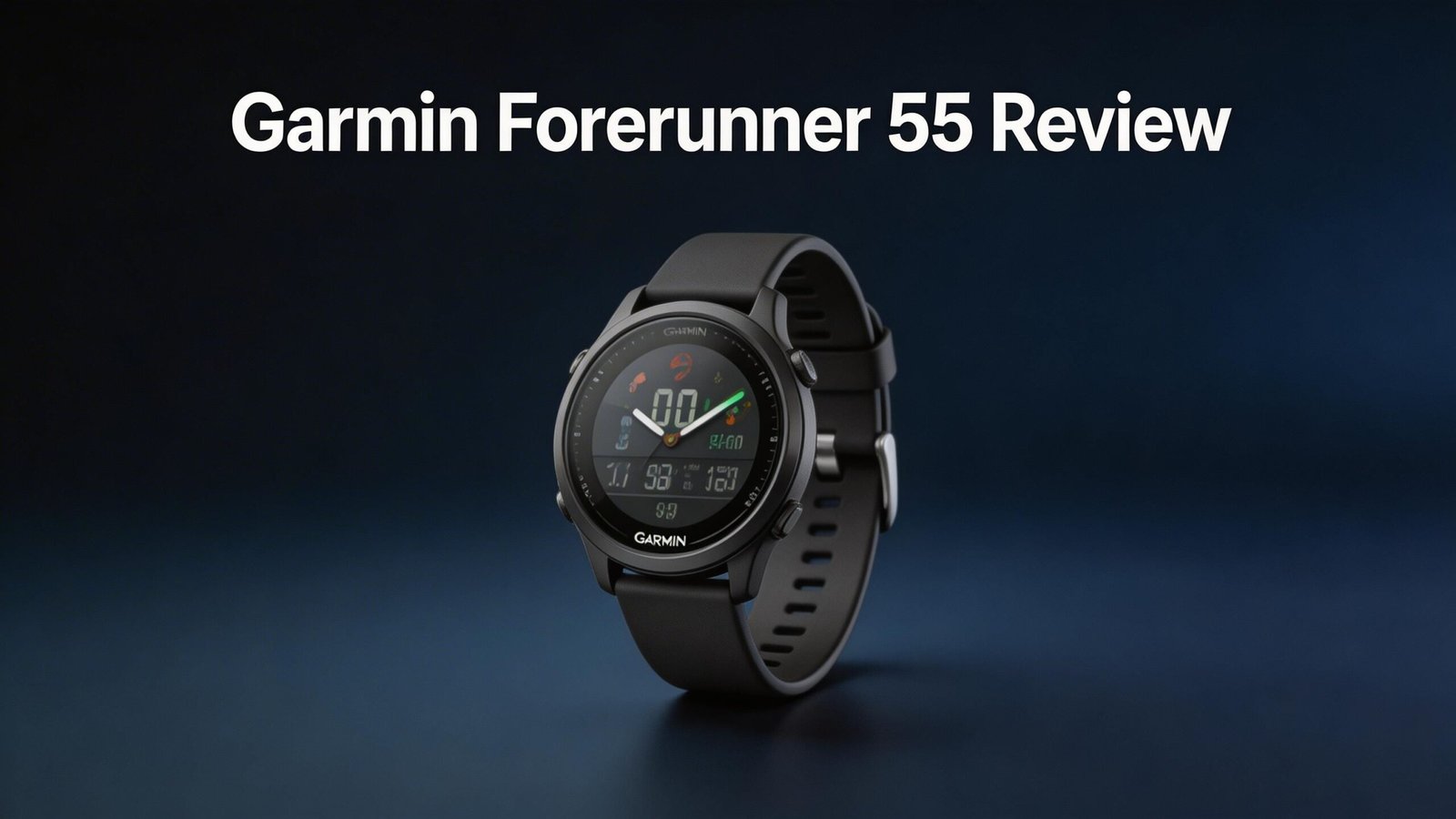
The Garmin Forerunner 55 features a lightweight, compact design that makes it comfortable for daily wear and long training sessions. It weighs only 37 grams, which is lighter than most running watches in its class.
The watch body is made from fiber reinforced polymer. This material feels durable enough for regular use, though it does not match the premium feel of stainless steel or titanium cases found on higher end models.
The case diameter sits at 42mm. This size fits most wrists well without looking too bulky. The silicone strap is soft and flexible, and it rarely causes skin irritation even during sweaty workouts. Garmin includes a standard quick release band, so you can swap it out for a different color or material if you want a fresh look.
The 1.04 inch MIP display is sunlight readable. This is a major advantage over AMOLED screens that can wash out in bright conditions. However, the screen resolution of 208 x 208 pixels looks a bit dated by 2026 standards.
GPS Accuracy and Performance
GPS accuracy is a critical factor for any running watch. The Garmin Forerunner 55 uses a single frequency GPS chip with support for GPS and GLONASS satellite systems. It does not support multi band or dual frequency GPS. This means it may lose accuracy in dense urban areas or under heavy tree cover.
That said, the Forerunner 55 performs well on open roads and park trails. Most runners report that distance and pace readings are consistent and reliable during standard outdoor runs. The watch typically locks onto satellites within 15 to 30 seconds. This is fast enough for most situations, though some newer watches connect in under 10 seconds.
Route tracking is accurate for simple runs. The watch records your path clearly in the Garmin Connect app. You can review your route on a map after each workout.
Heart Rate Monitoring and Health Tracking
The Garmin Forerunner 55 uses an optical wrist based heart rate sensor called the Garmin Elevate sensor. This sensor tracks your heart rate 24 hours a day, seven days a week. It records resting heart rate, active heart rate during workouts, and heart rate variability during sleep.
During running, the heart rate readings are generally accurate for steady state efforts. Interval training and high intensity bursts can sometimes cause the sensor to lag behind your actual heart rate.
This is a common limitation of wrist based optical sensors across all brands. For more precise data during intense sessions, Garmin allows you to pair an external chest strap using ANT+ or Bluetooth.
Health tracking features include daily step counting, calorie tracking, sleep monitoring, and stress tracking. The Body Battery feature is a standout tool. It assigns you an energy score from 0 to 100 based on your sleep quality, stress levels, and physical activity. This score helps you decide whether to push hard or take a rest day.
Top 3 Alternatives for Garmin Forerunner 55
Garmin Forerunner 165

COROS PACE 3

Polar Pacer

Battery Life: How Long Does It Really Last?
Garmin claims the Forerunner 55 delivers up to 14 days in smartwatch mode and up to 20 hours in GPS mode. These are impressive numbers for a budget running watch. Real world testing from multiple reviewers confirms that these claims are close to accurate.
If you use the watch primarily as a daily activity tracker with occasional notifications, you can expect 10 to 12 days between charges with typical use. Running three to four times per week with GPS active for 30 to 60 minutes per session will reduce this to about one week. This is still excellent performance.
Charging the Forerunner 55 takes about one to two hours from empty to full using the proprietary Garmin charging cable. The cable clips onto the back of the watch. It is a reliable connection, though some users wish Garmin would adopt a universal charging standard.
Compared to newer watches like the Garmin Forerunner 165, which offers 11 days in smartwatch mode with an AMOLED display, the Forerunner 55 actually wins on battery longevity. The simpler MIP display consumes less power. This is one area where older technology gives the Forerunner 55 a genuine advantage.
Battery saver modes are available to extend the life further. You can turn off Bluetooth, reduce the backlight brightness, or disable continuous heart rate monitoring to squeeze out extra days.
Running Features and Workout Modes
The Garmin Forerunner 55 is built for runners. It includes multiple run specific workout modes such as outdoor run, indoor run (treadmill), virtual run, and track run. Each mode is optimized to provide the most relevant data for that activity type.
The Daily Suggested Workouts feature is a highlight. This tool analyzes your training history, fitness level, and recovery status. It then recommends a workout for the day. These suggestions include easy runs, tempo runs, interval sessions, and long runs. The workout adjusts automatically as your fitness changes over time.
You also get access to PacePro pacing strategies through the Garmin Connect app. This lets you create a pacing plan for a race or goal run. The watch provides real time guidance to help you stay on target. Interval training is easy to set up. You can create custom intervals with warm up, work, rest, and cool down phases.
Run/walk alerts are perfect for beginners. You can set the watch to alternate between running and walking intervals. This is a proven method for building endurance safely. The Forerunner 55 also tracks running cadence (steps per minute) from the wrist without needing an external foot pod.
Garmin Connect App and Ecosystem
The Garmin Connect app is where the Forerunner 55 truly shines. This free companion app is available on iOS and Android. It syncs automatically with the watch via Bluetooth and displays all your activity data in clean, easy to read charts and graphs.
You can view your run history, heart rate trends, sleep patterns, step count, and Body Battery score all in one place. The app also stores your training calendar. You can plan future workouts and sync training plans directly to the watch. Garmin Connect offers free training plans for 5K, 10K, half marathon, and marathon distances.
The social features in Garmin Connect add motivation. You can join challenges, compete with friends on leaderboards, and share your activities. The app also integrates with popular platforms like Strava, TrainingPeaks, and MyFitnessPal. This means your data flows where you need it without manual entry.
Smartwatch Features: Notifications and Daily Use
While the Garmin Forerunner 55 is a running watch first, it does offer basic smartwatch features for daily use. You receive phone notifications on the watch screen. Incoming calls, text messages, emails, and app alerts all appear on your wrist when your phone is connected via Bluetooth.
You can read the notification text on the screen. However, you cannot reply to messages directly from the watch. There is no microphone or speaker. The notification display is clear enough to read at a glance, though the small 1.04 inch screen limits how much text you can view at once.
Weather updates are available directly on the watch face. The Forerunner 55 also includes a Find My Phone feature. If you misplace your phone nearby, the watch can trigger it to ring. Calendar reminders sync from your phone as well.
Music control is not available on the Forerunner 55. You cannot store music on the watch or control playback on your phone. This is a notable missing feature for runners who like to listen to music or podcasts during workouts. If music storage matters to you, the Garmin Forerunner 165 Music or Garmin Forerunner 265 Music are better options.
Sleep Tracking and Recovery Insights
Sleep tracking on the Garmin Forerunner 55 is automatic and fairly detailed. The watch detects when you fall asleep and when you wake up. It breaks your sleep into light, deep, and REM stages. This data appears in the Garmin Connect app each morning.
The sleep score feature gives you a number from 0 to 100 based on your total sleep duration and sleep quality. This score helps you understand whether you got enough rest. A higher score indicates better recovery. The breakdown shows how much time you spent in each sleep stage compared to recommended ranges.
Body Battery is closely linked to sleep quality. A good night of sleep will recharge your Body Battery score. A poor night will leave it low. This simple visual metric makes it easy to decide if you should train hard or take a recovery day.
The Forerunner 55 also tracks respiration rate during sleep. This data can reveal patterns over time. Sudden changes in respiration may indicate illness or overtraining. However, the watch does not offer advanced recovery metrics like HRV Status or Training Readiness that newer Garmin models provide.
Who Should Buy the Garmin Forerunner 55?
The Garmin Forerunner 55 is best suited for beginner and casual runners who want a reliable GPS watch without spending a lot of money. If you are new to running and need a watch to track your pace, distance, and heart rate, this model delivers everything you need.
It is also a good fit for people who prefer simplicity. The five button interface is straightforward. There is no touchscreen to accidentally activate during a run. The menus are clean and logical. You can learn all the functions within a day of using the watch.
Runners who train for 5K, 10K, or half marathon distances will find the Forerunner 55 well equipped. The daily suggested workouts and free Garmin training plans provide genuine coaching value. You do not need to hire a coach or buy a separate training app to follow a structured plan.
However, this watch is not ideal for advanced runners who need detailed running dynamics, onboard maps, or multi band GPS. It is also not the best choice for triathletes or multisport athletes. The Forerunner 55 lacks open water swim metrics and dedicated cycling or triathlon modes.
Garmin Forerunner 55 vs Garmin Forerunner 165
The Garmin Forerunner 165 launched in early 2024 and is the natural successor to the Forerunner 55. The biggest difference is the display. The Forerunner 165 features a vibrant 1.2 inch AMOLED touchscreen. This screen is brighter, sharper, and more colorful than the MIP panel on the Forerunner 55.
The Forerunner 165 also adds multi band GPS for improved accuracy in challenging environments. It supports more sport profiles and includes features like Training Readiness and Morning Report. These tools give runners deeper insight into their daily fitness status.
Battery life on the Forerunner 165 is 11 days in smartwatch mode and 19 hours in GPS mode. The Forerunner 55 wins slightly on battery. The Forerunner 165 weighs 39 grams compared to the Forerunner 55 at 37 grams. The size difference is minimal.
Pros and Cons of the Garmin Forerunner 55
Every product has strengths and weaknesses. Here is a clear look at what the Garmin Forerunner 55 does well and where it falls short in 2026.
On the positive side, the watch is extremely light at 37 grams. The battery life is outstanding for its price range. GPS accuracy is reliable on open roads and trails.
The Garmin Connect ecosystem provides a rich software experience with free training plans, social features, and third party integrations. Daily suggested workouts add real coaching value. The watch is comfortable for all day wear and sleep tracking.
On the negative side, the 1.04 inch MIP display looks outdated. There is no touchscreen, no AMOLED technology, and the resolution is low. The watch lacks music storage and playback controls. It does not support multi band GPS, which limits accuracy in dense areas.
Advanced running dynamics are absent. There is no Training Readiness or HRV Status feature. The watch was released in 2021, so it may not receive software updates for much longer.
The proprietary charging cable is another minor frustration. Losing the cable means buying a specific Garmin replacement rather than using a common USB cable. Despite these drawbacks, the overall value proposition remains strong for budget conscious runners.
Is the Garmin Forerunner 55 Still Worth Buying in 2026?
This is the central question for anyone reading this review. The short answer is yes, but with conditions. The Garmin Forerunner 55 is still worth buying in 2026 if you are on a tight budget and need a dependable GPS running watch with solid features.
The watch handles the basics better than most budget alternatives. GPS tracking, heart rate monitoring, daily suggested workouts, and the Garmin Connect app provide a complete package for new runners. The battery life remains class leading. The lightweight design ensures comfort during long runs and daily wear.
However, you should consider the Garmin Forerunner 165 if you can afford the extra cost. The newer display, better GPS, and expanded health features make it a smarter long term investment. The Forerunner 55 is five years old now. Software support may wind down soon, and the hardware gap with current models continues to grow.
Final Verdict on the Garmin Forerunner 55
The Garmin Forerunner 55 has aged gracefully. It does not have the flashiest screen or the newest sensors. But it delivers where it matters most for beginner runners: accurate GPS, reliable heart rate tracking, smart training suggestions, and outstanding battery life. The Garmin ecosystem adds tremendous value with free training plans, social features, and deep data insights.
If you want a no fuss running watch that gets the fundamentals right at a budget friendly price, this watch still earns a recommendation. Pair it with realistic expectations about its older display and limited advanced features, and you will find a capable training partner that lasts for years.
We give the Garmin Forerunner 55 a solid 7.5 out of 10 for 2026. It loses points for aging hardware but gains them back through dependable performance and excellent software support.
Frequently Asked Questions
Does the Garmin Forerunner 55 have a touchscreen?
No. The Garmin Forerunner 55 uses five physical buttons for all navigation and interaction. There is no touchscreen on this model. Many runners prefer buttons because they work reliably during wet or cold conditions. If you want a touchscreen, consider the Garmin Forerunner 165 or Forerunner 265 instead.
Can the Garmin Forerunner 55 play music?
No. The Garmin Forerunner 55 does not support music storage or music playback controls. You cannot store songs on the watch or control music playing on your phone. If music during runs is important to you, look at the Garmin Forerunner 165 Music or Garmin Forerunner 265 Music, both of which support on device music storage.
Is the Garmin Forerunner 55 waterproof?
The Garmin Forerunner 55 has a water resistance rating of 5 ATM. This means it can handle pressures equal to a depth of 50 meters. You can wear it in the shower, in the pool, and in the rain. It is suitable for swimming activities, though it does not track open water swim metrics.
How accurate is the GPS on the Garmin Forerunner 55?
The GPS on the Forerunner 55 is accurate for most standard running conditions. On open roads, park trails, and suburban areas, the distance and pace readings are consistent and dependable. In dense urban areas with tall buildings or under thick tree cover, accuracy may decrease because the watch uses single frequency GPS only.
How long does the Garmin Forerunner 55 battery last?
The battery lasts up to 14 days in smartwatch mode and up to 20 hours with GPS active. Real world use with notifications enabled and regular GPS runs typically yields 7 to 10 days between charges. Battery life is one of the strongest features of this watch.
Does the Garmin Forerunner 55 track sleep?
Yes. The Forerunner 55 automatically tracks sleep every night. It records light, deep, and REM sleep stages. It provides a sleep score in the Garmin Connect app each morning. The Body Battery feature also uses sleep data to show your daily energy levels and recovery status.