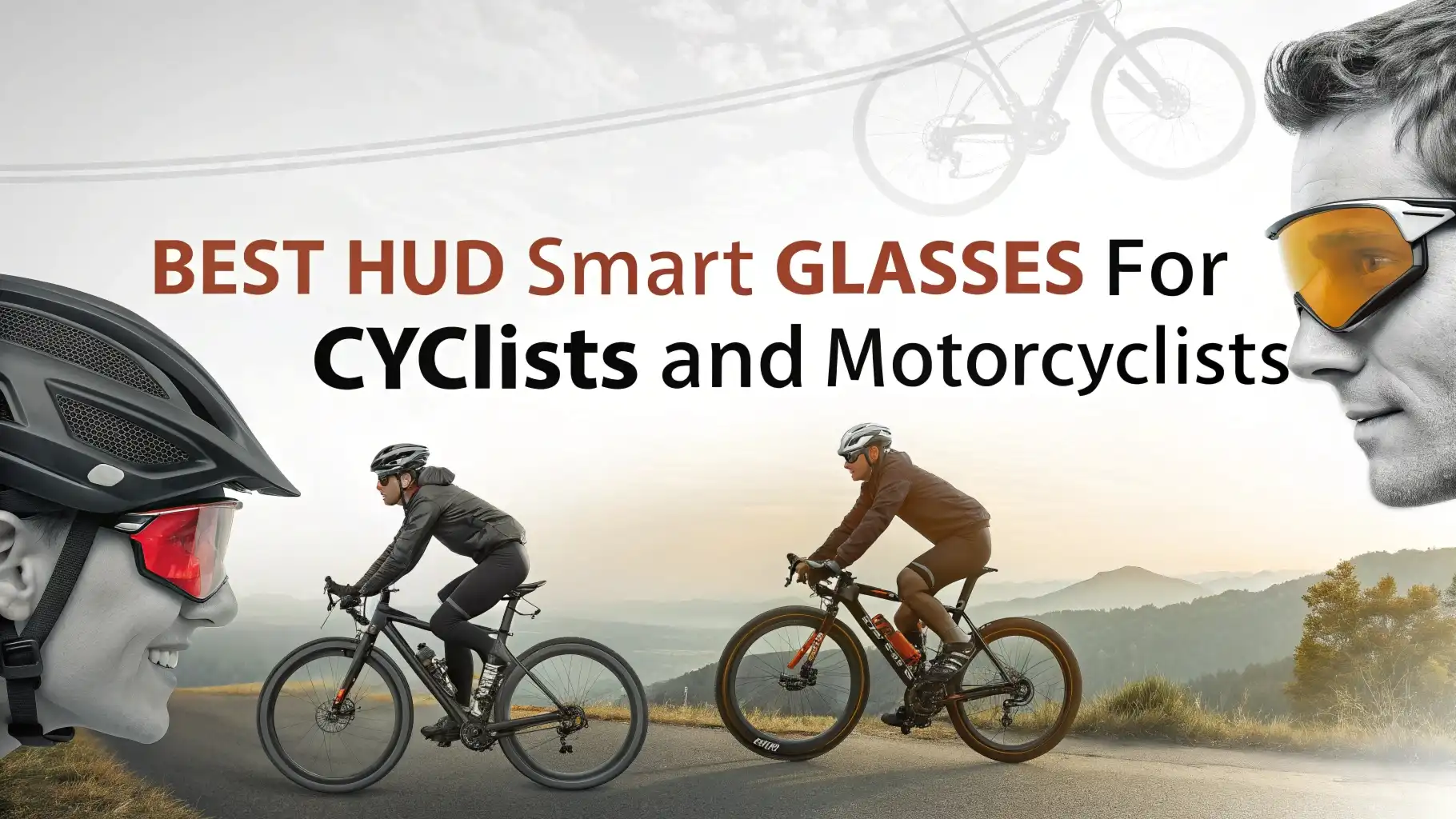
3 Best HUD Smart Glasses for Cyclists and Motorcyclists in 2026
Riding your bike or motorcycle just got a major upgrade. HUD smart glasses now bring your performance data, navigation, and safety alerts directly into your line of sight.
You no longer need to look down at your device or dashboard. These innovative glasses project crucial information right in front of your eyes while you stay focused on the road ahead.
The year 2026 brings remarkable improvements in HUD technology for riders. Modern smart glasses now feature lightweight designs, crystal clear displays, and extended battery life that can last through your longest rides.

Key Takeaways:
- Display Technology Matters: The best HUD glasses use MicroOLED or similar advanced display technology that remains clearly visible in bright sunlight. Look for glasses that automatically adjust brightness based on ambient light conditions. This ensures you can read your data whether you’re riding through shaded forest trails or under harsh midday sun.
- Battery Life Can Make or Break Your Ride: Top performing models now offer 10 to 12 hours of continuous use, which covers even the most demanding endurance events. Some premium options extend this to 24 hours with certain features disabled. Always check battery specifications against your typical ride duration.
- Weight Is Critical for Comfort: The lightest HUD glasses weigh around 36 to 41 grams, barely more than regular sports sunglasses. Heavier models can cause fatigue during long rides. Every gram counts when you’re wearing glasses for hours at a time.
- Connectivity Options Define Functionality: Most smart glasses connect via Bluetooth to your smartphone, cycling computer, or motorcycle system. The best models support multiple device types including Garmin, Apple, Android, and specialized motorcycle apps. Verify compatibility with your existing gear before purchasing.
- Safety Features Save Lives: Advanced models now include proactive alerts for vehicle approaches, heart rate warnings, and navigation prompts. For motorcyclists, features like speed display, gear position indicators, and rearview camera integration significantly enhance road awareness.
ZENITH Display Sports Glasses for Cycling and Hiking

The ZENITH Display Sports Glasses represent the cutting edge of HUD technology for active riders. These smart glasses deliver an AI powered real time display that shows your critical metrics without forcing you to look away from the path ahead.
The lightweight frame weighs just 39 grams, making them comfortable for extended wear during century rides or long distance motorcycle tours.
Turn by turn navigation appears directly in your field of vision, eliminating the need to glance at handlebar mounted devices. The glasses connect seamlessly to your smartphone and sync with popular fitness apps.
The proactive AI alerts monitor your performance and can warn you when your heart rate exceeds safe thresholds or when vehicles approach from behind.
The display quality impresses with its clarity in various lighting conditions. The MicroOLED technology adjusts automatically to ambient light, ensuring readability whether you’re riding through tunnels or under bright sunshine. Battery life extends through full day adventures, and the IPX5 water resistance protects against rain and sweat.
Pros:
✓ Excellent display clarity in all lighting conditions
✓ Lightweight design at just 39 grams
✓ Comprehensive AI safety alerts
✓ Long battery life for extended rides
✓ Turn by turn navigation integration
Cons:
✗ Premium pricing compared to basic models
✗ Learning curve for gesture controls
✗ Limited lens color options
E6+ Motorcycle Helmet HUD System

The E6+ Motorcycle Helmet HUD brings automotive grade head up display technology to motorcycle helmets. This system mounts directly to any helmet and projects speed, navigation, and communication information into your line of sight. The CarPlay and Android Auto integration means you get the same seamless smartphone connectivity you enjoy in modern cars.
The mesh intercom system allows communication with up to eight riders simultaneously over distances up to 2 kilometers. GPS navigation displays clear turn by turn directions without requiring you to look down at a phone mount. The rearview camera integration adds an extra layer of safety, showing approaching vehicles on your display.
RGB customizable lights add visibility for other drivers, while the IP66 waterproof rating ensures reliable performance in heavy rain. The remote control allows you to adjust settings without removing your hands from the handlebars. Noise reduction technology keeps communication clear even at highway speeds.
Pros:
✓ Full CarPlay and Android Auto support
✓ Mesh intercom for group riding
✓ Rearview camera integration
✓ Excellent waterproof protection
✓ Universal helmet compatibility
Cons:
✗ Higher price point than standalone glasses
✗ Complex initial setup process
✗ Requires charging between long rides
Bluetooth Audio Smart Glasses for Cycling and Running

These budget friendly smart glasses prove that HUD technology doesn’t require breaking the bank. While they focus primarily on audio features rather than visual displays, they offer open ear speakers that deliver music and navigation prompts without blocking ambient sounds. This approach maintains safety awareness while still providing essential information.
The polarized UV400 lenses protect your eyes from harmful rays and reduce glare during bright conditions. Touch controls on the temples allow you to answer calls, adjust volume, and activate voice assistants without reaching for your phone. The IPX5 waterproof rating handles sweat and light rain effectively.
Battery life provides up to 6 hours of continuous playback, sufficient for most recreational rides. The lightweight frame design ensures comfort during extended wear. These glasses work particularly well for casual riders who want connectivity without the complexity of full HUD systems.
Pros:
✓ Affordable entry point to smart glasses
✓ Good sound quality with ambient awareness
✓ Comfortable lightweight design
✓ Effective UV protection
✓ Simple touch controls
Cons:
✗ No visual HUD display
✗ Shorter battery life than premium models
✗ Basic feature set compared to advanced options
Understanding HUD Technology for Riders
HUD technology in smart glasses works by projecting information onto a small transparent display positioned in your peripheral vision. This placement allows you to see critical data without moving your eyes significantly from the road ahead. The technology draws from decades of development in military and aviation applications, now refined for consumer sports use.
Modern systems use MicroOLED or similar display technologies that produce bright, sharp images visible even in direct sunlight. The displays typically sit just above or to the side of your normal sight line, creating a floating image that appears several meters ahead. Your eyes can focus on this virtual display and the road simultaneously with minimal adjustment.
The integration with fitness sensors and navigation systems makes these glasses particularly valuable. They can display heart rate from chest straps, power output from bike sensors, speed from GPS, and navigation from smartphone apps. All this information updates in real time, giving you instant feedback on your performance without distraction.
Key Features to Consider When Choosing HUD Glasses
Display brightness and contrast determine whether you can actually read the information when you need it most. Look for glasses rated for at least 3000 nits of brightness for outdoor use. Automatic brightness adjustment helps preserve battery life while maintaining readability.
Field of view affects how much information you can see at once. Wider displays allow more data simultaneously but can feel more intrusive. Most riders prefer a compact display showing 3 to 6 metrics that they can customize based on their needs.
Prescription lens compatibility matters if you normally wear corrective lenses. Some systems offer prescription inserts, while others work over contact lenses. Check compatibility before purchasing if you need vision correction.
Data customization options let you choose which metrics appear during different activities. The best systems allow you to create multiple profiles for road cycling, mountain biking, motorcycle touring, and other activities. Each profile displays relevant information for that specific use case.
Battery Life and Charging Solutions
Battery performance varies significantly across HUD smart glasses models. Entry level options typically provide 4 to 6 hours of active use, adequate for shorter rides but limiting for endurance events. Mid range models extend this to 8 to 10 hours, while premium options reach 12 hours or more.
Charging methods have standardized around USB C connections for faster charging times. Most glasses fully charge in 1 to 2 hours. Some models include magnetic charging cables that attach more securely during charging and reduce wear on the charging port.
Power management features help extend battery life. Auto sleep modes turn off the display when you stop moving. Selective feature disable options let you turn off gesture controls or reduce display brightness to conserve power during ultra long rides.
Battery degradation over time affects all rechargeable devices. Quality glasses maintain 80% or more of original capacity after 500 charge cycles, representing roughly two years of regular use. Replaceable battery designs offer longer product lifespans but are less common in lightweight models.
Connectivity and Compatibility
Bluetooth connectivity forms the foundation of most HUD smart glasses systems. Bluetooth 5.0 or newer provides stable connections with lower power consumption. The best glasses can simultaneously connect to multiple devices, allowing them to receive data from your bike computer while also handling phone calls from your smartphone.
ANT+ support matters for cyclists using Garmin or other ANT+ enabled sensors. This protocol offers advantages in sensor connectivity and battery efficiency. Glasses supporting both Bluetooth and ANT+ provide maximum compatibility with existing equipment.
Smartphone apps serve as the control center for most smart glasses. These apps handle initial setup, allow data customization, provide firmware updates, and often include ride tracking features. Check whether the manufacturer supports both iOS and Android platforms if you might switch phones in the future.
Third party app integration expands functionality significantly. The best systems work with Strava, Komoot, Garmin Connect, Wahoo, and other popular platforms. This integration allows your ride data to sync automatically to your preferred tracking services.
Safety Features and Awareness Technology
Modern HUD glasses incorporate intelligent safety systems that monitor your surroundings and physical condition. Vehicle detection alerts use connected radar systems or smartphone sensors to warn when cars approach from behind. These visual and audio warnings give you crucial seconds to react.
Heart rate monitoring integration connects to chest straps or wrist based sensors to display your current heart rate zone. Advanced systems provide threshold alerts that warn when you exceed safe limits, helping prevent overexertion during intense efforts.
Navigation safety features include automatic route recalculation if you miss a turn, warnings for dangerous intersections, and alerts for upcoming terrain changes. The proactive notification system delivers these alerts at appropriate times without overwhelming you with constant information.
Emergency contact features in some models can detect crashes through accelerometer data and automatically notify emergency contacts with your GPS location. While not foolproof, these systems provide an additional safety net for solo riders.
Comparing HUD Glasses to Traditional Bike Computers
Traditional bike computers mounted on handlebars require you to look down and refocus your eyes, creating brief moments of reduced road awareness. HUD glasses eliminate this distraction by placing data in your peripheral vision. The difference seems small but becomes significant during technical riding or heavy traffic.
Handlebar space limitations affect riders using multiple accessories. Adding lights, GPS units, and phone mounts creates clutter and weight on your handlebars. Smart glasses consolidate many of these functions into a single wearable device.
Visibility concerns favor HUD glasses in challenging conditions. Rain, mud splatter, and bright sunlight can make bike computer screens difficult to read. HUD displays adjust automatically and remain visible because they’re always at the optimal viewing angle.
Cost comparisons show HUD glasses typically priced higher than mid range bike computers but lower than premium GPS units with full color mapping. When you factor in the additional functionality and convenience, the price premium becomes reasonable for serious riders.
Weather Resistance and Durability
Water resistance ratings indicate how well glasses withstand moisture. IPX4 rating protects against light rain and sweat. IPX5 rated glasses handle heavy rain and can be rinsed under running water. IPX6 and higher ratings provide protection against powerful water jets but are less common in lightweight sports glasses.
Temperature tolerance affects performance in extreme conditions. Quality HUD glasses function reliably from minus 10°C to 45°C, covering most realistic riding conditions. Battery performance degrades in extreme cold, reducing runtime by up to 30% in freezing temperatures.
Impact resistance matters for safety eyewear. Look for polycarbonate lenses meeting ANSI Z87.1 or similar safety standards. These lenses protect your eyes from flying debris while resisting scratches from regular use.
UV protection should be standard in any quality sports glasses. UV400 rated lenses block 100% of harmful UVA and UVB rays. This protection becomes increasingly important during long rides at high altitude where UV exposure intensifies.
Future Developments in HUD Technology
Augmented reality integration represents the next evolution for cycling glasses. Future models will overlay virtual markers on the actual road, showing ideal racing lines through corners or highlighting hazards detected by AI analysis of your route.
Biometric sensor integration will expand beyond simple heart rate monitoring. Next generation glasses will track blood oxygen levels, lactate threshold indicators, and hydration status through non invasive sensors. This data will enable more precise training and performance optimization.
Improved battery technology continues advancing with solid state batteries promising double the capacity in similar weight and size packages. This development could enable multi day battery life in lightweight HUD glasses within the next few years.
Social connectivity features will allow riders to see the real time positions and statistics of friends or training partners directly in their HUD. Live leaderboards for popular segments could appear as you approach, adding competitive motivation to regular training routes.
Maintenance and Care Tips
Regular cleaning keeps displays clear and lenses scratch free. Use microfiber cloths designed for optics rather than regular tissues or clothing. Specialized lens cleaning solutions work better than water alone for removing oils and residue.
Storage practices affect longevity. Store glasses in protective cases when not in use to prevent scratches and accidental damage. Avoid leaving them in hot cars where extreme temperatures can damage electronics and degrade frame materials.
Firmware updates often improve performance and add features. Check for updates monthly through the manufacturer’s app. These updates can fix bugs, improve battery life, and sometimes add entirely new capabilities to existing hardware.
Battery maintenance includes avoiding complete discharge cycles and storing glasses with 40 to 60% charge during extended periods of non use. These practices maximize long term battery health and capacity retention.
FAQs
How do HUD smart glasses display information while cycling?
HUD smart glasses use micro projection technology to create a virtual display that appears to float in your field of vision. A tiny projector mounted in the frame sends light onto a transparent prism or lens coating. Your eye sees this reflected image as if it’s several meters ahead of you. The positioning allows you to view the display and the road simultaneously without refocusing.
The display typically shows information in your peripheral vision rather than directly center. This placement minimizes distraction while keeping data accessible with a slight eye movement. Most systems let you adjust the display position to match your preferred viewing angle.
Are HUD smart glasses safe to use while riding?
HUD smart glasses are generally safer than looking down at handlebar mounted devices because they keep your eyes directed forward. The peripheral display placement means you maintain awareness of the road while viewing data. Research shows that glancing at HUD displays causes less than half the distraction compared to checking traditional bike computers.
However, any additional information in your field of vision creates some cognitive load. Start using HUD glasses on familiar, low traffic routes while you adapt to the technology. Most riders report the distraction becomes negligible after a few rides as they learn to process the displayed information naturally.
Can I use prescription lenses with HUD smart glasses?
Many HUD smart glasses accommodate prescription lenses through insert adapters that clip behind the main lenses. These inserts hold your corrective lenses without interfering with the HUD display. Check with manufacturers for compatibility with your specific prescription strength.
Contact lens wearers have the simplest solution, as most HUD glasses work perfectly over contacts. This approach provides the widest field of view and simplest setup. If you normally wear contacts for sports, HUD glasses won’t change your routine.
How long do HUD smart glasses batteries typically last?
Battery life varies widely based on model quality and feature usage. Entry level glasses with basic displays last 4 to 6 hours per charge. Mid range models with more advanced displays and sensors provide 8 to 10 hours. Premium options reach 12 hours or more of active use.
Power consumption factors include display brightness, sensor connections, GPS usage, and gesture controls. Turning off unused features extends battery life significantly. Some glasses offer ultra low power modes that display only basic information but last 24 hours or longer.
Temperature affects battery performance substantially. Cold weather reduces capacity by up to 30%, meaning your 10 hour glasses might only last 7 hours in winter conditions. Keep glasses in an interior pocket when not wearing them to maintain battery warmth.
What is the price range for quality HUD smart glasses?
Quality HUD smart glasses span a wide price range based on features and capabilities. Basic audio focused smart glasses start around $25 to $50, offering connectivity and voice features without visual displays. These work well for casual riders wanting simple enhancements.
Mid range HUD glasses with basic display functionality cost $250 to $450. These models provide essential metrics, decent battery life, and reliable connectivity. They represent the sweet spot for serious recreational riders and commuters.
Premium HUD systems range from $450 to $650, offering advanced features like AI safety alerts, extended battery life, superior display technology, and comprehensive sensor integration. Competitive athletes and dedicated enthusiasts typically invest at this level.