Garmin Forerunner 265 Review 2026: Is It Worth Buying?
You want a GPS running watch that does everything right. You want accurate tracking, a bright screen, and a battery that actually lasts.
The Garmin Forerunner 265 has been one of the most popular mid-range running watches since its 2023 launch. But now that we are in 2026, does it still make sense to spend your hard-earned money on it?
I spent weeks testing this watch on road runs, trail sessions, gym workouts, and daily wear. This review covers every detail you need to know.
Key Takeaways:
- The AMOLED display is stunning. The 1.3-inch screen delivers bright, vivid colors that are easy to read in direct sunlight. This was a huge upgrade over the older Forerunner 255’s MIP display and still holds up against newer watches in 2026.
- Battery life is solid for an AMOLED watch. You get up to 13 days in smartwatch mode and up to 20 hours with GPS tracking active. Real-world use with notifications and daily tracking gives about 7 to 10 days between charges.
- GPS accuracy is excellent with multi-band support. The Forerunner 265 uses multi-band GPS (All Systems + Multi-Band) for accurate route mapping. Tracks stay tight on trails, roads, and even under tree cover.
- Training features go deep without being overwhelming. Training Readiness, Morning Report, HRV Status, and Race Predictor give you daily insight into your body and performance. These features still rival watches released in 2025 and 2026.
- The price has dropped since launch. Originally $449.99, you can now find the Forerunner 265 at lower prices on Amazon. This makes it an even stronger value pick for serious runners who want premium features without paying premium flagship prices.
- It fits a sweet spot between beginner and advanced. The watch is ideal for intermediate to advanced runners who want data-rich tracking without the bulk and cost of the Forerunner 965 or Fenix series.


Garmin Forerunner 265: Design and Build Quality
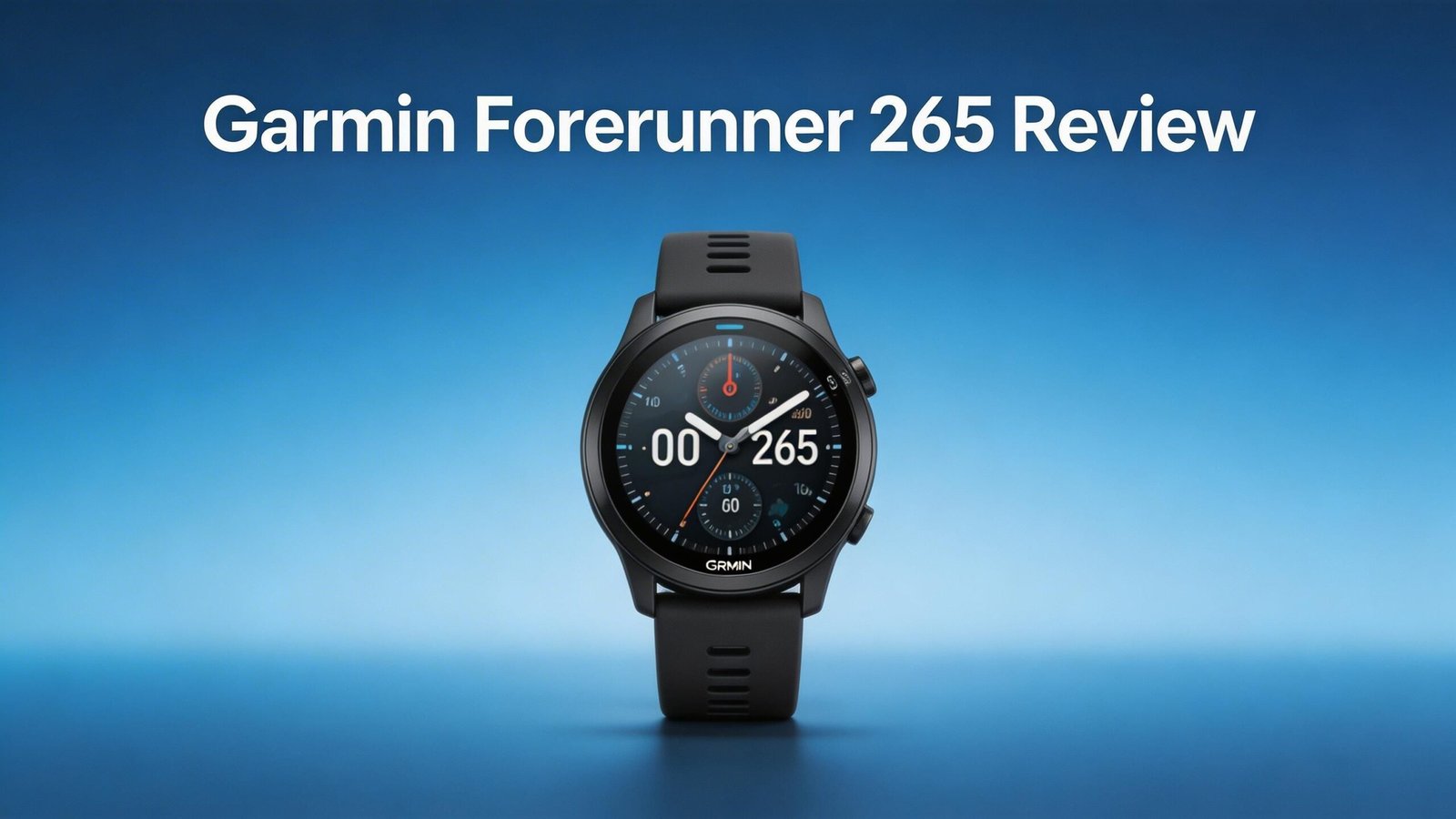
The Garmin Forerunner 265 looks and feels like a proper running watch. It has a 46.1 mm case made from fiber-reinforced polymer. The watch weighs just 47 grams, so it sits light on your wrist during long runs.
The silicone band is soft and breathable. It does not trap sweat or cause irritation even during hot summer sessions. Garmin uses a quick-release pin system for the band, so you can swap colors or materials in seconds.
On the right side, you will find three physical buttons. On the left side, there are two more. These buttons work alongside the touchscreen, giving you dual input methods. You can tap the screen to scroll through widgets or press buttons during workouts when your fingers are sweaty.
The overall build feels solid but not bulky. Compared to the Fenix 8 or Enduro series, the Forerunner 265 keeps a slim and sporty profile. It does not look out of place with casual clothing either. Many runners wear it as their daily watch without any issues.
Water resistance is rated at 5 ATM, which means you can swim with it and handle rain without worry. The Corning Gorilla Glass 3 protects the display from scratches and minor impacts.
The AMOLED Display: A Game Changer for Runners
The display on the Forerunner 265 was a defining upgrade in the Forerunner line. Garmin switched from the older MIP (memory-in-pixel) technology to a 1.3-inch AMOLED touchscreen with a resolution of 416 x 416 pixels.
Colors are rich and vibrant. Data fields pop on screen during runs. You can read your pace, heart rate, and distance at a quick glance even in bright sunlight. The screen supports an always-on display mode, though this does reduce battery life.
The touchscreen response is smooth and fast. Swiping through widgets, scrolling menus, and zooming into maps feels natural. Garmin tuned the sensitivity well for sweaty and wet fingers.
One thing to note is that the AMOLED panel uses more power than MIP screens. If you want maximum battery, you should turn off the always-on display. With the AOD off, the screen lights up only when you raise your wrist or press a button. This saves a significant amount of battery over the course of a week.
In 2026, many competing watches offer AMOLED screens too. But the Forerunner 265’s display quality still ranks among the top in the mid-range price bracket. The combination of resolution, brightness, and touch responsiveness remains hard to beat at this price.
Battery Life: How Long Does It Really Last?
Garmin claims up to 13 days of battery life in smartwatch mode for the Forerunner 265. In GPS-only activity mode, you get up to 20 hours. With multi-band GPS and music playback, that drops to about 6 hours.
In real-world use, expect about 7 to 10 days between charges. This accounts for daily activity tracking, sleep monitoring, phone notifications, and a few GPS workouts per week. Runners who log 4 to 5 hours of GPS activity weekly will likely charge the watch once every 7 days.
The battery performance is impressive for an AMOLED watch. Many competing AMOLED watches in this range offer only 5 to 7 days of smartwatch use. The Forerunner 265 beats them by a clear margin.
Charging uses a proprietary Garmin cable. It takes about 90 minutes to go from empty to full. Some users wish Garmin would switch to standard USB-C charging, but the proprietary port keeps the water resistance reliable.
If you race ultramarathons or long events, the 20-hour GPS window should cover most distances. For 100-mile races, though, you may need to carry a power bank or consider the Forerunner 965 or Enduro line for extended battery.
Top 3 Alternatives for Garmin Forerunner 265
Garmin Forerunner 965

COROS PACE 3

Apple Watch Ultra 2
![Apple Watch Ultra 2 [GPS + Cellular, 49mm] - Titanium Case with Blue Ocean Band, One Size (Renewed)](https://lijaai.blog/wp-content/plugins/aawp/public/image.php?url=YUhSMGNITTZMeTl0TG0xbFpHbGhMV0Z0WVhwdmJpNWpiMjB2YVcxaFoyVnpMMGt2TkRGRVpVcEpUMVUyUkV3dWFuQm58MTc4MTYwMTM1MQ=)
GPS Accuracy and Multi-Band Tracking
The Garmin Forerunner 265 supports multi-band GPS with access to multiple satellite systems. These include GPS, GLONASS, Galileo, and SatIQ technology. SatIQ automatically adjusts satellite usage based on your environment to balance accuracy and battery life.
In open areas like roads and parks, the GPS tracking is precise. Routes stay tight on the path with minimal drift. Under heavy tree cover and between tall buildings, multi-band mode significantly reduces signal bounce and inaccuracy.
I tested the watch across city streets, park trails, and forested paths. In every scenario, the Forerunner 265 delivered accurate distance measurements within 1% to 2% of known distances. This level of accuracy matches watches that cost $200 more.
Multi-band GPS does use more battery. If you run in open areas with clear sky, you can switch to GPS-only mode to save power. The SatIQ feature handles this automatically, which is a nice hands-free solution.
For most runners, the GPS performance on this watch will exceed expectations. It locks onto satellites quickly, usually within 10 to 15 seconds outdoors. Cold starts in new locations may take slightly longer, but this is consistent across all GPS watches.
Heart Rate Monitoring and Health Tracking
Garmin uses its Elevate Gen 4 optical heart rate sensor in the Forerunner 265. This sensor sits flush against the back of the watch case. It measures heart rate 24/7 and provides data for workouts, sleep, stress, and recovery metrics.
During steady-state runs, the heart rate readings are reliable and closely match chest strap data. At high intensities and during interval sessions, wrist-based sensors can lag slightly behind chest straps. This is true for nearly all optical sensors on the market, not just Garmin.
TechGearLab tested the Forerunner 265 and measured 96.55% heart rate accuracy compared to a reference device. That is an excellent score for a wrist-based sensor. For most training purposes, this level of accuracy is more than sufficient.
Beyond heart rate, the watch tracks blood oxygen saturation (SpO2), respiration rate, stress levels, and Body Battery energy monitoring. The HRV Status feature tracks heart rate variability over time and gives you a baseline reading of your autonomic nervous system health.
Sleep tracking is detailed. It breaks down sleep into light, deep, and REM stages. It also gives you a sleep score each morning, so you can see how restorative your night was. These health metrics combine into the Morning Report, which gives you a quick daily summary.
Training Features and Running Dynamics
The Forerunner 265 packs a full suite of training tools that most runners will love. Training Readiness is a daily score that combines sleep, recovery, HRV, stress, and training load. It tells you if your body is ready for a hard session or if you should take it easy.
Training Status shows whether you are productive, maintaining, peaking, or overreaching. This long-term view of your training helps prevent burnout and keeps progress on track. It updates based on your recent workouts and fitness data.
Race Predictor estimates your finish times for 5K, 10K, half marathon, and marathon distances. These estimates improve over time as the watch gathers more data about your fitness. They are most accurate for runners who do regular speed and threshold work.
The watch supports running dynamics if you pair it with a compatible chest strap or Running Dynamics Pod. Metrics include ground contact time, stride length, vertical oscillation, and vertical ratio. These numbers help you fine-tune your running form.
PacePro is another standout feature. It creates a pacing strategy for your race based on the course profile. You load a course into the watch, and it tells you exactly what pace to hit on each segment. This feature alone can shave minutes off a marathon.
Garmin Forerunner 265 for Everyday Smartwatch Use
The Forerunner 265 works well beyond running. It functions as a full-time smartwatch with notifications, calendar alerts, weather, and phone connectivity. You pair it with the Garmin Connect app on your iOS or Android phone.
Notifications mirror from your phone to the watch. You can read texts, emails, and app alerts on the AMOLED screen. You cannot reply to messages on iOS, but Android users can send quick replies and voice responses.
Garmin Pay is built into the watch. You can add credit or debit cards and make contactless payments at supported terminals. This is handy for mid-run coffee stops or post-workout errands when you leave your wallet behind.
Music storage is generous. The watch holds up to 8 GB of music and supports offline playlists from Spotify, Amazon Music, and Deezer. You pair Bluetooth headphones to the watch and leave your phone at home. Many runners consider this one of the best daily-use features.
The watch face library is large. You can download custom watch faces from the Connect IQ store. Some faces display extra data fields like sunrise times, step counts, and weather forecasts.
Garmin Connect App and Software Ecosystem
Garmin Connect is the companion app for all Garmin devices. It stores your workout history, health data, sleep records, and training plans. The app is available on iOS and Android and syncs automatically with your Forerunner 265 via Bluetooth.
The dashboard layout is clean. You see your daily stats, recent activities, and health snapshots at a glance. Tapping into any metric opens a detailed view with charts and trends over days, weeks, and months.
Garmin Coach offers free adaptive training plans for 5K, 10K, and half marathon distances. These plans adjust based on your performance and schedule. You get daily workout suggestions pushed to your watch, complete with pace targets and warm-up instructions.
The Connect IQ store adds extra value. You can download apps, data fields, widgets, and watch faces. Popular add-ons include custom workout screens, trail maps, and advanced data widgets for triathletes.
Garmin also shares data with third-party apps. You can sync your workouts to Strava, TrainingPeaks, and other platforms with a few taps. This open ecosystem makes the Forerunner 265 a flexible tool that fits into any runner’s existing workflow.
One area where Garmin leads the competition is software updates. The company continues to push firmware updates that add new features and improve existing ones. The Forerunner 265 has received several meaningful updates since its launch, adding features that were once exclusive to higher-end models.
Garmin Forerunner 265 vs. Forerunner 965
This is one of the most common comparisons. The Forerunner 965 costs about $100 more and targets serious multisport athletes. It has a 1.4-inch AMOLED display with a titanium bezel and up to 23 days of battery life in smartwatch mode.
The 965 includes full-color mapping with preloaded topo maps. The 265 does not have onboard maps. If you run trails and need turn-by-turn navigation, the 965 is the better choice.
For road runners and track athletes, the Forerunner 265 offers nearly identical training features at a lower price. Training Readiness, HRV Status, Running Dynamics, and Race Predictor all work the same on both watches.
The 965 also supports triathlon and multisport modes with automatic sport transitions. The 265 supports multisport tracking too, but the 965 handles it more smoothly for competitive triathletes.
If your primary activity is running, the Forerunner 265 gives you 90% of the 965’s features for a lower cost. The main things you miss are the maps and extended battery. For many runners, those trade-offs are easy to accept.
Who Should Buy the Garmin Forerunner 265?
The Forerunner 265 fits a specific type of runner. You are serious about training but do not need the absolute top-tier features of a $600+ watch. You want deep health and fitness data without a steep learning curve.
Intermediate runners who have moved past basic watches will find the Forerunner 265 perfect. It gives you Training Readiness, HRV tracking, and advanced workout tools that basic watches skip. The jump in data quality from a $200 watch to the 265 is significant.
Marathon and half marathon runners will benefit from PacePro, Race Predictor, and detailed training load analysis. These tools help you plan and execute race strategies based on real data from your body.
Casual runners who also use the watch daily will enjoy Garmin Pay, music storage, and notification support. The AMOLED screen makes it pleasant to wear as an all-day watch, not just a workout tool.
This watch is not ideal for trail runners who need maps or triathletes who need seamless sport transitions. Those users should look at the Forerunner 965, Fenix 8, or COROS VERTIX 2.
Sleep and Recovery Tracking on the Forerunner 265
Sleep tracking on the Forerunner 265 is detailed and reliable. The watch tracks your sleep automatically each night. It records light sleep, deep sleep, and REM sleep stages along with periods of wakefulness.
Each morning, you receive a sleep score between 0 and 100. Scores above 80 indicate good sleep quality. The score factors in sleep duration, restfulness, and the balance of sleep stages. This number pairs well with the Training Readiness score to guide your daily decisions.
Body Battery is another recovery metric. It tracks your energy levels throughout the day on a scale of 0 to 100. High-stress activities, poor sleep, and intense workouts drain your Body Battery. Rest, relaxation, and good sleep recharge it.
The watch also monitors your HRV (Heart Rate Variability) during sleep. Over time, it builds a baseline HRV reading. When your HRV drops below your personal norm, the watch suggests you may be stressed, fatigued, or fighting illness. This early warning system is genuinely useful for avoiding overtraining.
Recovery time estimates appear after each workout. The watch tells you how many hours of rest your body needs before your next hard effort. Respecting these recommendations helps reduce injury risk and improve long-term progress.
Pros and Cons of the Garmin Forerunner 265
Pros:
The AMOLED display is bright, sharp, and easy to read in all conditions. Battery life holds up well at 7 to 10 days with regular use. GPS accuracy with multi-band tracking is top-tier for a mid-range watch. Training features like Training Readiness and HRV Status provide actionable daily insight.
The watch is lightweight at 47 grams and comfortable for all-day wear. Music storage and Garmin Pay add strong smartwatch value. The Garmin Connect ecosystem is mature and well-supported with regular updates.
Cons:
There are no onboard maps for trail navigation. The proprietary charging cable is less convenient than USB-C. The $449 launch price was steep, though current pricing is friendlier. iOS users cannot reply to messages from the watch.
The always-on display drains battery faster than expected. Some runners feel the 265 has too many metrics, which can cause data overload for beginners. The plastic case, while durable, lacks the premium feel of titanium on the Forerunner 965.
Is the Garmin Forerunner 265 Still Worth It in 2026?
This is the big question. In 2026, you have newer watches from Garmin, COROS, Polar, and Apple competing for your attention. The Forerunner 265 still holds its ground for several good reasons.
First, the training features remain current. Garmin’s software updates have kept this watch relevant with new data fields, UI improvements, and bug fixes. Training Readiness, HRV Status, and Morning Report still deliver genuine daily value.
Second, the price has dropped since launch. You can now buy the Forerunner 265 for less than its original $449 retail price. At current street prices, it offers exceptional value for the feature set you receive.
Third, the GPS accuracy and heart rate tracking are still among the best in this price range. Newer watches have not made dramatic leaps in sensor accuracy, so the 265 does not feel outdated.
The watch makes less sense if you need maps, longer GPS battery, or want the absolute latest hardware. In that case, look at the Forerunner 965 or newer models. But for runners who want a feature-rich, reliable, and beautiful AMOLED running watch at a fair price, the Forerunner 265 remains a strong buy in 2026.
Frequently Asked Questions
Is the Garmin Forerunner 265 good for beginners?
The Forerunner 265 works for beginners, but it may feel overwhelming at first. It offers many advanced metrics that new runners might not use right away. If you are just starting out, a simpler watch like the Garmin Forerunner 165 may be a better fit. However, if you plan to grow into more serious training, the 265 gives you room to expand without needing a new watch.
Does the Garmin Forerunner 265 have maps?
No. The Forerunner 265 does not include onboard maps. It can display a breadcrumb trail of your route, but it lacks full topographic or street maps. If you need turn-by-turn navigation with map visuals, consider the Garmin Forerunner 965 or Fenix 8 series instead.
Can you swim with the Garmin Forerunner 265?
Yes. The watch has a 5 ATM water resistance rating. You can wear it in the pool for swim workouts, and it tracks pool swimming with metrics like laps, stroke count, and SWOLF. It also handles rain, showers, and everyday water exposure without any issues.
How accurate is the Garmin Forerunner 265 heart rate sensor?
The Elevate Gen 4 sensor delivers approximately 96.55% accuracy according to independent testing. It performs well during steady runs and daily wear. For high-intensity intervals or maximum accuracy, pairing a chest strap heart rate monitor gives the best results.
Does the Garmin Forerunner 265 play music?
Yes. The watch stores up to 8 GB of music. It supports offline playlists from Spotify, Amazon Music, and Deezer. You connect Bluetooth headphones directly to the watch and leave your phone behind during runs.
Is the Garmin Forerunner 265 being discontinued?
As of early 2026, the Garmin Forerunner 265 remains available on Amazon and other retailers. Garmin has not officially announced a discontinuation. However, a successor model could arrive later this year. Current stock and discounted pricing make this a good time to buy if you are interested.