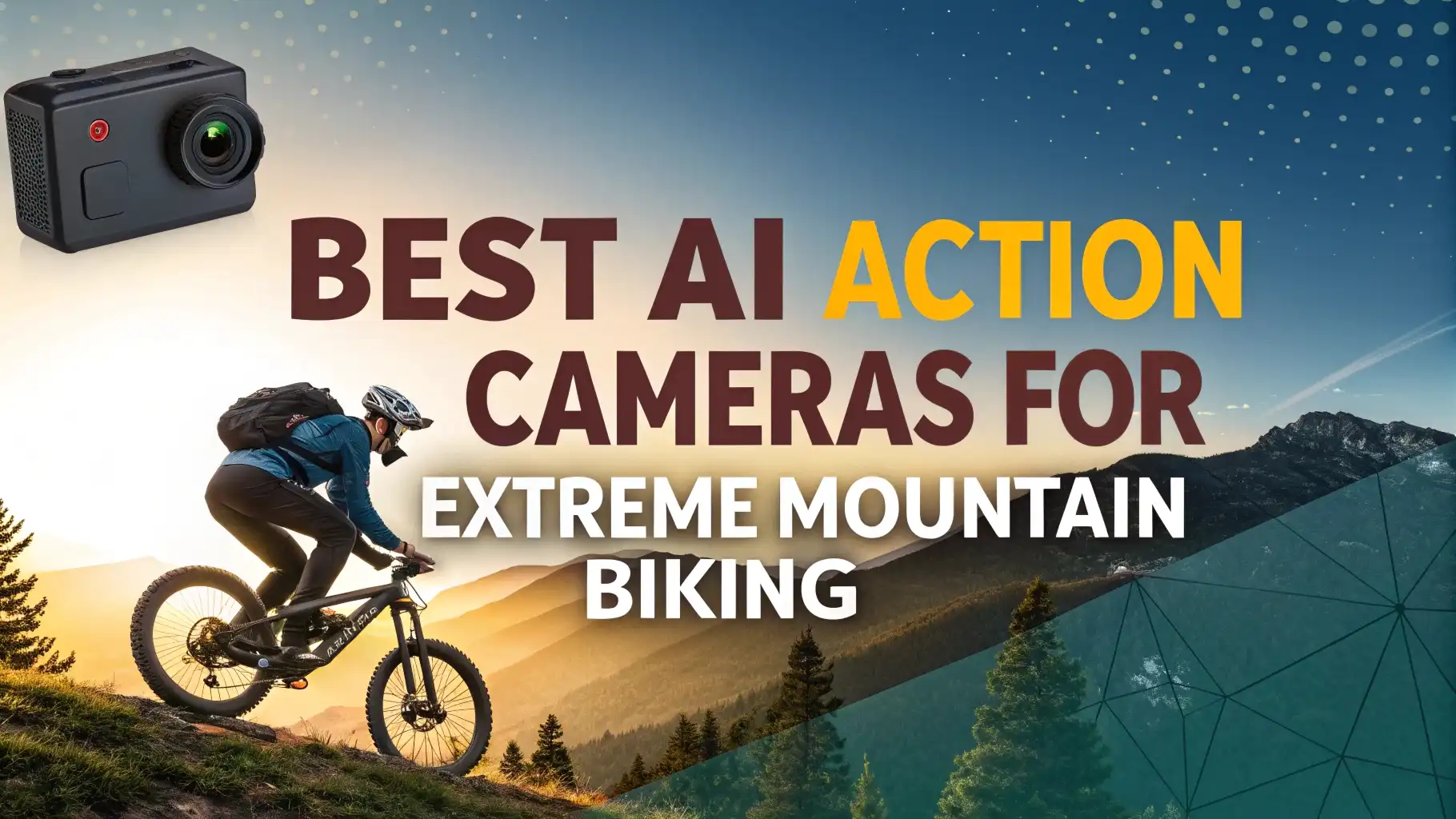
5 Best AI Action Cameras for Extreme Mountain Biking in 2026
You charge down a rocky descent at full speed. Your wheels hit roots, rocks, and drops without warning. One wrong turn, and you miss the shot of a lifetime. That is exactly why the right AI action camera matters more than ever in 2026.
Mountain biking is raw, fast, and unpredictable. Your camera needs to keep up. With AI-powered stabilization, smart subject tracking, and automatic highlight detection now built into the best cameras on the market, you can focus on riding and let the camera do the heavy lifting.
This guide cuts through the noise. We tested and researched the top-performing AI action cameras specifically for extreme mountain biking.
In a Nutshell:
- The DJI Osmo Action 6 is the best overall AI action camera for mountain biking in 2026. It features a 1/1.1-inch square sensor, 8K video, variable aperture, and class-leading stabilization that handles brutal terrain with ease.
- The GoPro Hero 13 Black remains a top choice for riders who want the most versatile, ecosystem-rich camera. Its HyperSmooth 6.0 stabilization and 5.3K video quality are exceptional, and it supports interchangeable lens mods.
- The Insta360 Ace Pro 2 packs a dedicated 5nm AI chip, co-engineered with Leica, that powers real-time AI Highlights detection, noise reduction, and superior low-light performance up to 8K30fps.
- The Insta360 X4 is the ultimate 360-degree camera for MTB. It captures every angle automatically, so you never miss a moment. Its AI reframing tools let you pick the best shots in post-editing with total freedom.
- The DJI Osmo Action 5 Pro is the best value AI camera on this list. It delivers 4K/120fps, subject tracking, 47GB built-in storage, and a 4-hour battery life at a price that beats the competition.
- AI features like subject tracking, automatic highlight reels, and AI noise reduction are no longer luxury add-ons. They are essential tools for mountain bikers who want professional-quality footage without a professional editing budget.
Why Your Mountain Bike Camera Needs AI Features
Mountain biking creates some of the most challenging filming conditions on earth. You deal with rapid directional changes, extreme vibration, harsh lighting transitions, and speeds that push traditional cameras to their limits.
Standard action cameras struggle in these conditions. Footage comes out shaky, dark, or blurry. Manual settings require constant adjustments mid-ride, which is simply not practical. This is where AI changes everything.
AI-powered cameras process footage in real time. They use machine learning to detect motion blur and apply corrections before the footage is even saved. Subject tracking means the camera locks onto you or a riding partner and keeps them in frame automatically, even during fast directional changes. AI noise reduction cleans up low-light footage without losing detail, which is perfect for shaded forest trails or dawn rides.
DJI Osmo Action 6 – Best Overall AI Action Camera for Mountain Biking

The DJI Osmo Action 6 is the most advanced AI action camera available on Amazon in 2026. It takes everything DJI perfected in previous models and raises the bar significantly with a brand new 1/1.1-inch square sensor and a variable aperture lens ranging from f/2.0 to f/4.0.
That variable aperture is a game changer for mountain biking. When you ride into deep forest shadows and emerge into bright sunlight, the Osmo Action 6 automatically adjusts its aperture to maintain perfect exposure.
No manual tweaking required. The 8K video output is sharp, vibrant, and packed with detail that lets you crop and reframe in post without losing quality.
The AI stabilization system in the Action 6 is the best DJI has ever produced. It uses a gyroscope plus AI motion prediction to deliver footage that looks like it was shot on a gimbal even at high speeds over rough terrain.
Pros:
- Variable aperture (f/2.0 to f/4.0) for automatic exposure control
- Best-in-class 8K video with 1/1.1-inch square sensor
- RockSteady 4.0 and HorizonSteady AI stabilization
- Waterproof to 65ft (20m) without a case
- Interchangeable lens system for creative shooting
- Up to 4-hour battery life with Extreme Battery Plus
Cons:
- Higher price point compared to previous DJI models
- 8K recording can fill storage quickly
- Interchangeable lenses sold separately at additional cost
GoPro Hero 13 Black – Best for HyperSmooth Stabilization


The GoPro Hero 13 Black continues to be one of the most trusted names in action cameras, and for good reason. It delivers 5.3K60fps video with HyperSmooth 6.0 stabilization, which GoPro describes as the smoothest video stabilization they have ever produced.
For mountain biking, HyperSmooth 6.0 is exceptional. It combines optical and electronic stabilization to produce footage that stays butter-smooth even over the worst rock gardens, drops, and root sections. The camera automatically senses the level of activity and adjusts stabilization intensity accordingly, so you always get the best result without changing settings manually.
The GoPro ecosystem is one of the biggest advantages here. The Hero 13 Black supports interchangeable HB lenses, including an Ultra Wide Lens, a Macro Lens, and ND filter mods that let you shoot creative, cinematic footage on the trail.
Pros:
- HyperSmooth 6.0 delivers industry-leading AI stabilization
- 5.3K60fps video with outstanding color accuracy
- Extensive accessory and lens ecosystem
- Quik app with AI auto-editing and highlight detection
- Waterproof to 33ft (10m) without housing
- Magnetic mounting system for fast attachment
Cons:
- Battery life shorter than some competitors at high resolution
- No built-in storage; requires a microSD card
- Some AI editing features require a GoPro subscription
Insta360 Ace Pro 2 – Best AI Chip Action Camera for MTB

The Insta360 Ace Pro 2 is the most AI-powered camera on this list. Co-engineered with Leica, it features a dedicated 5nm dual AI chip that processes footage in real time for smarter shooting, better low-light performance, and automatic content creation.
The standout feature for mountain bikers is the AI Highlights Assistant. This tool runs in the background as you ride and automatically identifies your most exciting moments based on speed data, motion intensity, and visual interest.
After your ride, it has a pre-edited highlight reel ready to share within minutes. For riders who document their rides regularly, this feature alone saves hours of editing time every week.
The 1/1.3-inch sensor paired with the Leica SUMMARIT lens produces stunningly sharp 8K30fps footage. The Active HDR mode keeps colors accurate and highlights controlled even when you transition rapidly between dark tree canopy and open sunny sections.
Pros:
- 5nm dual AI chip for real-time AI Highlights and noise reduction
- 8K30fps video with Leica SUMMARIT lens
- Best-in-class low-light performance
- AI Highlights Assistant creates automatic post-ride highlight reels
- Active HDR for accurate colors in mixed lighting
- 2.5-inch flip screen for easy monitoring
Cons:
- Larger and slightly heavier than some competitors
- AI features tied to the Insta360 app ecosystem
- Higher price compared to non-Leica action cameras
Insta360 X4 – Best 360-Degree AI Action Camera for MTB

The Insta360 X4 takes a completely different approach to mountain biking footage. Instead of pointing a standard camera at one angle and hoping for the best, the X4 captures a full 8K 360-degree sphere of video in every direction simultaneously.
This is a revolutionary concept for mountain bikers. You mount the X4 on your helmet or handlebar, and it records everything around you at once. After your ride, you use the Insta360 mobile or desktop app to reframe the footage into any angle you want.
Want a dramatic low-angle shot from the trail? Done. Want to switch to a rear-facing perspective showing the trail behind you? Easy. The AI-powered AutoReframe feature detects your body and keeps you centered in the shot automatically.
The AI editing tools in the Insta360 app are among the most powerful available. AI Highlight Watch identifies the best moments from your ride automatically, and Shot Lab applies creative camera movements like cinematic pans, zooms, and hyperlapse effects with a single tap.
Pros:
- 8K 360-degree footage captures every angle simultaneously
- AI AutoReframe keeps you centered without manual editing
- AI Highlight Watch and Shot Lab for fast automatic editing
- Invisible selfie stick effect for clean, creative footage
- FlowState stabilization works in all directions
- Waterproof to 33ft (10m)
Cons:
- 360-degree files are very large and require powerful editing hardware
- AI reframing requires time spent in the app after each ride
- Not as straightforward as a traditional action camera for beginners
DJI Osmo Action 5 Pro – Best Value AI Action Camera for MTB

The DJI Osmo Action 5 Pro offers the best combination of AI features, video quality, and battery life at a price that is noticeably more accessible than the flagship Osmo Action 6. It is the smart choice for riders who want serious performance without spending at the top of the market.
The 1/1.3-inch CMOS sensor with a 155-degree field of view captures 4K/120fps slow-motion video that lets you replay your best moments in stunning, silky-smooth slow motion.
The 13.5 stops of dynamic range is among the highest of any action camera in this price range, producing footage with accurate highlights and deep shadows in challenging trail lighting.
DJI’s AI Subject Tracking in the Action 5 Pro works reliably for mountain biking. You can set a subject on the front screen, and the camera locks onto them and keeps them in frame throughout the shot.
Pros:
- 4-hour battery life with standard combo setup
- 47GB built-in storage included
- 4K/120fps slow-motion video
- AI Subject Tracking for riding partner shots
- 13.5 stops of dynamic range for excellent trail lighting
- Dual OLED touchscreens front and rear
Cons:
- Maximum resolution is 4K rather than 8K like flagship competitors
- Stabilization, while excellent, is a step below the Action 6
- Some users prefer the wider lens options available on competitors
How to Mount an Action Camera on Your Mountain Bike
The way you mount your camera is just as important as the camera itself. A poor mount placement results in shaky, boring footage even with the best AI stabilization working at full strength.
Helmet mounting is the most popular choice for mountain biking. A top-of-helmet or chin mount gives a natural rider’s perspective that puts viewers directly in the action. Chin mounts are particularly popular for enduro and downhill riding because they show more of the trail ahead without the up-and-down helmet bobbing motion.
Handlebar mounting creates a lower, more dramatic perspective and is a great option for showing technical trail features up close. Use a short arm extension mount to move the camera slightly forward of the bars for a cleaner field of view without hands and controls in the frame.
Chest mounting works well for riders who want to show their upper body interaction with the bike, including braking, shifting, and body positioning. The DJI Magnetic Ball-Joint Adapter and GoPro Chesty mounts are both excellent options for this style.
Best Camera Settings for Extreme Mountain Biking
Getting the right settings dialed before you hit the trail saves your footage from being ruined by poor exposure, motion blur, or over-compression. Here are the settings that professional MTB content creators use.
Frame Rate and Resolution: For social media highlights, 4K60fps gives a good balance of sharpness and smooth motion. For slow-motion replays of big drops and jumps, shoot at 4K120fps and slow it down to 25 percent speed in editing. If you are creating a documentary-style video, 5.3K or 8K gives maximum detail for grading and cropping.
Stabilization Mode: Always use the highest stabilization setting available. On DJI cameras, set RockSteady + HorizonSteady together. On GoPro, use HyperSmooth Boost mode. On Insta360, activate FlowState at maximum level.
Exposure: Avoid fully automatic exposure mode when possible. It can pulse brightness as you ride between sunny and shaded sections. Instead, use ISO-priority mode with a maximum ISO of 800 to keep noise under control, and let the camera adjust shutter speed within a defined range.
How AI Features Improve Your MTB Footage
Artificial intelligence in action cameras has moved well beyond simple scene recognition. In 2026, AI actively shapes every frame of your footage in ways that were impossible just a few years ago.
AI stabilization systems use predictive algorithms to anticipate camera movement before it happens. Traditional electronic image stabilization (EIS) only reacts to movement after it occurs, which creates a slight lag in correction. AI-based systems model the physics of the camera mount and the terrain type, then pre-stabilize the frame before the shake even reaches the sensor. The result is footage that looks smoother than any traditional EIS system can produce.
AI noise reduction works by analyzing multiple frames simultaneously and identifying which elements are camera noise versus genuine image detail. It then suppresses noise while preserving real texture, which is why low-light footage from AI cameras looks dramatically cleaner than equivalent footage from cameras without this technology.
Tips for Protecting Your Action Camera on the Trail
Even the most durable AI action cameras need some protection on aggressive mountain bike trails. Crashes, flying debris, and prolonged exposure to dust and water all take a toll over time.
Use a silicone protective case over your camera housing for extra impact protection. Most major brands offer these accessories, and they absorb small impacts that would otherwise crack the outer shell.
Always carry lens caps and only remove them just before shooting. Rock strikes and branch impacts can scratch or crack lens covers, which affects image quality permanently.
Waterproof your ports. Even cameras rated to IP68 standards can fail if port covers are left open or damaged. Check all door seals and USB-C port covers before rides in wet conditions.
Check your mounts before every ride. Vibration from rough trails loosens screws and quick-release mechanisms gradually. A brief check of all mounting hardware before descending prevents cameras from falling off mid-ride.
For dusty, desert, and dry trail conditions, consider using a lightweight dust cover or sock over the camera body. Dust infiltration is a leading cause of button and sensor failure in action cameras used in arid environments.
Final Verdict: Which AI Action Camera Is Right for You?
After reviewing all five cameras, here is a clear summary to help you make the right choice.
Choose the DJI Osmo Action 6 if you want the absolute best AI camera on the market right now. The 1/1.1-inch square sensor, variable aperture, 8K video, and top-tier RockSteady 4.0 stabilization make it the flagship choice for serious mountain bikers who demand the best footage quality money can buy.
Choose the GoPro Hero 13 Black if you want a camera that fits into a large, proven ecosystem with excellent app support and the most versatile lens system available. HyperSmooth 6.0 is spectacular, and the Quik app AI editing is fast and user-friendly.
Choose the Insta360 Ace Pro 2 if AI-powered editing tools and outstanding low-light performance are your top priorities. The dual AI chip and Leica lens combination produce footage quality that stands apart from every other camera on this list.
Choose the Insta360 X4 if you want complete creative freedom after your ride. The 360-degree capture means you never miss a shot, and the AI reframing tools give you limitless editing options in post-production.
Frequently Asked Questions
What is the best AI action camera for mountain biking in 2026?
The DJI Osmo Action 6 is the best overall AI action camera for mountain biking in 2026. It offers the largest sensor, variable aperture, 8K video, and the most advanced AI stabilization available. For those who want the best value, the DJI Osmo Action 5 Pro delivers outstanding features at a lower price point.
Do I need a waterproof case for my action camera while mountain biking?
Most modern AI action cameras are waterproof without any extra case. The DJI Osmo Action 6 is rated to 65 feet (20m), while the GoPro Hero 13 Black, Insta360 Ace Pro 2, and Insta360 X4 are all waterproof to 33 feet (10m). You do not need a separate housing for normal trail riding in wet conditions. A protective case is useful only for crash protection, not waterproofing.
What stabilization mode should I use for mountain biking?
Use the highest stabilization setting your camera offers. On DJI cameras, this means RockSteady 4.0 combined with HorizonSteady. On GoPro, use HyperSmooth Boost. On Insta360 cameras, activate FlowState stabilization at the maximum setting. For extremely rough terrain like downhill or enduro racing, some riders also add a physical vibration dampener between the mount and the camera.
Is a 360-degree camera like the Insta360 X4 good for mountain biking?
Yes, the Insta360 X4 is an excellent choice for mountain biking. The 360-degree capture means you never miss a shot angle, and the AI AutoReframe tools let you choose the perfect perspective in post-editing. It is particularly popular with MTB content creators because a single ride produces enough footage for multiple different video styles, from POV to follow-cam to wide-trail perspectives.
How long does an action camera battery last during a mountain bike ride?
Battery life varies by camera and recording settings. The DJI Osmo Action 5 Pro leads the pack with up to 4 hours per charge. The DJI Osmo Action 6 delivers approximately 4 hours with the Extreme Battery Plus. The GoPro Hero 13 Black provides approximately 1.5 hours at 5.3K and longer at lower resolutions. For full-day rides, always carry a spare battery or a small power bank with a USB-C cable.
Can I use voice commands with AI action cameras while mountain biking?
Yes. GoPro Hero 13 Black, DJI Osmo Action 5 Pro, DJI Osmo Action 6, and Insta360 Ace Pro 2 all support voice commands. You can start and stop recording, take photos, and switch modes using voice commands without touching the camera. This is extremely practical for mountain biking when your hands are occupied with steering and braking. Most cameras support commands like “GoPro, start recording” or “DJI, take photo” right out of the box.
What frame rate is best for mountain biking video?
For standard trail riding footage, 4K60fps produces smooth, sharp video that looks great on any screen. For capturing high-speed moments like jumps, drops, and technical sections in slow motion, shoot at 4K120fps and slow the footage down to 25 to 50 percent speed in editing. If you want maximum detail for cinematic films or large screen presentations, use 5.3K or 8K at 24fps or 30fps.